Table Of ContentState Fauna Series 3
FAUNA OF WEST BENGAL
PART-1I
Edited by
The Director
Zoological Survey of India, Calcutta
~!l~~
Zoological Survey of India
Calcutta
1999
<:ITATION
Edih)r-Dircclor. I '}l)'}. FaulIlI (~r West Bengal-Port II. I-IV, 1-60,) pp.
(Puhlishcd-Dircctor. ZSI. Calcutta)
Puhlishcd : March. 1,},:)9
ISBN : XJ -X5X7..J-23-Y
© GOl'enllllenl of Illdia. I YYX
ALL RIGHTS ResERVED
• No part of this publication may be reproduced. stored in a retrieval system or transmitted.
in any form or by any means. electronic, mechanical. photocopying. recording or otherwise
without the prior permission of the publisher.
• This book is sold subject to the condition that it shall not, by way of trade, be lent, re-sold hired
out or otherwise disposed of without the pU.bJisher'q...eonsent. in an.y form of binding or cover
other than that in which it is publisbad.
• The corr'ect price of this publication is the price printed on this page. Any revised price
indicated by a rubber stamp or by a sticker or by-any other means is incorrect and should
be unacceptabJe.
Pn~iect Co-oft/illlltO/'
Dr. A. K. Ghosh
(Zoological Survey (~llllclill)
PRICE
Indian Rs. 1.400.00
eM' ;
Foreign $ 1 £ 60
Puhlishcd m the Puhlicalion Division hy the Director. Zoological Survey of India, 234/4, AJC Bose Roud. 2nt
MSO Building. (13th Floor). Nil.am Palace. Cakullu-7(X) 020 after laser.typesetting by Neul Point PhOlCK.'Ompuscrt
Calcutta-7()() 045 and printed at Govl. of India Press. Chundigarh.
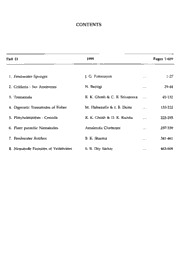
CONTENTS
Part 11 1999 Pages 1-609
1. Freshwater Sponges J. G. Pattanayak 1-27
2. Cnidaria : Sea Anenlones N. Bairagi 29-44
3. Trematoda R. K. Ghosh & C. B. Srivastava 45-132
4. Digenetic Tretnatodes of Fishes M. Hafeezulla & I. B. Du tta 133-222
5. Platyhelminthes: Cestoda R. K.Ghosh&D. K.Kundu 223-295
6. Plant parasitic Nematodes Amalend u Cha tterjee 297-339
7. Freshwater Rotifers B. K. Sharma 341-461
8. Nematode Parasites of Vertebrates S. R. Dey Sarkar 463-609
Zoo I. Surv. India
State Fauna Series 3: Fl1una of West Bengal. Part t 1 : 1-27.1998
FRESHWATER SPONGES
1. G. PATIANAYAK
Zoological Sur e)' of India, Calcutta
INTRODUCTION
A perusal of literature reveals that after the pioneering works of Annandale (1906 - 1916) on the
freshwater sponges of India including those of West Bengal a single paper by Soota and Pattanayak
(1982) is available wherin only 7 species from this state have been dealt with. It may be mentioned
here that so far a total of 31 species belonging to 18 genera have been recorded from India (Prakash
et.al., 1972; Khera and Chaturvedi, 1976: M~lhotra et.al. 1977; Soota and Pattanayak. 1982: Soota
and Pattanayak, 1983) and 14 species under 8 genera were recorded from West Bengal.
In order to make an upto date account of the freshwater sponge fauna of West Bengal a
number of faunistic surveys were undertaken in dif('erent areas of the state during the years
1985-1988. As a result of above surveys a total of 66 lots of freshwater sponges were collected
which belong to 9 species under 6 genera. In addition to this, 7 more species under 3 genera
records are available in literature. As a result the lotal species of freshwater sponges of West
Bengal goes up to 16 under 9 genera. These are being dealt with in this paper. OUI of these one
genus and two sp\!cies are recorded for the first liJne in Indian region and 7 species are forming
new locality recDrds. Key to the genera and species of freshwater sponges of West Bengal and
their distribution by charts and .maps are also included in this paper The classification of
sponges is based on Penney and Racek (1968).
MORPHOLOGY AND TERMINOLOGY
Acerate : A type of Jnicrosclere~ with their ccnlrai portion bear a number of long pcrpcndkular
radiating rays. (Text-fig. 19)
Anlphioxea : Spicule with tapering or pointed at both ends. (Text-fig. J)
Al1lphistrollgyle : Spicule with blunt or rounded at hoth ends. (Text-fig. 9)
Aster: A type of microscleres with several rays originating from the same centre. (Text-fig. 18)
Basal ianlina : The attachment surface of a sponge.
Birotulate : A type of gemmoscleres with a cylindrical shaft with two rotules at both ends
(Text-fig. 20)
Body colour : Colouration of spongillids depends on the presence or absence of zoochlorellae
within the tissue of the sponge, rarely by the presence of green or purple pigments or by adventitious
sediments. Except some wel1-established cases, the colouration seems therefore of little taxonomic
significance.
FornI and consistency : Form of sponge body depends on the growth. In mature spong~. fornl
may range from thin to thick crusts or cushions, be of bulbous or otherwise nlassive nature. or
2 State Fauna Series 3 : F aUlla of West Bengal
display branching, subbranching or pseudobranching projections. Consistency depends on the
spongin present in the skeletal meshwork, this may be hard, soft or brittle.
Foramen : An orific of the gemmule.
Foraminal tubule: A horny tube that surrounded the foramina of some gemmule.
Gemmosclere : Spicule of the gemmule.
Gemnlule A desiccation-resistant asexual reproductive b~dy composed of a mass of
archaeocytes charged with reserves and enclosed in a non-cellular protective envelope.
Megasclere : A structural spicule.
MicroscLere : Spicule that lie free in the symplasm.
Osculum : An aperture through which water is ejected from the sponge.
Pneumatic coat : A horny or chitinous layer on the surface of the gemmule containing air
spaces. If these spaces are of regular fonn and arrangement it is said to be cellular; if they are
minute and irregular it is called granular.
Spicule : A discret element of the sponge skeleton. Usually composed mainly of silica or
calcium carbonate but spongin spicules do occur rarely. In Spongillidae spicules arc of silicious
type.
Stellate : A type of microscleres consisting of many rays projecting froln a distinct central
globular nodule.
Synlplasm : The inner mass of spongebody.
SYSTEMATIC ACCOUNT
Phylum PORIFERA
Class DEMOSPONGIAE
Order HAPLOSCLERINA
Family SPONGILLIDAE Gray
1. Genus SpongillD Lamarck
( I ) Spongilla lacustris (Linnaeus)
(2) SpongiUa aLba Carter
2. Genus Eunapius Gray
(3) Eunapius carter; (Bowerbank)
* (4) Eunapiusfragilis (Leidy)
(5) Eunapius calcuttanus (Annandale)
(6) EUllapius crassissinlUS (Annandale)
3. Genus Stratospongilla Annandale
(7) Stratospollgilla indica (Annandale)
PATIANAYAK: Freshwater Sponges 3
4. Genus Corvospongilla Annandale
(8) Corvospongilla lapidosa (Annandale)
(9) Corvospongilla caunteri Annandale
5. Genus Rildiospongilia Penney and Racek
(10) Radiospongilla indica (Annandale)
(II) Radiospongilla cerebellata (Bowerbank)
6. Genus Ephydlltia Lamourox
(12) Ephydatia meyeni (Carter)
*7. Genus Umborotula Penney and Racek
* (13) Umborotula bogorensis (Weber)
8. Genus Dosilia Gray
(14) Dosilia plumosa (Crater)
9. Genus Trochospongilla Vejdovsky
(15) Trochospongilla latouchiana Annandale
(16) Trochospongilla philottiana Annandale
* indicates first record from India
Family SPONGILLIDAE Gray, 1867
Diagnosis : Freshwater sponges. with a soft cavernous structure most noticeable just below the
surface. Spicules smooth or spined oxeas, or stronglyes or birotulates; organised into bundles or
tracts and bound by spongin. Reproduction by gemmules, coated with pneumatic layer of loosely
packed spongin; complex microscleres sometimes associated with the gemmule coat.
KEY TO GENERA
..,
1. Microscleres absent. ............................................. . .. .................................................... ..
Microscleres present ................................................................................................................ 6
2. Gemmoscleres birotulates ........................................................................................................ 3
Gemmoscleres amphioxea or amphistrongyla ........................................................................... 5
3. Rotules flat in lateral view ......................................................................................... Ephydalia
Rotules not flat in lateral view ................................................................................................. 4
4. Rotules circular. with entire margin ................................................................. Trochospongil/Q
Rotules umbonate, with margine bearing large number of small regular indentations ................ .
............. ............................ ..................... ...... ........... ......... .......... ... ... ..... .... .......... .... U",h(,r()(liia
5. Gemmoscleres with characteristic arrangement of tenninal spines ..................... Radiospo"~il/Q
Gemmosclercs either with uniformly distributed spines or entirely smooth ................. EUllap;us
4 State Fauna Series 3 : Fauna o/West Bengal
6. Microscleres microbirotulates ............................................................................ Corvolpollgilla
7. Microscleres either distinct aster or acerate .....................................................................D oIUill
Microscleres amphioxea or amphistrongyla .............................................................................. 8
8. Foramen tubular ................................................................................................. Stratolpollgilla
Foramen never tubular, simple to slightly cup-shaped ................................................. Spongil'"
I. Genus Spongilla Lamarck, 1816
1758. Spongia Linnaeus. Systema Naturae. 10th ed' I. Animalia : 1348.
9
1816. Spongi/la Lamarck Hisloire nalurella des animaux sans vertebres, 2 : 98.
9
1968. Spongi/la, Penney and Racek, Bull. U.S. natn. Mus. No. 272 : 7.
1982. Spongi/la, Soota and Pattanayak. Rec. zoo I. SlIrv. India. 80 : 223.
Type-species Spongia lacustris Linnaeus, 1758
Diagnosis : Megascleres-slender to stout, smooth, amphioxea. Microscleres-slender, spined,
amphioxea and different from gemmoscleres.
Gemmoscleres stout. curved, strongly spined amphioxea or amphistrongyla.
Gemmules spherical. large, abundant and scattered throughout the sponge; pneumatic layer
granulated with very small nonpolygonal air spaces, gemmoscleres embedded tangentially in it;
foramen cup-shaped, never tubular.
Distribution : Cosmopolitan.
Key to Species
Microscleres with small spines or granules of almost equal size and distribution ............... S. lacustris
Microscleres with spines much longer and more prominent in central part. .............................. S. alba
I. Spongilla lacustris (Linnaeus, 1758)
(Text fig. 1-3)
1758. Spongia lacuslr;s Linnaeus. Systema Naturae. 10th ed .• 1. Animalia : 1348.
1968. Spongilla lacustris. Penney and Racek. Bull. U.S. naln. Mus., No. 272 : 9.
1982. S[Jongilia lacustris. Soota and Pattanayak, Rec. zoo I. Surv. India. 80 : 224.
Material examined : Bankura Dist 2 lots, Aral Bansi, 27.XI.1986; one lot, Bansi, 27.XI.1986;
One lot, Gard Kotalpur, 30.XI.1986; 3 lots, Sahora, 29.XI.1986; Coil. 1. G. Pattanayak. Birbhum
Dist One lot, Nalhati, 27.XI.1983; Coil. K. R. Halder. Barddhaman Dist - One lot, Galsi,
6.XII.1986; Coli. J. G. Pattanayak. HugH Dist One lot, Hooghly, 12J{l1.1986; CoIl. J. G.
Pattanayak. Maldah Dist One lot, Bamangola, 13.1X.1987; one lot, Gajal, 14.1X.1987; CoIl. J. G.
Pattanayak. Medinipur Dist One lot. Talpurkur. 4 Km S. of Tamluk, 13.1V.1986; Coil. 1. G.
Pattanayak.
Description : Sponge consisting of a nat or rounded thin basal portion with long free cylindrical
branches; surface hispid; oscula small and star shaped; dermal membrane well developed;
consistency soft and easily compressed.
PATTANAYAK: Freshwater Sponges 5
Megascleres straight. sharply pointed, smooth amphioxea; length range .225-.410 mm. width
range .006-.009 mm.
Microscleres abundant, straight. long, slender, amphioxea with small spines of almost equal
size and distribution; length range .075-.090 mm. width range .0035-.006 mm.
Gemmoscleres resembling the microscleres but stout and slightly to strongly curved;
amphioxea; covered with strong curved spines; length range .045 .095 mm. width range
.0035 .006.
Gemmules abundant. present throughout the body. large. spherical; pneumatic layer thick.
granular in which the spicules tangentially arranged, foramen not tubular, simple, bearing a shallow
peripheral collar; diameter of gemmule .50 .60 mm.
Colour in life Generally bright green due to presence of zoochlorellae, otherwise pale white to
light grey in colour.
Distribution : INDIA : West Bengal Bankura, Birbhum. Barddhaman, Calcutta. Hugli.
Maldah, Medinipur and South 24 Parganas districts; Assam; Bihar; Himachal Pradesh; Jamrnu and
Kashmir; Karnataka; Maharashtra; Orissa; Punjab; Rajasthan and Tamilnadu. OUTSIDE INDIA:
Northern hemisphere, with its greatest expansion in cold-temperate regions.
Renzarks : This species is widely distributed in India.
2. Spongilla alba Carter. "1849
(Text fig. 4-6)
1849. Spongilla alba Carter, Ann. Mag. Nat. Hisl .. 4 : 83
1968. Spong ilia alba, Penney and Racek, Bull. U. S. natn. Mus .. No. 272 : 16.
] 982. Spong ilia alba. Soota and Pattanayak. Rec. zool Surv. India. 80 : 224.
Description Sponge forming massive growth of moderate thickness; surface smooth with
irregular projection; oscula moderate or large size, never very conspicuous; dermal menlhrane
.
closely adherent to symplasm; consistency hard but brittle .
Megascleres feebly curved, slender to stout and fusiform. smooth amphioxea; length range
.265-.330 mm, width range .012-.019 mm.
Microscleres numerous in dermal membrane; slightly curved. slender. amphioxea with erect
spine more prominent and longer in central region; length range .065-.125 mm. width range .002-
.OO4mm.
Geinmoscleres feebly curved, slender. cylindrical amphistrongyla; covered with large recurved
spines. more numerous at the tips than near the middle of the shaft; length range .085-.110 lnm.
width range .005-.0085 mm.
Gemmules abundant, scattered throughout the body large spherical; pneumatic layer
moderately thick granular. gemmoscleres clnbcdded in this layer with their tips projecting beyond
outer surface of layer; foramen not tubular but cup-shaped; diameter range .45-.60 mm.
Colour in life : whitish.
Distribution : INDIA : West Bengal Calcutta. North and South 24 Parganas districts; Kerala;
Maharashtra; Orissa; Rajasthan. OUTSIDE INDIA: Africa. Australia. South America and South
East Asia.
State Fauna Series 3 : Fauna of West Bengal
Renwrks During the present survey no material of this species is available; hence-dhe
dc~criptl()n is based on the material present in National Zoological Collections.
2. Genus Eunapius Gray, 1867
1851. S,wngillll Leidy. Proc. Acad. Nat. Sci. Philadelphia. 5 : 278.
1867. Eunapius Gray. Proc. Zool. Soc. London. 1867 : 558.
1968. Eunapius. Penney and Racek. Bull. U.S. natn. Mus .. No. 272 : 21.
1982. Eunapius. Soota and Pattanayak. Rec. zool. Surv. India. 80 : 219.
Type species spollgilla carteri Bowerbank. 1863
Diagnosis Megascleres - stout, smooth, amphioxea or amphistrongyla, rarely spined.
Microscleres absent.
Gemmoscleres slender to robust, slightly curved, strongly spined amphioxea or amphistrongyfa.
Gemmules somewhat flattened, comparatively small abundant and scattered singly or in groups
or forming distinct pavement layer at the base; pneumatic layer well developed with conspicuously
polygonal air spaces. gemmoscleres embedded in this layer strictly tangentiaJly over the gemmules;
foramen tube straight or strongly curved.
Distribution : Widely distributed throughout the world.
Key to Species
I. Megascleres amphistrongyla .............................................................................. E. crassissimus
\
Megascleres amphioxea ........... ; ............................................................................................... 2
2. Megascleres amphioxea with a lanceolate apical projections ................................ E. calcuttanus
Megascleres amphioxea with smooth tapering ends .................................................................. 3
3. Gemmoscleres similar in shape and structure to megascleres but smaller in size ......... E. carter;
Gemmoscleres not similar in shape and structure to megascleres and covered with spines ........ .
.................................................................................................................................. E. fragilis
3. Eunapius carteri (Bowerbank. 1863)
(Text-fig. 7 & 8)
1849. S/Jongilla!riabilis Carter. Ann. Mag. Nat. Hist., 4 : 83
1863. Spongilla carteri Bowerbank. Proc. Zool. Soc. London. 1863 : 469.
1867. Eunapius carter; Gray. Proc. Zool. Soc. London. 1867 : 552.
1968. Eunapius carteri Penney and Racek. Bull. U.S. natn. Mus .. No. 272 : 23.
1982. Eunapius carteri. Soota and Pattanayak, Rec. zool. Surv. India, 80 : 221.
Material exanlined : Bankura Dist : One lot. Bishnupur 28.XI.1986; one lot, Joyrambati,
I.XII.1986; two lots, Saitora, 29.XI.1986; One lot. Susunia. 2.XII.1986; ColI. J. G. Pattanayak.
PAT TA NAY AK : Freshwater Sponges 7
Birbhum Dist Two lots, Nalhati. 27.1X.1983; one lot, Sainthea, 28.1X.1983; Coil. K. R. Halder.
Koch Behar Dist Two lots, Mathabhanga, 16.1V.1987; Coil. 1. G. Pauanayak. Hugli Dist One lot,
Chinsura, 12.XII.l986; Coil. 1. G. Pattanayak. Haora Dist Two lots, Bagnan, 7.1V.1986; Coil. 1. G.
Pattanayak. Jalpaiguri Dist : Two lots, Alipurduar, 17.1V.1987; Coil. J. G. Pauanayak. Maldah Dist :
One lot, Maldah town, 12.XI.I987; Coli. 1. G. Pattanayak. Medinipur Dist One lot. Contai.
25.111.1986; one lot, Ghatal, 28.111.1986; two lots Gopiballavpur, 30.111.1986; five lots. Midnapore
town, 26.111.1986; one lot, Naradari, 5 Km. S. of Tamluk Town. ] 3.1V. ) 986; Coil. 1. G. Pauanayak.
Nadia Dist One lot, Krishnanagar, 16.1X.1983; Coli. K. R. Halder. Purulya Disl One lot,
Bagmundi, 3.1V.1986; one lot, Manbazar, 2.1V.1986; one lot, Raghunathpur, 4.1V.1986; Coil. 1. G.
Pattanay~k. N. 24 Parganas Dist One lot, Ankhola Nabapally, 28.111.1986; ColI. I. B. Dt,tta. West
Dinajpur Dist One lot, Raiganj, 7.VI.] 987; Coil. J. G. Pattanayak.
Description - Sponge massive, forming irregular masses of varying dimention; surface hispid;
oscula large, rounded and conspicuous but not raised above the surface of sponge; dermal membrane
well developed; consistency of live sponge moderately soft and has a peculiarly strong and offensive
smell.
Megascleres slightly curved, stout fusiform, smooth amphioxea; length range .265-.350 mm.
width range .011-0.25 mm.
Microscleres absent.
Gemmoscleres similar in shape and structure of megascleres but much smaller in size; length
range .150-.200 mm, width range .005-.008 mm.
Gemmules numerous, scattered singly throughout the body; comparatively large, spherical or
flattened at the base; pnematic layer very thick, consisting of several layers of relatively large
polygonal air-spaces, gemmoscieres embedded in this layer tangentially or in an irregular manner,
foramen tubular, resembling an inverted bottle in shape; diameter range .445-.560 mm.
Colour in life : greyish.
Distribution : INDIA : West Bengal Bankura, Birbhum. Calcutta, Koch Behar. Hugli. Haora.
Jalpaiguri, Maldah, Medinipur, Nadia, North 24 Parganas, Purulya. South 24 Parganas and West
Dinajpur districts: Bihar; Kerala; Maharashtra; Orissa; Punjab; Rajasthan Tamilnadu; Uttar Pradesh.
OUTSIDE INDIA: Africa, Burma, China, Hungary, Indonesia, Iran, Malaysia. Turkestan. and
USSR.
Renlarks : This species is widely distributed in West Bengal as well as in other parts of India.
4. Eunapius fragilis (Leidy, 1851)
(Text-fig. 11 & 12)
) 851. Spong ilia Jragilis Leidy Proc. Acad. Nat. Sci. Philadelphia. 5 : 278.
t
1968. Eunaplus Jragilis Penney and Racek. Bull. U.S. natn ..M us .. No. 272 : 25.
Material exanlilled : HugJi Dist. One lot. Janai, II.XII.1986; coil. J. G. Pattanayak. Haora
Dist. Two lots, Mourigram, 6. VI. t 986; ColI. 1. G. Pattanayak. Medinipur Dist.- One lot, Kolaghat.
29.111.1986; two lots, Naradari, 5 km S. of Tamluk, 4.V .1986; Coil. J. G. Pattanayak.
Descriptiof.l : Thin to thick flat crusts forms on aquatic weeds or hard substances: surface
smooth and even; oscula small. numerous, flat and producing distinct radial canals: consistency very
soft and fragile.