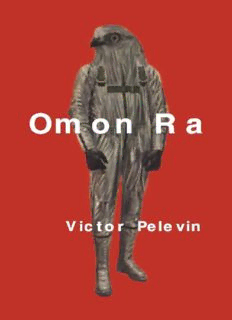
Table Of ContentOmon Ra
Victor Pelevin
Translated from the Russian by Andrew Bromfield
A NEW DIRECTIONS BOOK
For the Heroes
of the Soviet Cosmos
Omon is not a particularly common name, and perhaps not the best there is. It
was my father’s idea. He worked in the police all his life and wanted me to be a
policeman too.
“Listen to me, Ommy,” he used to say to me when he’d been drinking, “if
you join the police, with a name like that… then if you join the Party …”
Although my father had occasionally shot at people, he wasn’t really vicious
by nature; in his heart he was a cheerful and sympathetic man. He loved me a
lot, and hoped that life would at least grant me the achievements it had denied
him. What he really wanted was to get hold of a plot of land somewhere near
Moscow and start growing beetroot and cucumbers on it—not so that he could
sell them at the market or eat them (though that too), but so that he could strip to
the waist, slice into the earth with his spade, and watch the red worms and the
other underground life wriggling about, so that he could cart barrowloads of
dung from one end of the holiday village to the other, stopping at other people’s
gates to swap a few jokes. When he realised he would never get any of this, he
began to hope that at least one of the Krivomazov brothers would lead a long
and happy life (my elder brother, Ovir, whom my father had wanted to make into
a diplomat, died of meningitis at the age of eleven, and all I remember about him
is that he had a long oblong birthmark on his forehead).
My father’s plans on my behalf failed to inspire me with any real confidence
—after all, he himself was a Party man, and he had a perfectly good Russian
name, Matvei, but all he had earned for his efforts was a miserly pension and a
lonely, drunken old age.
I don’t remember my mother too well. The only memory I have is of my
drunken father in his uniform trying to pull his pistol out of its holster while she
clutched at his arm, her hair all messed up, and shouted: “Matvei, come to your
senses!”
She died when I was still very young, and I was raised by an aunt and went
to see my father on weekends. He usually had a red and puffy look, and the
medal he was so proud of hung crooked on his soiled pyjama jacket. There was a
bad smell in his room, and hanging on the wall was a reproduction of
Michelangelo’s fresco The Creation of Adam, with Adam lying on his back and a
bearded God floating above him stretching out his mighty hand to touch the frail
human one. This picture had a strangely profound effect on my father; it clearly
reminded him of something from the past. I usually sat on the floor of his room
and played with a toy train set, while he snored on the fold-down divan.
Sometimes he would wake up and peer at me for a while through screwed-up
eyes; then he would hang over the edge of the divan, propping himself against
the floor, and stretch out a large veinous hand that I was supposed to shake.
“So what’s your surname?”
“Krivomazov,” I would reply, faking a shy smile, and he would pat me on the
head and feed me sweets; he ran through the whole routine so mechanically that
it didn’t even disgust me.
There’s almost nothing I can say about my aunt—she was quite indifferent to
me and made sure that I spent most of my free time in various summer camps for
Young Pioneers, and extended day-school groups.
Everything I remember from my childhood is linked in one way or another
with a dream of the sky. Of course, all this wasn’t the very beginning of my life:
before this there was a long, bright room full of other children and large plastic
cubes scattered haphazardly about the floor; there were the icebound steps of the
wooden slide that I plodded up with eager haste; there were the frost-cracked
models of young mountaineers made of painted plaster in the yard; and lots more
besides. But I can’t really say that it was I who saw all this; in early childhood
(as, perhaps, after death), a person extends in all directions at the same time, so
we can say he still doesn’t exist yet—the personality comes into being later,
when an attachment to some particular direction appears.
I lived not far from the Cosmos cinema. Our district was dominated by a
metal rocket standing on a tapering column of solid titanium smoke, like some
huge scimitar thrust into the ground. But funnily enough, it wasn’t this rocket
that marked the beginning of my personality, it was the wooden aeroplane in the
small children’s playground beside my block. It wasn’t exactly an aeroplane,
more a toy house with two windows, and during some repair work someone had
nailed on a pair of wings and a tail made from the boards of a fence that had
been pulled down, then covered the whole thing with green paint and decorated
it with a few large reddish stars. There was room inside for two or three people,
and there was a small attic with a little triangular window that looked out onto
the wall of the military enlistment office: by unwritten agreement of the entire
yard, this attic was regarded as the pilot’s cabin, and when the plane was shot
down, those who were sitting in the body of the fuselage jumped first, and only
afterwards, when the earth was already roaring up towards the windows, could
the pilot follow them—if, of course, he had time. I always tried to be the pilot,
and I could actually see the sky and the clouds and the earth floating by below,
where the brick wall of the military enlistment office should have been, with the
whiskery violets and dusty cacti peering forlornly out of its windows.
I really loved films about airmen, and one of these films provided the most
powerful experience of my childhood. On a cosmically dark December evening,
I switched on my aunt’s television and there on the screen was an aeroplane
swaying its wings, with an ace of spades on its side and a cross on its fuselage. I
leaned down towards the screen, and immediately it was filled with a close-up of
the cabin section. Behind the thick panes of glass a subhuman face smiled in
goggles like a mountain skier’s and a helmet with gleaming ebonite earpieces.
The pilot raised an open hand clad in a glove with a long black sleeve and waved
to me. Then the screen was filled with an inside view of another plane: two fliers
in fur-lined jackets were sitting at identical control columns and peering through
the metal-framed Plexiglas, following the convolutions of the enemy fighter
flying close beside them.
“M-109,” said one flier to the other, “they’ll bring us down.” The other, with
a handsome emaciated face, nodded.
“I don’t hold it against you,” he said, clearly continuing an interrupted
conversation. “But just remember: this thing between you and Varya had better
be for life … To the grave!”
At that point I stopped taking in the action on the screen. I was struck by the
sudden thought, or not even a thought, merely its faintly registered shadow—as
though the actual thought had floated past close to my head, only catching it
with its edge—that if I’d just been able to glance at the screen and see the world
from the cabin where the two fliers in fur-lined jackets were sitting, then there
was nothing to prevent me from getting into this or any other cabin without the
help of the television, because flight is no more than a set of sensations, the most
important of which I’d already learned to fake, sitting in the attic of the winged
hut with the red stars, staring at the enlistment office wall that was where the sky
should be, and making quiet droning noises with my mouth.
This vague realisation struck me so hard that I watched the rest of the film
without paying proper attention, getting involved in the television reality only
when the screen was filled with smoke trails or a row of enemy planes standing
on the ground hurtling up towards me. That means, I thought, I can look out
from inside myself like looking out of a plane, it doesn’t really matter at all
where you look out from, what matters is what you see … From that time on, as
I wandered along some wintertime street, I often imagined that I was flying in a
plane over snow-covered fields; as I turned a corner, I inclined my head, and the
world obediently tilted right or left.
All the same, the person that I could with real certainty call myself took
shape only later, and gradually. I think the first glimpse of my true personality
was the moment when I realised I could aspire beyond the thin blue film of the
sky into the black abyss of space. It happened the same winter, one evening
when I was strolling around the Exhibition of Economic Achievements in
another corner of Moscow. I was walking along a dark and empty snow-covered
alley; suddenly on my left I heard this droning, like a huge telephone ringing. I
turned—and saw him.
Sitting there in empty space, leaning back as though in an armchair, he was
slowly drifting forwards, and the tubes behind him were straightening out at the
same slow pace. The glass of his helmet was black, and the only bright spot on it
was a triangular highlight, but I knew he could see me. He could have been dead
for centuries. His arms were stretched out confidently towards the stars, and his
legs were so obviously not in need of any support that I realised once and for
ever that only weightlessness could give man genuine freedom—which,
incidentally, is why all my life I’ve only been bored by all those Western radio
voices and those books by various Solzhenitsyns. In my heart, of course, I
loathed a state whose silent menace obliged every group of people who came
together, even if only for a few seconds, to imitate zealously the vilest and
bawdiest individual among them; but since I realised that peace and freedom
were unattainable on earth, my spirit aspired aloft, and everything that my
chosen path required ceased to conflict with my conscience, because my
conscience was calling me out into space and was not much interested in what
was happening on earth.
What I saw in front of me was simply a spotlit mosaic on the wall of an
exhibition pavilion, a picture of a cosmonaut in open space, but it told me more
in an instant than the dozens of books I’d read before that day. I stood there
looking at it, until suddenly I felt someone looking at me.
Glancing round, I saw behind my back a rather strange-looking boy my own
age—he was wearing a leather helmet with gleaming ebonite earphones, and
there were plastic swimming goggles dangling round his neck. He was a little
taller than I and probably a few months older. As he entered the area illuminated
by the spotlight, he raised an open hand in a black glove, stretched his lips into a
cold smile, and for an instant there stood before me the flier from the cabin of
that fighter plane marked with the ace of spades.
He was called Mitiok. It turned out that we lived close to each other,
although we went to different schools. Mitiok had his doubts about many things,
but he knew one thing for certain. He knew that first he would become a pilot,
and then he would fly to the moon.
There’s obviously some strange correspondence between the general outline of a
life and that stream of petty events which a person is constantly involved in and
regards as insignificant. I can now see quite clearly that the course of my own
life was already set, determined before I had even begun to think seriously about
the way I wanted it to turn out: I was even given a glimpse of it in simplified
form. Perhaps it was an echo of the future. Or perhaps those things which we
take for echoes of the future are actually its seeds, falling into the soil of life at
the very moment which in distant retrospect comes to seem like an echo out of
the future.
To be brief, the summer after seventh grade was hot and dusty. All I
remember of the first half of it are long bicycle rides on one of the highways
outside Moscow. I attached a special rattle to the rear of my bike, a Sport semi-
racer; it consisted of a piece of thick paper folded over several times and
fastened to the frame with a clothes peg—as I rode along, the paper struck
against the spokes and made a quick, quiet whirring noise, like the sound of an
aero-engine. Time and again as I hurtled down a tarmac incline, I became a
fighter plane closing in on its target, and by no means always a Soviet one. But I
wasn’t to blame for that; it was just that at the beginning of summer I’d heard
someone sing a stupid song which included the words “Swift as a bullet my
Phantom roars into the clear blue sky.” I must confess that for all the song’s
stupidity, which I realised perfectly well, I was moved to the depths of my soul.
What other words can I remember? “I see a smoke trail in the sky … My Texas
home is far away …” And there was a father, and a mother, and someone called
Mary, a very real person, because she was actually named in the song.
I was back in Moscow for the middle of July, and then Mitiok’s parents got
us places in the Rocket camp. It was a typical summer camp for children in the
south, maybe even a little better than most. I really only remember the first few
days we spent there—but that was when everything that became so important
later happened. In the train Mitiok and I ran through the carriages, throwing all
the bottles we could find down the toilets—they fell on the railway tracks
rushing by beyond the tiny hatch and burst soundlessly; the stupid song that was
stuck in my head gave this simple game the flavour of the struggle for the
liberation of Vietnam. The next day the entire contingent for the camp, who had
all travelled in the same train, was unloaded at a wet railroad station in a
provincial town to be counted and loaded into trucks. We drove for a long time
along a road which looped between mountains; then on our right the sea
appeared and little houses of various colours came drifting towards us. We piled
out onto an asphalted parade square and were led up steps flanked by cypress
trees to a low glass-walled building on the top of the hill. This was the dining
hall, where a cold lunch was waiting for us, although it was already suppertime
—we had arrived several hours later than expected. The food was pretty bad—
thin soup with macaroni stars, tough chicken with rice, and tasteless stewed fruit.
•
Hanging down from the ceiling of the dining hall on threads covered with tacky-
looking kitchen glue were cardboard models of spaceships. I stared at one of
them in admiration—the anonymous artist had gone to a great deal of effort and
covered it all over with the letters USSR. The setting sun looking in on it through
the window suddenly seemed to me like the headlight of a train in the metro as it
emerges from the darkness of the tunnel. Somehow I felt sad.
But Mitiok was in a happy mood and felt like talking.
“In the twenties they had one kind of spaceship,” he said, jerking his fork up
into the air, “in the thirties they were different, in the fifties they were different
again, and so on …”
“What kind of spaceships were there in the twenties?” I asked listlessly.
Mitiok thought for a moment.
“Alexei Tolstoy had these huge metal eggs powered by explosions at
minuscule time intervals,” he said. “That was the basic principle, but there could
be lots of variations.”
“But they never really flew,” I said.
“Neither do these,” he answered, pointing to the model we were discussing
as it swayed gently in the draught.
I finally got his point, although I couldn’t really have put it into words. The
only space in which the starships of the Communist future had flown
(incidentally, when I first came across the word “starship” in the science fiction
books I used to like so much, I thought it came from the red stars on the sides of
Soviet spacecraft) was the Soviet psyche, just as the dining hall we were sitting
in was the cosmic space in which the ships launched by the previous camp
contingent would go on ploughing their furrows through time up there above the
Description:"An inventive comedy as black as outer space itself. Makes The Right Stuff looks like a NASA handout."—Tibor Fischer.Victor Pelevin's novel Omon Ra has been widely praised for its poetry and its wickedness, a novel in line with the great works of Gogol and Bulgakov: "full of the ridiculous and the