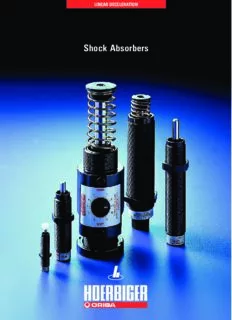
Table Of ContentLINEAR DECELERATION
Shock Absorbers
Table of Contents
Industrial
Shock Absorber
Data Sheet No.
Technical informations 1.70.001E
Survey 1.70.001-13E
Non-Adjustable Shock Absorber
Type SA 10, SA 10S 1.70.002E
Type SA 12 1.70.003E
Type SA 14, SA 14S, SA 14S2 1.70.004E
Type SA 20, SA 20S, SA 20S2 1.70.005E
Type SA 20x25, SA 20Sx25, SA 20S2x25 1.70.005E
Type SAI 25, SAI 25S, 1.70.006E
Type SA 33, SA 33S, SA 33S2, SA 33S3 1.70.007E
Type SA 45, SA 45S, SA 45S2, SA 45S3 1.70.008E
Type SA 64, SA 64S, SA 64 S2, SA64S3 1.70.009E
Adjustable Shock Absorber
Type SA 1/4 x 1/2 1.70.100E
Type SA 3/8 x 1D 1.70.101E
Type SA 1/2 x 1M, SA 1/2 x 2M 1.70.102E
Type SA 1/4 x 1, SA 1/4 x 2 1.70.103E
Type SA 3/4 x 1, SA 3/4 x 2, SA 3/4 x 3 1.70.104E
Type SA 1 1/8 x 2, SA 1 1/8 x 4 1.70.105E
Type SA -A 3/4 x 1, SA 3/4 x 2, SA 3/4 x 3 1.70.106E
Type SA-A 1 1/8 x 2, SA -A 1 1/8 x 4 1.70.107E
SA -A 1 1/8 x 6
Data Sheet No. 1.70.000E-1
LINEAR DECELRATION
Industrial Shock Absorbers
Adjustable
Non-adjustable
SMOOTH, CONTROLLED STOPPING A WIDE RANGE OF APPLICATIONS
The System Operation
Concept
OF MOVING LOADS
High-pressure hardened
HOERBIGER-ORIGA shock absorbers prevent damage to moving parts steel metering tubes
– knife-edge orifices for high
and to machines and plant: flow efficiency
– no readjustment if fluid
destructive impact forces are absorbed by controlled linear deceleration. High-pressure metallic temperature changes
piston ring
Easy replacement
of seals on site
Adjustor provides settings
from "hard" to "soft" and back
to "hard" in one turn (360°)
Ball-type check valve
HOERBIGER-ORIGA reduced while kinetic energy HOERBIGER-ORIGA shock the shortest distance, in the for positive closure
SHOCK ABSORBERS levels are dramatically in- absorbers convert the kinetic shortest time and without
LET YOU creased. These again have energy generated by the de- sudden peak loads during
Extra-long rod bearing for high
■ increase operating to be dissipated in a control- celeration of the load into the stroke. side forces and maximum life
led manner. thermal energy.
speeds
■ increase operating loads Some commonly used stop- Optimum operating condi-
Corrosion-resistant
■ increase system ping devices such as tions are achieved if the return spring as standard
energy is dissipated almost
performance springs, rubber buffers or
■ increase operating dashpots actually increase uniformly, i.e. if the moving Hardened button
mass is brought to a halt in – optional soft pad available
reliability shock loading instead of
for low-noise, scratch-free
■ reduce stresses on reducing it – they do not operation
equipment dissipate energy at a uniform
■ reduce production rate. Viton version
also available
costs For smooth dissipation of the
■ reduce noise levels kinetic energy we recom-
Oil return passages
mend the use of hydraulic Wrench flats for easy
Precision surfaces guarantee installation
shock absorbers.
optimum function
Hardened steel metering Closed-cell accumulator
tube has knife-edge orifices sponge
All moving parts in a produc- for high flow efficiency Extra long rod
Thread at both ends
tion process have to be stop- bearing for high
for mounting Precision surfaces
ped without damage to them- Full-length body thread smidaex imfourcme sli faend Closed-cell accumulator sponge versatility guarantee optimum function
selves or to the stopping – maximum mounting – The oil forced through the
devices of the machines and versatility metering holes compresses the
– metric or American sponge. Large-diameter hardened Corrosion-resistant body
plant. thread – When the piston rod is unloaded and chromium-plated
The high impact forces have the sponge expands and forces piston rod for high force Precision-machined shoulders
to be reduced in a controlled the oil back into the bore, while absorption for accurate positioning and
manner: to bring a moving Strong return spring the spring returns the piston to easy rotation for access to the
for shortest cycle times its starting position. adjustor
load to a standstill, the kinetic
energy generated by the
movement has to be dissi-
Floating piston head with
pated. built-in check valve for
The heavier the moving load oil flow control during
operation
and the faster it moves, the
higher the kinetic energy. Large-diameter hardened
and chromium-plated
In automation especially,
piston rod for high force
shorter and shorter cycle absorption Simplify your design work by
Piston rod seal installing our shock absorber
times are demanded, so that
dimensions on your system.
stopping times are greatly Stop collar The file is compatible with all
–prevents "bottoming out" popular CAD systems.
at end of stroke
Data Sheet No. 1.70.001E-2 Data Sheet No. 1.70.001E-3
ABSORBING SHOCKS
Shock Absorption
Ordinary shock absorbers, The Force/Stroke Diagram
Hydraulic dashpot
springs, buffers and pneu- clearly shows these effects.
Force (N)
matic cushioning cannot The shock absorber curve is
match the performance of ideal because all the energy
Industrial shock absorber
HOERBIGER-ORIGA shock is dissipated by linear dece-
absorbers. leration without initial impact
These shock absorbers or final rebound. Pneumatic
match the speed and mass end cushioning
of the moving object and
Spring
bring it smoothly and uni-
formly to rest.
Springs and buffers, on the
other hand, store energy rat-
her than dissipate it.
Although the moving object is
stopped, it bounces back and
this leads to fatigue in
materials and components
which can cause premature
breakdown of the machine.
Pneumatic cushioning
provides a better solution
Stroke (s)
because the energy is
actually converted, but
because of the compressibi-
Stopping Time
lity of air the maximum bra-
Both damping units stop the
king force is generated at the V (m/s)
same mass from the same
end of the stroke, which can
speed with the same stroke.
lead to excessive loads on
Therefore they do the same
components.
work but the industrial shock
absorber reduces the Hydraulic dashpot
Hydraulic dashpots also
stopping time by 60 to 70 %. t
cause excessive loads
because peak resistance
Industrial
comes at the beginning of
shock absorber
the stroke and then quickly t
falls away. This generates
unnecessarily high braking
forces.
Stopping time (t)
Data Sheet No. 1.70.001E-4
SELECTION OF SHOCK ABSORBER TYPE
Selection
HOERBIGER-ORIGA shock absorbers are available in two main types, to suit different
applications and installation requirements. After selection of the appropriate type,
sizing is determined by calculation.
COMPACT SERIES WITH in many different ways, e.g. ACCUMULATORS OPTIONS
FULL-LENGTH BODY in a tapped blind hole, in a
Normally shock absorbers (cid:127) Stop collars for front or
THREAD tapped through-hole, in a
with internal accumulators rear mounting – these
clearance hole in a flange or
This compact, space-saving are used. This simplifies provide a positive stop to
bracket, etc.
series is available in adju- installation by eliminating prevent damage caused
stable and non-adjustable external piping and oil by the piston "bottoming
versions and can be installed storage. out".
However, in applications with They also allow precise
short cycle times and high setting of the stroke
kinetic energy the oil can length.
become overheated. In this
(cid:127) Soft pad for the hardened
case an external
steel button – to avoid
accumulator should be used
surface damage and
so that the oil can be cooled
reduce noise levels.
in the external circuit.
SHOCK ABSORBER
UNIVERSAL SERIES It is especially suited to
RETURN STROKE
applications which require
This versatile, adjustable
several of the same shock (cid:127) Piston rod with return
series with various mounting
absorbers with the same spring combined with
accessories is designed to
stroke length. internal accumulator
stop heavier loads.
(cid:127) Return stroke actuated by
compressed air or
mechanically, combined
with external
accumulator. With this
version a delayed return
stroke is also possible.
MOUNTING METHODS can be either built into
machines or supplied as
HOERBIGER-ORIGA shock
accessories.
absorbers are designed for a
variety of mountings, which
(cid:1)(cid:2)(cid:3)
Data Sheet No. 1.70.001E-5
THE SELECTION OF SHOCK ABSORBERS
Selection
CORRECT CHOICE OF ACCUMULATORS Note: HOERBIGER-ORIGA SA-A
SHOCK ABSORBER ■Internal accumulator The tank should always be Series shock absorbers
The type of shock absorber The fluid displaced by the installed higher than the feature steplessly adjustable
and its mounting method are piston compresses a shock absorber and the stroke, time-delay damping
mainly determined by the nitrogen-filled, closed-cell connecting pipework should and adjustable rod return
application. sponge. be as short as possible. forces.
In most applications, shock When the piston is If possible there should also The SA Series is fitted with
absorbers with internal unloaded the return spring be a 10 µm filter between the return springs as standard. If
accumulators are preferred pushes the piston back to two units. these types are used with an
to those with external its rest position. At the If the tank is installed further external accumulator for
accumulators. same time the away from the shock absor- better heat dissipation, this
Shock absorbers with compressed sponge ber there must be a positive does not need to be
internal accumulators are expands and forces the oil circulation system (see pressurized because the
supplied prefilled with oil and fluid back into the high diagram) to ensure that the spring returns the rod.
therefore ready for immedi- pressure chamber. oil actually flows through the
tank and is cooled down.
ate use, where as shock ■External accumulator
absorbers with external
The use of external
PISTON ROD RETURN
accumulators require additio-
accumulators is
nal equipment, resulting in recommended where high Piston rod return is actuated
higher installation costs. energy conversion is by
needed or excess heat ■Return springs
SELECTION CRITERIA dissipation is required, In the self-contained units,
■Type of shock absorber e.g. in applications with a built-in spring returns
– with internal short cycle times or in the piston rod to its rest
accumulator high temperature areas. position when it is
unloaded.
– with external
The external accumulator,
accumulator including consisting of an open or ■Air/Oil
air/oil tank closed tank, is connected In units with external
■Type of piston rod return to the shock absorber by accumulators an air/oil
– return spring pipework. system or a mechanical
– air or mechanical The oil heated in the device is used for piston
■Stroke length shock absorber circulates rod return.
Use the longest stroke between the tank and the ■Mechanical units
possible taking any side
shock absorber and is Mechanical rod return is
loads into account.
therefore continuously mostly used in types with
– maximum impact force
cooled during operation. a clevis mounting, with
reduction
actuation by another unit
via levers.
Data Sheet No. 1.70.001E-6
CALCULATIONS FOR SHOCK ABSORBER
Calculations
SELECTION
SELECTION FACTORS EFFECTIVE MASS velocities are very high or The higher the Effective
■How much energy has to Effective Mass is a very very low. Mass, the higher the impact
force at the end of the shock
be dissipated during each important factor in correctly As a general rule, the next
absorber stroke, whereas
deceleration stroke (cycle) sizing a shock absorber. larger size of shock absorber
■How much energy has to It indicates whether the is selected if the impact low Effective Mass
generates very high impact
be dissipated during one shock absorber can be velocity is under 0.3 m/s and/
forces at the beginning of the
hour of operation adjusted to perform properly. or the propelling force
■The Effective Mass It also prevents under- or energy (F x S) exceeds 50 % stroke.
These two points have to be
over-sizing where propelling of the calculated E3 value.
considered in the calculation
forces are involved or
as they can lead to serious
damage over a longer period
of time..
SYMBOLS FORMULAE Minimum/ maximum
Effective Mass is laid down
C =Cycles per hour m (cid:127) V2
t =Time in seconds W = ––––––– = [Nm] = m (cid:127) g (cid:127) h [Nm] inertia and free fall for all HOERBIGER-ORIGA
1 2
s =Shock abs. stroke [m] shock absorbers (see Table
V, Vi =Impact velocity [m/s] 1 (cid:127) ω2 1.70.001-13).
Vt =Velocity of rotating = ––––––– = [Nm] rotating mass
2 Effective Mass is calculated
table [m/s]
g =Gravitational using the following formula.
acceleration [m/s2] m (cid:127) V2
= ––––––i– = [Nm] rotating table
d =Cylinder diameter [mm]
4
b =Radius to centre of
2 (cid:127) W
gravity [m] M.eff = ––––––3–
W = Fp (cid:127) s = [Nm] oder m x g x h for free-falling mass
m =Mass [kg] 2 V2
ma =Additional mass [kg] W = W + W [Nm]
H =Height [m] 3 1 2
W = W (cid:127) C [Nm/h]
Fp =Propelling force [N] 4 3
W =Inertial energy [Nm] Fp = 0,078 (cid:127) d2 (cid:127) P = [N] determines the cylinder force
1
W =Propelling force energy
2
[Nm]
2500 (cid:127) Pm
W =Total energy per cycle
3 Fp = ––––––––––– = [N] etermines the working force of an
[Nm] V
electric motor
W =Total energy to be
4 dissipated per hour Vt = ωωωωω (cid:127) a = [m/s] determines the velocity at distance a from
[Nm/h] pivot
P =Pressure [bar]
M =Torque [Nm]
V = 2 (cid:127) g (cid:127) H = [m/s] determines the impact velocity of
P =Motor power [kW]
m a free-falling mass
R =Radius to cylinder [m]
ωωωωωC =Angular velocity [rad/s]
M.eff =Effective Mass
µ =Coefficient of friction
V (cid:127) b
I =Moment of inertia V = ––––––– = [m/s] determines the impact velocity of a
[Nm/s] i a
rotating mass
r =Radius of table [m]
D =Distance to shock
absorber [m]
l = m (cid:127) a2 [Nm/s2]
2r =Diameter of table [m]
ααααα =Slope angle [°]
2,6 (cid:127) s
t = ––––––– = [s] determines the stopping time in the
V
course of a stroke
2 (cid:127) W
M.eff = ––––––3– = [kg] determines the Effective Mass
V2
Data Sheet No. 1.70.001E-7
EXAMPLES OF CALCULATIONS FOR
Calculations
SHOCK ABSORBER SELECTION
Example 1 – Vertical Free-Falling Load Example 3 – Vertical Load Propelled Upwards
m = 25 kg m = 450 kg d = 100 mm (2 Cylinders)
H = 0.4 m V = 1.2 m/s s = 0.1 m
C = 140/h P = 6 bar C = 200/h
s = 0.05 m
Calculation Calculation
W = m (cid:127) g (cid:127) H m (cid:127) V2 450 (cid:127) 1.22
1 = 25 (cid:127) 9.81 (cid:127) 0.4 W1 = –––2–––– = –––––2–––––
= 98 Nm
= 324 Nm
W = m (cid:127) g (cid:127) s
2 = 25 (cid:127) 9.81 (cid:127) 0.05 Fp = 2(0,078(cid:127)d2(cid:127)P) - (g(cid:127)m)
m = 13 Nm = 2(0.078(cid:127)1002(cid:127)6) - (9.81(cid:127)450)
= 4950 N
W = W + W
3 1 2
V = 98 +13 W = F(cid:127)s
H = 111 Nm s 2 = 49p50(cid:127)0.1
W = W (cid:127) C V = 495 Nm
s 4 3
= 111 (cid:127) 140 m W = W+W
= 15540 Nm/h 3 = 3214+4295
V = 2 (cid:127) g (cid:127) H = 819 Nm
= 2 (cid:127) 9.81 (cid:127) 0.4 d W = W(cid:127)C
2 4 3
= 2.8 m/s P Cylinder P = 819(cid:127)100
2 (cid:127) W 2 (cid:127) 111 = 81900 Nm/h
M.eff = ––––––3– = –––––––
V2 2.82 2(cid:127)W 2(cid:127)819
M.eff = ––––––3– = ––––––––
222 V2 1.22
= ––––––– = 28 kg
7.84 = 1137 kg
Select Type: SA1/2 x 2 Select Type: SA11/8x4
Example 2 – Vertical Load Propelled Downwards Example 4 – Moving Load Without Propelling Force
m = 450 kg P = 6 bar m = 900 kg
V = 1.2 m/s C = 100/h V = 1.5 m/s
d = 50 mm s = 0.1 m F = 0
p
C = 200/h
Calculation
m (cid:127) V2 450 (cid:127) 1.22
W = ––––––– = –––––––– s
1 2 2
P = 324 Nm
F = (0,078(cid:127)d2(cid:127)P) + (g(cid:127)m) m
p
= (0.078(cid:127)502(cid:127)6) + (9.81(cid:127)450) V
d = 5585 N
W = F(cid:127)s
2 p
= 5585(cid:127)0.1
m = 558 Nm
W = W+W Calculation
V 3 = 3214+5258
m (cid:127) V2 900 (cid:127) 1.52 W = W(cid:127)C
= 882 Nm W = ––––––– = –––––––––– 4 3
s 1 2 2 = 1012(cid:127)200
W = W(cid:127)C = 202400 Nm/h
4 3 = 1012 Nm
= 882(cid:127)100
2(cid:127)W 2(cid:127)1012
= 88200 Nm/h W2 = 0 M.eff = –––V–2––3– = –––1–.5–2–––
M.eff = –2–(cid:127)–W–3––– = –2–(cid:127)8–8–2–––– W3 = W1+W2 = 900 kg
V2 1.22 = 1012
= 1225 kg
Select Type: SA 1 1/8x4 Select Type: SA 1 1/8x4
Data Sheet No.1.70.001E-8
EXAMPLES OF CALCULATIONS FOR
Calculations
SHOCK ABSORBER SELECTION
Example 5 – Moving Load With Propelling Force Example 7 – Moving Load Propelled by Rollers
(Conveyor with Chain/Belt Drive)
m = 900 kg P = 6 bar
V = 1.5 m/s C = 100/h m = 80 kg C = 300/h
d = 50 mm s = 0.05 m V = 1.0 m/s s = 0.025 m
µ = 0.3
s
s
d
m
P m V
V
Calculation W = W+W Calculation W = W(cid:127)C
3 1 2 4 3
m (cid:127) V2 900(cid:127) 1.52 =1012+58.5 m (cid:127) V2 80 (cid:127) 1.02 = 45.9(cid:127)300
W1 = –––2–––– = –––––2––––– =1070.5 Nm W1 = –––2–––– = –––––2––––– = 13770 Nm/h
= 1012 Nm W4 = E3(cid:127)C = 40 Nm M.eff = –––2–(cid:127)W––3– = –2–(cid:127)4–5–.–9–––
= 1070.5(cid:127)100 V2 1
F = 0,078(cid:127)d2(cid:127)P W = F(cid:127)s
p = 0,078(cid:127)502(cid:127)6 = 107050 Nm/h 2 = 80p(cid:127)0.3(cid:127)9.81(cid:127)0.025 = 91.8 kg
= 1170 N 2(cid:127)E 2(cid:127)1070.5 = 5.9 Nm
M.eff = –––––3–– = ––––––––
V2 1.52
W = F(cid:127)s W = W+W
2 = 11p70(cid:127)0,05 = 951 kg 3 =40+15.92
= 58.5 Nm Select Type: SA 1 1/8x2 =45.9 Nm Select Type: SAI 25
Example 6 – Moving Load Propelled by Motor Example 8 – Load Moving Down a Slope
m = 900 kg C = 100/h m = 200 kg C = 100/h
V = 1.5 m/s s = 0.05 m ααααα = 15° s = 0.05 m
P = 1 kW H = 0.2 m
m
s m D
s
H
V m V
P
m
ααααα
Calculation W = W+W Calculation W = W(cid:127)C
3 1 2 4 3
m(cid:127)V2 900(cid:127) 1.52 =1012+83 W = m(cid:127)g(cid:127)H = 417.91(cid:127)100
W = ––––––– = –––––––––– 1
1 2 2 =1095 Nm = 200(cid:127)9.81(cid:127)0.2 = 41791 Nm/h
= 392.4 Nm
= 1012 Nm W =W(cid:127)C V = 2 (cid:127) g (cid:127) H
F = –2–5–0–0–(cid:127)–P–m– = ––2–5–0–0–(cid:127) –1– 4 = 10395(cid:127)100 W2 = m(cid:127)g(cid:127)sin ααααα(cid:127)s = 2(cid:127)9.81(cid:127)0.2
p V 1.5 = 109500 Nm/h = 200(cid:127)9.81(cid:127)0.26(cid:127)0.05 = 1.98 m/s
2(cid:127)W 2(cid:127)1095
= 1666 N M.eff = –––V–2––3– = –––1–.5–2––– = 25.51 Nm M.eff = –––2–(cid:127)W––3– = –2–(cid:127)4–1–7–.–9–1–
V2 1.982
W2 = Fp(cid:127)s = 973 kg W3 = W1+W2 = 213 kg
= 1666(cid:127)0.05 = 392,4+25.51
= 83 Nm Select Type: SA1 1/8x2 = 417.91 Nm Select Type: SA 3/4x2
Data Sheet No. 1.70.001E-9
Description:Type SA 64, SA 64S, SA 64 S2, SA64S3. 1.70.009E. Adjustable Shock Absorber. Type SA 1/4 x 1/2. 1.70.100E. Type SA 3/8 x 1D. 1.70.101E. Type SA