Table Of Content. . . .
D I S T I N G U I S H E D I L L U S T R A T O R S E RI E S
R.O. BLECHMAN :
THE INQUIRING LINE
In R.O. Blechman’s engaging visual world, an exasperated stomach looks deeply into its owner’s eyes,
begging for less irritating food choices, or Alka-Seltzer™; a mother strikes a Whistler-inspired pose, delighted
to received the Mother’s Day gifts bestowed by her children; a jack-o-lantern shares its unique perspective
on the Halloween experience; and a pen reveals that it is definitely mightier than the sword, Don Quixote-
style. Filled with humanity and humor, Blechman’s whimsical, intelligent drawings, created in an instantly-
recognizable hand, have been revealing us to ourselves for six decades. Deceivingly uncomplicated, they
offer meaningful metaphors for life, delivered with a wink and a nod and a twinkle in the artist’s eye.
Norman Rockwell Museum is honored to present R.O. Blechman: The Inquiring Line, celebrating the
exceptional career of an outstanding illustration master. The Distinguished Illustrator Exhibition Series
highlighting the unique contributions of contemporary visual communicators is presented by the Rockwell
Center for American Visual Studies, the nation’s first research institute devoted to the art of illustration. The
Distinguished Illustrator Series reflects the impact and evolution of published art, and of Norman Rockwell’s
beloved profession, which remains vibrant and ever-changing.
Norman Rockwell Museum holds the largest and most significant collection of art and archival materials
relating to the life and work of Norman Rockwell. The Museum also preserves, interprets, and exhibits a
growing collection of original illustration art by noted American illustrators, from historical to contemporary.
The Norman Rockwell Museum Art Collection and Norman Rockwell Archive inspire a vibrant year-round
exhibition program, national traveling exhibitions, and arts and humanities programs that engage diverse
audiences. The Museum’s collections, which are made accessible worldwide, are a comprehensive resource
relating to Norman Rockwell and the art of illustration, the role of published imagery in society, and the
American 20th century.
Stephanie Haboush Plunkett
Deputy Director/Chief Curator
Norman Rockwell Museum
Exhibition curator Joyce K. Schiller, Ph. D. is Curator of the Rockwell Center for American Visual Studies at
Norman Rockwell Museum. She has organized many exhibitions relating to the art of illustration, and her
writings on the subject can be found on the Rockwell Center’s website at rockwell-center.org.
All illustrations © R. O. Blechman. All rights reserved.
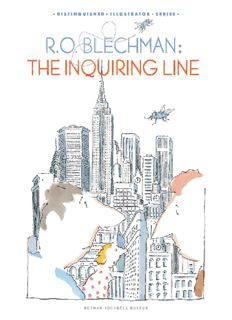
Front cover: Illustration for Franklin the Fly by R.O. Blechman (Mankato, MN: Creative Editions, 2007).
Back cover: New York at Night, cover illustration for The New Yorker, October 1, 1979. This page: Age of Terrorism, Op-ed illustration for
The New York Times, September 13, 2001. Facing page: 9/11 Memorial Lights, 2006, Illustration for The Municipal Art Society of New York.
Designed by Rita Marshall
9 Glendale Road, Stockbridge, MA 01262, 413-298-4100, nrm.org
R.O. BLECHMAN :
THE INQUIRING LINE
May 11 through June 30, 2013
. . . .
D I S T I N G U I S H E D I L L U S T R AT O R S E R I E S
R O C K W E L L C E N T E R F O R A M E R I C A N V I S U A L S T U D I E S
The Power of the Pen, cover illustration for Story, Autumn 1998.
4
R.O. BLECHMAN :
THE INQUIRING LINE
JOYCE K. SCHILLER
R.O. Blechman is a sayings or commonly held customs offered up in various
celebrated illustrator, guises. One theme in his work addresses the age-old query,
animator, children’s “is the pen mightier than the sword?” Blechman conveys
book author, graphic this adage as an image of a sword or a scythe in the
novelist, and editorial role of the active aggressor, with a pen in the role of the
cartoonist. His seminal object aggressed upon. The pen, or the words it writes, are
animated commercial sometimes represented by a drawn ink pen, as in a 2010
created for Alka-Selt- illustration for The New York Times Book Review featuring a
zer™ and his witty illustrations for The New York Times, The scythe chasing after an ink pen that writes “I’m not finished”
New Yorker, and The Huffington Post have established Blech- as it runs away. After the laugh, Blechman’s image prods us
man’s work as an important touchstone in modern illustration to question whether it is the continual laying down of words
art. This has brought a flurry of honors: in 1983 Blechman that makes the pen mighty or what the words say?
was awarded the title of Illustrator of the Year by Adweek; Another powerful pen image was created for the cover of
in 1984 he received an Emmy as director of The Soldier’s the Autumn 1998 issue of Story magazine. On this cover, an
Tale, a animated PBS special; he was named a member of oversized fountain pen draws a man riding a horse who also
the New York Art Directors Club prestigious Hall of Fame in carries an ink pen held as though it were a lance. Blechman’s
1999; he received a Lifetime Achievement Award from The drawn figures gallop toward a sheet of lined yellow legal
National Cartoonists Society in 2010; and in 2012, Blech- paper. Here the pen is both prime mover and weapon, but
man was inducted into the Illustrators Hall of Fame by the also anachronistic. The pen shown is not a modern ball point
Society of Illustrators. In 2003, retrospective exhibition of his pen or marker pen, it is a fountain pen. By their design, ink
animated films was mounted at the Museum of Modern Art in pen nibs are dangerous things. Made of metal, nibs have
New York. sharp points through which ink is delivered, so the fountain
Over the breadth of his career, Blechman has focused pen that draws the man on horse also appears to prod its
on and even revisited a variety of visual themes. Some creation into action.
originated within the stories he has written and illustrated The cover illustration
since the 1950s. Some evolve from the appropriation of is also an image of
art made in other times and places. His art also reflects his Don Quixote tilting at
experiences or the places he has been. The world may be windmills. Sheets of
his oyster, but it becomes our treat. yellow legal paper
Blechman’s illustrations sometimes focus on popular float above the drawn
Standing Bob, story illustration for Print v. 67 no.1, February 2013.
I’m not finished, illustration for “Working on the Ending” by Gail Godwin, in The New York Times Sunday Book Review, December 10, 2010.
5
surface serving as the paddles of the wind mill. Notice how everyone else was asleep, that pleases the Lady beyond all
the paper and fountain pen appear to cast shadows while the others. So although we may all be nebbishes, the core
the drawn horseman does not. Each permutation of the pen value Blechman communicates to us is to be yourself—to offer
and sword provides amusement, but also fosters continued up to your community, the real you.
contemplation of an essential juxtaposition. Indeed, each time In his 2008 Parody of Freedom from Fear by Norman
Blechman tackles the relationship, the pen inevitably becomes Rockwell, created for Thoughts on Democracy, an
mightier. exhibition inspired by Norman Rockwell’s Four Freedoms
at Wolfsonian FIU2, Blechman’s reworking of this Rockwell
Line and Style image acknowledges some of the challenges that assail
Blechman’s quality of line is notable and distinctive with its the contemporary everyman: foreclosure, stolen identity,
quivering character, laid down with obvious stops and starts; recession, bad cholesterol, terrorist attacks, and taxes, as
yet that is not the essential facet of his images. Though he opposed to those detailed on the newspaper in Rockwell’s
describes it as his “tremulous line,”1 it is the characters his World War II era painting: bombings, kill, horror, hit. To
lines create that hold the power in each work. communicate the immensity of these issues, Blechman’s father
Many of Blechman’s characters appear to be nebbishes figure looks out of the picture frame at those of us viewing
(a Yiddish term meaning an unfortunate, timid geek), but it, while Rockwell’s father figure gazes down at his children.
they are really the artist’s depiction of every man whose Rockwell couched his Four Freedoms illustrations in personal
perseverance is his essential trait. In his 1988 Story and private terms. Blechman’s decision to pose the father
magazine cover, Blechman makes it clear that the nebbish figure looking back at the audience broadens the realm of
(the figure riding the horse) views the blank sheet of lined personal fear into every man’s fear.
paper with trepidation. Some of Blechman’s characters seek to succeed in life,
In Blechman’s first and still remarkable publication, but despite their best intentions, things are sometimes beyond
The Juggler of Our Lady, the protagonist Cantalbert finds their control. His juxtaposition of Johnny Appleseed racing to
he has no exceptional gift he can use to create something plant seeds that will grow into apple trees and a gigantic
to present to the Paul Bunyan following close behind, chopping down those
Madonna in honor of same trees as they move through the arc of life, is a perfect
the anniversary of the reflection of Blechman’s world view.
birth of the Christ child. Despite personal excellence and transcendent devotion,
Instead, in the dark of an everyman like Johnny Appleseed stumbles through
the night, Cantalbert life trying to make a difference as he makes his daily
offers the Virgin Mary contribution. This image could easily reference the quip
the activity that he Thomas á Kempis wrote in Of the Imitation of Christ, ‘Man
loves most, juggling. It
is Cantalbert’s humble
1 R. O. Blechman, Dear James: Letters to a Young Illustrator (New York: Simon &
offering of the best of Schuster, 2009): 1.
2 The Wolfsonian FIU challenged 60 artists and designers to create contemporary
himself, made when responses to Norman Rockwell’s 1943 Four Freedoms paintings.
Norman Rockwell (1894–1978), Freedom From Fear, illustration for The Saturday Evening Post, March 13, 1943.
6
Parody of Norman Rockwell’s Freedom From Fear, Thoughts on Democracy: Reinterpreting Norman Rockwell’s Four Freedoms, The Wolfsonian FIU, 2008.
7
proposes, God disposes.’ Blechman acknowledges that his sculpture’s influence is immense, in part because it had been
images are often a response to a written idea or concept: praised in the 1st century by the writer Pliny the Younger. It
was so highly regarded that not long after its rediscovery, the
“I always felt that my skills, such as they are, are as much Pope brought the sculptural group into the Vatican collections.
literary as visual maybe even more literary than visual, The discovery of the Laocoön figures inspired sculptors of the
because I always enjoyed language a lot. As for my early 17th century, like Gianlorenzo Bernini (1598–1680),
drawing skills, if I work hard I can do very well.”3 to attempt to convey dramatic emotion in addition to physical
beauty, as he did in his sculpture of David, 1623.
Beyond references to Don Quixote and Thomas á Kempis, The Laocoön has also been appropriated and
Blechman’s drawn lines breathe along with the characters reinterpreted by many other artists including William Blake
they create. Thus, his drawn line style may express nervous and Charles Dickens. Blechman’s twist (literal and figural)
energy, or when emboldened with watercolor wash, reveal was to posit a modern version of the image with father and
and convey three-dimensional form that appears to come to sons balancing on wrapped packages, bound together
life on the page. by holiday ribbons and Christmas lights. While many
Renaissance and Baroque period Italians knew about this
Artistic Homage: Contextual Reuse figural group, in the 20th century it is predominantly familiar
For his 1990 holiday cover for The New Yorker, Blechman to those who study art history. Blechman’s choice of this
borrowed from the figures of the ancient marble group of image source supposes that the rest of us who view his New
Laocoön and His Sons. That sculpture depicts a Trojan priest Yorker cover illustration will get the joke. Our big conundrum,
and his sons being punished by the gods for warning his he suggests, is getting ready for the holidays without being
countrymen about the Greek Trojan horse that would invade overwhelmed.
the city. Probably carved in the 1st century B.C. and perhaps In Blechman’s 1996 book, the Life of Saint Nicholas, he
based on an earlier Greek bronze figure, the Laocoön was again referenced the Greek Laocoön, this time along with
rediscovered in Rome in the early 16th century. The other classical sculptures that were transformed, according
to his story, into politically correct Christian-themed images
by Nicholas’s father Pompus Pluvius in order to maintain his
3 Quote from “R. O. Blechman.” in Talking Lines: The Graphic Stories of R. O.
Blechman (Montreal, Quebec, Canada: Drawn & Quarterly, 2009): 5. thriving business.
Smart Drones, illustration for “Smart Drones” by Bill Keller, The New York Times, March 16, 2013.
8
Christmas Wrapping (Modern Laocoön), cover illustration for The New Yorker, December 17, 1990.
9
The humor of this story demands that the reader When Blechman created an illustration referencing
recognize and understand the meanings and origins of these Shell Oil’s™ passivity in the face of the deaths of Nigerian
sculptural forms: Aphrodite versus the Madonna; Nike versus activists campaigning against the company’s onshore drilling
the Annunciation; the Discobolus versus Jesus Casting Out the unit, he appropriated Botticelli’s central figure from his
Money Changers; and the Laocoön versus The Three Magi. 1486 painting The Birth of Venus. Because the deceased
In broad terms the appropriation of art implies a visual activists wanted the company to abandon oil production in
fluency with the art of the past that may not be common in Ogoniland, Blechman drew a new version of Venus on the
our society. That said, examples of this phenomena seen Half-shell, as she is popularly known, to make visual sense
on covers of The New Yorker or in the pages of The New of the story he was referencing. Scallops and other hinged
York Times, by Blechman and many others, may be viewed shells have been used to symbolize the feminine principle, so
by readers who are perhaps more likely to have a broad it is understandable that images of Venus (or Aphrodite), the
and deep visual education than in the population at large. goddess of love and fertility, include a scallop shell to identify
Nevertheless, we must also acknowledge that in the 21st a woman. No doubt Shell Oil™ chose a scallop shell as
century, viewers of popular illustration may possess a broader the central feature of their logo, because over geologic
knowledge of visual references because of the explosion of time, shells and others detritus of the ancient world became
internet access than could have been imagined in the past. compressed and transformed into oil. Blechman’s image
The Life of Saint Nicholas, (New York: Tabori & Chang, 1996): pages 19 and 21.
10
Description:Front cover: Illustration for Franklin the Fly by R.O. Blechman (Mankato, MN: Creative was awarded the title of Illustrator of the Year by Adweek;.