Table Of Contentvirasat
Sisira Ritu October-December 2016 A Newsletter of the IndIan naTIOnaL TRusT fOR aRT and CuLTuRaL HeRITage
!
INTACH | 1
In thIs Issue
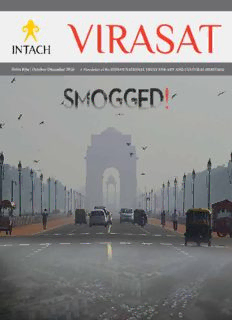
smogged 3
news from Central Office 8
heritage tourism Division (htD) 10
Architectural heritage Division (AhD) 11
natural heritage Division (nhD) 18
Intangible Cultural heritage Division (IChD) 21
Cultural heritage Cell 24
heritage Craft & Community Division (hCCD) 26
New Year does not
promise change....... Material heritage Division / ICI 28
You promise change
IntACh heritage Academy (IhA) 37
to the New Year!
Chapters 46
news from here and there 78
Chairman: Maj. Gen. (Retd.) L.K. Gupta, AVsM
INTACH Vice-Chairman: Ms. tasneem Mehta
Member secretary: Dr. (smt.) C.t. Misra, IAs (Retd.)
Advisor: Jagdish Chander, Director, Projects and Policies
[email protected]
S.K. Verma, IFS (Retd.)
Principal Advisor, Natural Heritage Division V.K. Aggarwal, Director, Administration & Finance
[email protected] [email protected]
heads of Divisions:
Ms. A. Vijaya, Director Listing
Dr. (Mrs.) C.T. Misra, Heritage Tourism
[email protected]
Manu Bhatnagar, Principal Director, Natural Heritage
Ms. Manisha Singh, Senior Coordinator
[email protected]
[email protected]
Nilabh Sinha, Principal Director, Material Heritage Consultants:
[email protected]
T.S. Randhawa, Consultant, IDC/Library/Archives
Divay Gupta, Principal Director, Architectural Heritage
Ms. Rekha Khosla, Consultant, Publication
[email protected]
[email protected]
Navin Piplani, Principal Director, INTACH Heritage Academy
Jayant Tripathi, Legal Adviser
[email protected]
Owner: IntACh
Ms. Purnima Datt, Principal Director,
Editor: Rajeshwari Tandon
Heritage Education & Communication Services
Published & Printed by Indian National Trust for Art
[email protected]
and Cultural Heritage (INTACH)
Ms. Nerupama Y. Modwel, Principal Director,
71, Lodhi Estate, New Delhi-110003
Intangible Cultural Heritage
Tel: 24641304, 24692774, Fax: 24611290
[email protected]
Email: [email protected] Website: www.intach.org
Ms. Bindu Manchanda, Director Project & Crafts
Design and production: VAP Enterprises
[email protected]
Mob: +91 9811285510 Tel: +91 11 41755660
Group Captain Rahul Pathak (Retd.), Director Chapters
[email protected], [email protected]
[email protected]
Registration no.: English: DEL Eng/2004/14304 Hindi: DEL Hin/2004/14144
2 | VIrAsAT | October-December 2016
!
Smogged
At present it is only the ‘Tale of Delhi’ set in early the mighty mountains disappeared behind a heavy curtain
November 2016, creeping into December and threatening of smog. Evacuating Delhi, or for that matter any heavily
to spill into the New Year. Of a city canopied often in populated city, is an impossible solution. It can never even
thick smog and bare visibility. Even before the last lights of be an option. A year ago a study was commissioned from
Diwali flickered in the loud burst of crackers, a thick hazy IIT Kanpur, but like all such studies it has remained an
smog blanketed the capital. The city was even described academic exercise.
as a gas chamber. It can be the tale of many other cities in
Expressing deep concern over the capital’s rising pollution
the future.
level, the Supreme Court questioned the Central Pollution
Board and other authorities on being clueless, not even
having a Central Control Room or adequate control
centres to monitor the air and take timely action in the
most affected areas of the city. ”You want to wait till people
The historic capital of India had already capped the list start dying…..the capital of the country cannot be left to be
of most polluted cities in the world, with the Air Quality poisoned?” Nor can any city for that matter.
Index (AQI) crossing the 500 danger level. In November
A slew of ‘quick fix’ measures were announced. Thousands
it nearly touched a hazardous 1000 AQI, averaging 600
of Delhi schools closed down. Construction work was
micrograms per cubic metre - nearly 60 times the level
halted. People rushed to buy air purifiers. Citizens wore
WHO considers safe. Even the 1952 Great Smog of
masks till the shops ran out of stock. Old people were
London that claimed death of a few thousand people, had
advised to stay indoors. A medical check was recommended
not recorded this level. The Global Burden of Disease Report
for participants of the Half Marathon held in Delhi. For a
released at a workshop organized jointly by the Centre
for Science and Environment, India; Indian Council
of Medical Research and the US based Health Effects
Institute concluded that “air pollution is the fifth largest
killer in India”. It is a ‘Wake Up Call’ for India!
Early morning risers were advised to forsake their morning
walks as they would be breathing toxic air. Travellers flying
into Delhi sailed through clear blue skies and fleecy clouds,
before plunging through the smog without a glimpse
of city lights. Participants in the Delhi Marathon were
warned to seek medical advice before participating in the few days there was watering and vacuum cleaning of dusty
race. A photograph from Eastern India showed a clearly roads, but only in Lutyens Delhi. Tenders were floated for
visible Himalayas, but in the snapshot from North India mechanical sweepers but failed to get any response;firms
INTACH | 3
Save environment to save the future...
that had them were not interested in lending them to study conducted by IIT scientists.”
Government. However these are just short-time measures.
Swachh Bharat remains grounded in photo opportunities.
Industries allotted land outside Delhi failed to shift.
It must become a People’s Movement if it has to succeed.
Some diesel vehicles belching poisonous emissions were
And garbage dumps must be stopped from growing into
diverted, and a crackdown on 15 years old diesel vehicles
hillocks hissing fumes. The reported 73% of all fecal sludge
began, others continued to ply. Scooter were identified
in India that is left untreated in the environment needs
as major culprits, but they are everyman’s transport. Less
to be tackled. What are needed in fact are not bandaids
polluting cars might get back to odd/even numbered days
but permanent systems in place as may be seen in some
driving - to make a statement.
cities of the western world, infused with a sense of social
responsibility at all levels. One sliver of good news is that
Delhi will soon get its biggest waste-to-energy (WTE)
plant that processes 2500 metric tonnes of garbage and
can produce 25 megawatts of electricity.
There are lessons here to be learnt before this state
of affairs becomes the ‘Tale of Many Cities’ of India.
Perhaps the Media should help in creating a ‘sanitation
platform’ instead of endless rancorous debates for TRP
that politicise most issues.
Smoke from burning fields in neighbouring States will Article 21 of the Indian Constitution guarantees the
continue to waft into other States. It was reported that Fundamental Right to live i.e. the right to clean air, clean
a staggering 32 million tonnes of leftover grains were water and a clean environment that can be imposed by
burnt in Punjab alone. 70% of the winds blow into Delhi the Supreme Court and the High Courts. Concurrently,
from Pakistan, Punjab and Haryana from one side; and citizens are reminded that Environmental Protection
Uttar Pradesh and Bihar from the other direction, to is one of their Fundamental Duties, as laid down in the
make Delhi prone to more pollution now that the winter Constitution. Both have been widely abused in the frantic
has arrived. “After burning biomass the oxidized organic race for development. The attention of the Green Tribunal
carbon is only 9%, it rises to 35% on foggy days – says a has to be very seriously and actively engaged to avert
4 | VIrAsAT | October-December 2016
Earth - planet wth only habitable environment...
another pollution crisis.
These serious issues are already getting demonetised and nudged out
of sight with new Headlines every day. And all’s well with our capital
city gearing up for the tourist season! However it remains to be seen
how many tourists plan to visit “Incredible India” this year.
For Nations to make true on the global pact, average warming must
be limited to 2 degrees Celsius over pre-industrial revolution levels,
and emissions must do more than level off. The global warning bells are ringing louder each year. What is needed is a
world-wide responsible relationship with environment. It remains to be seen if the global efforts will be ‘trumped’ or
garner world-wide support?
Meanwhile UNICEF warned “unless decisive actions are taken to reduce air pollution, the
events witnessed in Delhi the past week are likely to be common.” According to UN, 2016
was the hottest year setting a new high for the third year in a row. Its brief scan of
extreme weather phenomena recorded there were devastating fires in Canada, second
lowest ice cover recorded in the Arctic Sea that can result in altered climatic patterns as
far away as Asia, major flooding in Niger River basin, flooding in China with a mud rain
in Yinongzhen due to chemical dispersal; typhoons in Korea and Japan with snow in
Tokyo this winter in November after 50 years; hurricane in the Caribbean; heat waves in
Southern Africa; snow in the Sahara for the first time in 37 years; record temperatures in
Thailand;landslides in Sri Lanka, 400 lives in Tehran claimed by smog, and closer home
Shimla in November was hotter than Ahmednagar etc.etc.etc. What next? What will
happen in 2017 – “Airocalypse” ? Let us just hope and pray!
Pollution Kills
Editor-in-Chief Hindustan Times, Shashi Shekar writes authoritatively that as per statistics pollution kills more people
than terrorism, civil wars and accidents put together. Close to 6,00,000 children aged 5 or below die of diseases where
pollution is one of the primary causes. The question is “why maintain this suicidal silence. Are we waiting for the world
to turn into a gas chamber?” he asks.
Hindustan Times, 28th November 2016
Deadliest Worry
Particulate matter with a diameter of 1 micron (PM1) or less is the tiniest of dust pollutants that can easily penetrate
deep into the lungs and enter blood circulation. Inner walls of the heart can be affected, causing cardio-vascular
problems. While PM10 is due to dust, PM1 is entirely because of combustion. It is the new “fear factor” that needs
urgent attention, according to scientists. Meters to measure PM1 concentration need to be installed in all urban areas,
as is generally mooted but awaits action in all metropolitan city planning schemes in anticipation of future requirement.
Silent Spring
Best selling author Rachel Carson begins with a “fable for tomorrow” – a true story drawing examples from many
communities using DDT that caused damage to wildlife, domestic pets and human beings. She identifies human
hubris and financial self interest as the crux of the problem. She questions what various authorities allow to be put in
the environment in liberal societies instead of acting as stewards of the living earth.
INTACH | 5
Global warming - not a prediction but a predicament...
ADviSory from iNTACH NATurAl HeriTAge DiviSioN
The air we breathe has become a deadly mix of toxic gases. It also contains harmful particulate matter such as PM
10 and the even finer PM 2.5. Air pollution is worsening by the year. The culprits have been identified by various
scientific studies:
• Vehicular emissions. • Construction activity. • Industrial emissions. • Thermal power plant emissions
• Burning of municipal wastes and leaf litter. • Burning of crop stubble in the hinterlands. • Miscellaneous roadside
dust • Other factors are cooking fuels such as dung cakes, kerosene lamps, DG sets, transport of construction
material with significant leakages.
Several ideas have been floated to reduce air pollution and many of them are proven elsewhere. At the same time
most of them have a long term horizon. Measures such as upgrading to Bharat VI emission standards for vehicles are
not in the hands of individuals or local Governments. They require both engine and fuel improvements. So what is
required is a mix of measures both short and long term.
• Increasing green cover wherever possible. The green cover is a carbon sink which absorbs carbon dioxide and
emits oxygen through photosynthesis while also trapping dust. In addition, occasional washing of the green cover is
important as with the passage of time dust layers diminish the photo synthesis process. For the roadside plantation, the
deployment of fire tenders for this purpose can be effective. • Preventing any form of unregulated burning – thus leaf
litter needs to be composted and not burnt. Municipal solid waste fires should also not be allowed by the authorities.
• Cooking fuel – whilst many households are having LPG there are many in smaller towns which still use cow
dung cakes and kerosene stoves. Provision of smokeless chulahs and even biogas in cylinders can curb pollution
from this source.• Planting urban forests can help set up wind currents which disperse the smog. • Curtaining
of construction sites and water spraying around them can curtail particulate matter spread from these sites.
• Transport of construction material such as sand, bricks or cement also deposits loose material especially
on bumpy roads. Trucks carrying such material would need to be regulated to prevent such deposition.
• Banning the use of generators within the urban area. • Shifting to renewable energy [solar] through policy and
incentive models.• Smoothening traffic movement [one
way streets where possible], redesigning traffic junction
geometry to enable smooth turnings and avoiding pile
ups.• Planning for the pedestrian, bicycles and rickshaws.
• Discouraging car entry in congested areas by applying
congestion tax. • Improving public transport [metro/bus]. •
Introducing vacuum cleaning of roads. • Disincentivizing
car sales/ incentivizing electric cars. • Opposing thermal
power plants in the air shed and improving emission
cleaning equipment. • Improving indoor air quality
through the use of specific indoor plants which perform
photosynthesis even in low light conditions.
manu Bhatnagar
Principal Director,
iNTACH Natural Heritage Division
iNTACH Central office roof Top
The visible deterioration of the air quality evidenced by the overhanging haze also affects plant productivity as well
as the solar energy production. With thick layers of dust and particulates coating leaves and other green matter
the photosynthesis process is reduced in efficiency. It is in the interest of urbanites to wash foliage and other green
matter at least once a month in summers and twice a month in winters, to maintain efficiencent photosynthesis.
The authorities can deploy fire tenders to wash the canopies of the roadside trees. On the INTACH Central Office
rooftop the solar photovoltaic panels were generating 25% less energy as compared to a rare clearer day when winds
dispersed the smog. On checking up with a similar sized installation in Bikaner Rajasthan) of similar latitude, the
output over a month was higher by 15% average. This was due to the curtain of haze and dust smothering of the solar
panels themselves.
6 | VIrAsAT | October-December 2016
Clean and green makes a perfect scene...
PoTTeD PlANTS for CleAN Air
Bamboo Palm: snake Plant Removes spider Plant Pothos: Aloe Vera: Clears
Natural humidifier Carbon Dioxide Removes Carbon Battles Formaldehyde Carcinogens
Monoxide
Indoor plants are natural air purifiers as they generate more oxygen than other plants, and are easy to maintain. Certain
plants combined with the micro-organisms in their soil kill indoor air pollutants. Money plants wrapped around moss
stick can work best inside the house even in ambient light and no sunlight. Areca Palms and Peace Lily need a little air
circulation and ambient light, and watering once or twice a week to keep homes air fresh. Sprayed with lemon grass,
neem or essential oils keeps insects and bugs away.
A housewife Aanchal Oswal in Delhi placed 36 indoor plants in different corners of her home as she found the air
purifier did not protect the entire area of her house. She planted Areca Palm plants that filter indoor air pollutants
like toluene and xylene. Snake Plants in bathrooms to remove carbon monoxide, monoxide, chloroform, etc. Ivy
Plants in rooms as a natural way of removing toxic agents from the air. Aloe Vera, Spider and other species help to
generally cleanse the air in homes, she says. Terracotta or clay pots stain floors. Ceramic, fibre and even plastic pots
work equally well with indoor plants.
from Delhi to faraway Tawang no respite from Smoke and Dust
A smogged city is not only all about Delhi. The world’s first real time pollution map
is the brain child of Air-Visual created by a French tech entrepreneur Yann Boquillod,
who is based in Beijing. His start up helps to forecast air quality and pollution levels
so that young families can take preventive measures ahead of bad air alerts. He says
it enables us to “understand the status of health of the earth…...by visualizing it on
a 3D map so that people can actually see the amount of emissions being spread to
the world”. Not surprisingly the US Embassy in Beijing now puts out daily tweets
measuring the PM 2.5 data. When the readings crossed 500 in 2011, the Chinese
Government closed down 4 power plants.
According to a local Greenpeace campaigner,the Chinese Government have succeeded in reducing the overall PM
2.5 by more than 10% when he compared it to 189 other cities. Apart from the odd and even numbered car limit,
time restrictions were imposed on construction sites and coal mines. The younger generation were enthused to clean
their country’s skies and rivers. Soon their environmentally friendly e-bikes and bicycles were parked over three floor
office space populated by eager young Chinese doing their bit. The larger trend shows China is moving away from
coal, with emissions falling year on year. Their 2020 target is 62% and likely to be met 3 years ahead of schedule.
China is also powering ahead with expanding wind and solar power, and building capacities bigger than anywhere
else in the world. It is adding 46GW of wind and solar energy every year. A new environment law raised fines on
polluters. Nine out of ten plants in China are equipped with scrubbers used to clean up industrial emissions. They
also have real time third party monitors that alert the authorities when any plant reaches its emission cap for the year,
and fined. Beijing is a good case study, for Indian environmentalists.
Ack: Beijing Diary, Ananth Krishnan, Daily mail, 23rd Dec 2016
INTACH | 7
News from CeNtral offiCe
Message froM the ChairMan
Dear Members,
In recent years Geoscience is widely acknowledged as a subject of
serious studies. The 1851 Geological Survey of India (GSI) identified
various sites valued as National Geological Monuments. The creation and
management of such Parks and Monuments is now receiving long due
attention, and are recognized as important components of the national
heritage. The GSI envisages management of such Monuments and
Park, to draw public attention and popularise them on the tourist
circuits.
Geoscience is increasingly also a subject of interest for students, and research studies are on-going on
geological features like rocks, fossils, minerals, soils and landscapes. The 2000 years old zinc mining and
smelting site of Zawar in Rajasthan has received international recognition. However there is not a single
designated Geoheritage Site in India to date, universally recognized as a precious component of natural
heritage. It remains a neglected feature of the conservation landscape of India.
It is now acknowledged that “preserving the rocks beneath our feet is necessary for earth science and for education; and
a vital part of nature conservation. Geoparks and Geosites can become our modern earth science clubs if maintained
and manned with urgent top priority dedication”.
Rajasthan authorities are availing the Swades Darshan Scheme floated by the State Government to promote
theme based tourism. A monograph was recently brought out by the Architectural Division, a purposeful
compilation on the subject.
Chapters are requested to explore and identify Geo-Heritage Sites in their region, in addition to National
Geological Monuments and bring them to the attention of Central Office and of the local authorities.
Maj. Gen. (Retd.) L.K. Gupta AVSM
Chairman INTACH
CoNDoleNCeS
INTACH Founder Member Padma Vibhushan Professor M.G.K. Menon passed away on 22nd November.
Professor Menon served as Director of Tata Institute of Fundamental Research at the young age of 35, and was one of the few
Indians to be Fellow of the Royal Society of London. During a career spanning 50 years devoted to science, he was Advisor to the
Department of Space/Indian Space Research (ISRO) during its critical period in 1972.
Professor Menon was Life Trustee of the India International Centre, and its former President for two terms. A Memorial Meeting was
held on 30th November at the IIC Fountain Lawns attended by people from many walks of life who held some dear memories of
him. Devotional songs were rendered by Radhika Chopra and by Dr. Shruti Sadolikar.
INTACH sent its condolences to Smt. Menon and their daughter and son with our heartfelt sympathies and good wishes for the
future.
8 | VIrAsAT | October-December 2016
MeeTING Of INTACH exeCuTIVe records.
COMMITTee
EC Committee Member Lalit Surjan drew attention
INTACH Executive Committee met on 5th December in to the Odian temples that he visited during his visit to
a smaller number this time, as several Members had taken Jodhpur. He brought their utter neglect to the attention
leave of absence due to other personal commitments. of Convenors S.K. Verma and Dharmendra Kanwar,
and hoped the state of this 1000-1200 years old Jain
Chairman L.K. Gupta welcomed the Members present
Temple would be taken up with the Chief Minister, and
and updated them on some of the recent developments in
a protective wall can be constructed around the temple
INTACH Chapters. INTACH made its presence felt in
cluster.
Mithila, Bihar by opening the new Chapter at Darbhanga.
It has 700 years old record of marriages available which is Member Secretary briefed the EC Members on the Audit
a unique reference for people trying to trace their ancestry. Report submitted to the CAG Office. It was satisfactory
INTACH Central Office has offered to initially conserve and there would be follow up on some of the suggestions
these records on the understanding that further funds regarding tender purchase, installation of Porta Cabins on
would have to be mobilized locally by the Chapter. the terrace, and purchase of travel tickets. The Members
were also briefed about the INTACH-APSARA MOU
The Darbhanga Chapter was inaugurated by the Vice
signed with Cambodia, and IHA Programmes being held
Chancellor of Darbhanga, who announced that the
in consultation with INTACH Divisions so that training
University would like to become an Institutional Member
programmes are targeted specifically for conservation and
of INTACH. The University Library has many books in
restoration undertakings.
a bad condition, and hoped that INTACH would extend
technical assistance for conserving them. The erstwhile EC Members were also informed that the Collector of
Maharani of Darbhanga also has some amazing historical Porbunder requested INTACH to prepare a DPR for
records, but there is no proper access to them and needs conservation works in connection with the centenary of
to be looked into. Mahatma Gandhi in the year 2019 for which INTACH
will prepare a probono DPR. The poster/maps prepared
Darbhanga also has a classical music tradition. It was
for Varanasi showing important temples, ghats and
suggested that the Chapter could join hands with the
intangible heritage components was appreciated by the
Dharwad and Varanasi Chapters to share their music
Committee. Member Secretary elaborated on the peer
traditions.
review of AHD projects and the recommendations of
the Advisory Committee for Heritage Tourism. Similar
The Executive Committee was updated on other such
reviews will be undertaken for the Architecture and
information from Chapters. Like the Geo-Heritage
Natural Heritage Divisions. The Committee was updated
Seminar held in Udaipur; the 2500 years old Zawar
on some of the administrative decisions and renovation of
industrial heritage site where zinc used to be melted.
INTACH premises.
INTACH proposes to send a team for preparing a holistic
plan for presentation of the Industrial Heritage of India,
GOVerNING COuNCIl MeeTING
along with other heritage assets of the region.
The Governing Council Meeting was held on 6th
The Committee was also informed that the Jogi
December. The briefing given to the GC Members was
community in Rajasthan has records of 40 generations.
on the same lines as the Executive Committee Meeting.
They shifted from Jaisalmer to Bhilwara, so the latter
Chapter will undertake conservation of this community’s
INTACH | 9
Heritage tourism DivisioN (HtD)
Speakers were doctorates in their subject. Agenda for the
Workshop was drawn up in consultation with the officials
and members of the Approved Tour Guides Association
(ATGA) and specifically tailored for Tour Guides in and
around Tamil Nadu. The Course comprised a heady mix
of seven Academic/Technical Sessions of special interest
for all participating States. Several Group Discussions
and Field Visits were also scheduled. The range of subjects
covered in the Academic Sessions included Art and
Architectural Heritage of South India, the Role of Museums
in Tourism, INTACH and its Role in Tourism Development;
INTACH Heritage Tourism Division initiated a four-day
Tourism Related Problems in Mammalapuram and its
Capacity Building Workshop for Government-Approved
neighbourhood.
Tour Guides in South India, covering the regions of
Andhra Pradesh, Tamil Nadu and Puducherry. It was
the first ever INTACH sponsored workshop specifically
for Tour Guides in the South. Hosted by Tamil Nadu,
it was coordinated by Tamil Nadu State Convenor Dr.
S. Suresh on 18th-21st October at Chennai. One of the
sessions on 20th October however was held at the well
known heritage town of Mammalapuram located 55 kms
from Chennai. There were some local field visits as well
followed by informal discussions. This was the first ever
INTACH sponsored workshop of its kind in Tamil Nadu
held exclusively for Tour Guides.
The Workshop was inaugurated by a well known artist and
writer Manohar Devadass. He stressed on the importance
of such workshops, especially for professional Tour Guides
who could make tours an exciting experience for the
visitor. They are in fact the “living link” he said between
India’s natural and built heritage and the foreign tourists
who come seeking to experience and enjoy another’s The participants included several Tour Guides attending
heritage. He commended INTACH on initiating this all the sessions. A few representatives from the travel trade
unique refresher programme-like Workshop. He also and local tour companies also attended as Observers.
suggested that such workshops should be held in other Officials from the local Archaeology Department and
parts of Tamil Nadu. the Government Museum at Egmore, Chennai were in
attendance at some of the sessions.
The Workshop Faculty consisted of internationally
known scholars and some celebrity speakers like Dr. The Workshop concluded with participation Certificates
Padma Subrahmanyam who is both a dancer and awarded to all Tour Guides by the Tamil Nadu former
an art historian. Most of the Resource Persons and Commissioner of Archaeology, Dr. S. Vasanthi.
10 | VIrAsAT | October-December 2016
Description:English: DEL Eng/2004/14304 Hindi: DEL Hin/2004/14144 V.K. Aggarwal, Director, Administration & Finance . Meanwhile UNICEF warned “unless decisive actions are taken to reduce air pollution, the . The 2000 years old zinc mining and .. Heritage in India for which collating of secondary data.