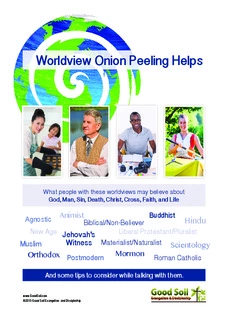
Table Of ContentWorldview Onion Peeling Helps
What people with these worldviews may believe about
God, Man, Sin, Death, Christ, Cross, Faith, and Life
Animist Buddhist
Agnostic Hindu
Biblical/Non-Believer
New Age Liberal Protestant/Pluralist
Jehovah’s
Muslim Witness Materialist/Naturalist
Scientology
Orthodox Mormon
Postmodern Roman Catholic
And some tips to consider while talking with them.
www.GoodSoil.com
©2015 Good Soil Evangelism and Discipleship
One page/worldview? Is this all there is?
Yep. First of all, you need to know that there are already a lot of good hints in the Worldview Persona
cards used in the seminar, so this material should be used in conjunction with the helps already on the
persona cards, available at www.GoodSoil.com/resources
Also, this in no way should be considered the definitive research on any one of these worldviews. There
is a lot of material out there on all of them. If your host culture has a worldview that is dominant, you
should research that worldview more extensively. This is intended to give general helps for all the
worldviews.
Where did this come from?
Research was done
• On the internet
• In books
• In interviewing missionaries and using from some of their research who work predominantly with
a particular worldview.
At the end of each worldview page a short list of helpful books/sites are given.
Significant books read in preparation of this material that should be part of anyone’s library who is
serious about peeling worldview onions:
Evangelism Made Slightly Less Difficult, Nick Pollard, Inter Varsity Press, 1997.
The Gospel in a Pluralist Society, Lesslie Newbigin, Eerdmans, 1989.
The Open Secret, Lesslie Newbegin, Eerdmans, 1995.
Understanding World Religions, Irving Hexham, Harper Collins, 2014.
Missionaries interviewed and/or who contributed according to the dominant worldview on their re-
spective fields: Scott Carter, Harry Gebert, George King, Dale Marshfield, John Morgan, Jim Ruff, Jane
Schmitz, Fred Seiferth, Jack Shiflett, Gil Thomas.
We encourage you to never stop researching the dominant worldview in your host culture.
How do I use it?
The first part of each page gives a brief synopsis of what one with that particular worldview would
believe about the eight concepts we consider the Eight Essential Truths of the Gospel. Of necessity, this
is very brief, but it at least gives one an idea of how they differ in belief from one who believes in Jesus
Christ as personal savior from sin. What we believe about these eight Gospel concepts can be found in
The Story of Hope, pages 32-39.
The second section gives a couple hints as to how to converse with someone from this worldview as
you try to “peel their worldview onion.” Remember, the worldview persona cards have some other
hints—use these two documents together.
Finally, at the bottom of each page at least one or two resources are given where you can get more help
on a particular worldview.
Have fun peeling onions!
2
Worldview Onion Peeling Helps – Agnostic
What They Believe
God – Does not believe or disbelieve in God; the agnostic be-
lieves that we cannot know whether or not God exists.
Man – Agnosticism comes in at least two versions: hard and
soft. The hard agnostic would say that one cannot know
anything for sure. Therefore, an agnostic can’t know anything
about anything, including each of these propositions.
Sin – Most would be aware of evil in the world, but without
a solid belief in the Bible, neither the origin nor the conse-
quence of this evil can be known.
Death – Again, agnostics are aware of death, but would have
no authoritative document which could tell her what happens
after death.
Christ – Without a god or any way for this non-being to com-
municate to mankind, there would be no existence of or
reason to believe in a redeemer from sin which we don’t know
why exists or what the results of it may be.
Cross – Therefore, the cross would have no purpose other
than being a cruel, merciless judgment employed by the Ro-
mans centuries ago.
Faith – Agnosticism is simply a set of tenets and not a religion. Therefore, faith is unnecessary.
Life – As with God, life after death—eternal life—is unknowable.
Conversation hints that could break through levels as you carefully peel an agnostic’s
worldview onion:
If someone appears to be “looking for a fight” it may be better to move on to someone else and only
come back to him when he is truly seeking or facing a crisis that opens him up.
While praying that God will help him realize his need for Christ, we can talk in natural conversations
about how God gives us peace, or helps us in certain situations, which may create curiosity in an agnos-
tic about his principal question: Can we really know there is a God? Apparently his friend (that’s you!),
has a relationship with Him! Developing a sincere relationship with our agnostic friends can open their
minds and hearts to the possibility of God.
Helpful Books and/or Sites:
Christian Apologetics and Research Ministry (CARM): http://carm.org/what-is-agnosticism
Ray Comfort has a series of interesting films (available on youtube.com) with people on the street using
logic to try to show them that agnosticism/atheism doesn’t make sense which may give ideas for dealing
with them, but know this: Ray Comfort’s talent may be difficult to reproduce by the average Christian.
3
Worldview Onion Peeling Helps – Animist
What They Believe
God – Normally their concept of a Creator God is that He is
distant, impersonal, and works slower than Satan, so working
through Satan or with a sorcerer is preferred. A loving, holy
God is inconceivable. The spirit world controls all and is to be
feared.
Man – Man is considered the center of the universe.
Sin – Offending traditional customs which everyone follows is
“sin” (Many times the word does not exist.), or ruinous. “Get-
ting caught” is wrong, not breaking some moral standard. Sins
are socially defined. [i.e. adultery (don’t get caught!) could be
considered wrong while fornication would not.]
Death – Death is the passage to the spirit world and is not
necessarily judgment for sin. Passing to be with their dead an-
cestors may be more appealing than living with God forever.
Christ – With a lack of understanding of sin, there is no need
of a Savior. Mediators are used to settle differences, so use of
this term for Christ may be helpful in illustrating reconciliation.
Cross – One animistic group (the Kabiye in Togo) have a term,
nuu yabu, which means to have one’s head purchased and may have come from times when slavery
was rampant. This type of substitution, when found in a culture, may be able to be used in referring to
Christ’s substitutionary death on the cross.
Faith – Words for faith, though existent, may be foreign, difficult to understand, and need explanation
in animistic cultures (as in the Kabiye). Care should be taken to find and use words that clearly convey
the concept of belief and transfer of trust from self to another.
Life – Animistic groups may lack this concept, having focused on the spirit world (which includes their
ancestors) which actively participates in the destiny of the living.
Conversation hints that could break through levels as you carefully peel the worldview
onion of a non-believer with a biblical worldview:
Remember that the spirit world is considered powerful; the spirits control everything. Try to find out
which spirit(s) is the most important (fearsome) to your friend; which one is she trying to appease? As
you find out these things, look for Bible stories that address the issues she is facing (e.g. If dreams are
an issue, Joseph and Daniel clearly teach that God is the only revealer of dreams; if powerful spirits are
creating fear, other Bible events show how God is greater than all spirits; God created all spirit beings
and is authoritative over those who are rebelling.)
Helpful Books and/or Sites:
Communicating Christ in Animistic Contexts, Gailyn Van Rheenen, Baker Book House, 1991;
Quest for Power, Robert Blaschke, Guardian Books, 2001.
http://www.reference.com/browse/animism
4
Worldview Onion Peeling Helps – Biblical/Non-Believer
What They Believe
God, Man, Sin, Death, Christ, Cross, Faith, Life
– A non-believer who has somewhat of a biblical
worldview (because of growing up hearing the
gospel and/or attending church) may have a va-
riety of views on these essential gospel elements.
That is why peeling the worldview onion is par-
ticularly crucial with these folks. Just knowing the
person was “raised Baptist, or Lutheran, or what-
ever” may give us an idea of where to start, but we
will still need to probe to see what our friend truly
believes about God, man, etc. The fact of the mat-
ter is that our friend’s former religion might teach
that God is all-powerful, for example, but he never
believed that, or something disillusioned him about that last year, for example, and he no longer holds
to that truth. That said, understand that a non-believing person with a biblical worldview could “be-
lieve” basically everything you believe about all these gospel elements, but it is merely an intellectual
assent—there is no faith or trust involved. He could also have a “biblical worldview” and have very little
Bible knowledge.
Conversation hints that could break through levels as you carefully peel a Biblical/Non-
Believer’s worldview onion:
Don’t assume anything! Just because someone grew up Baptist (or in some other Bible-teaching
church) does not mean he knows what the Bible truly teaches nor (more importantly) that he believes
what the Bible teaches. Many people in this category may never have heard or understood the Bible’s
big story and how it all fits together. By asking questions we may uncover this fact and be able to offer
them a way to gain that understanding.
If your friend is struggling with difficult questions (the validity of miracles, God sending people to Hell,
etc.), don’t argue. You might share that you believe the Bible has the answers to these questions and
you’d be glad to do a study or story time with her to discover the answers. If disbelief is a strong issue,
but it is clear to both of you that your friend really does not know the Bible, you might try something
like this: “I understand that you don’t believe in God (or whatever it is she says she doesn’t believe), but
the Bible has so much we can learn about these things. I would encourage you to simply set aside your
unbelief for now—let’s just see what the Bible says—then you can decide for yourself whether you be-
lieve it or not. What do you say?” In this way, the Holy Spirit can use God’s word to change a disbelieving
heart.
Helpful Books and/or Sites:
How to Lead a Seeker Bible Discussion, Rebecca Pippert, Inter Varsity Press, 2003.
5
Worldview Onion Peeling Helps – Buddhist
What They Believe
God – Although a personal, all-powerful God is not taught in
Buddhism, some of the branches of Buddhism see Buddha
himself as a deity who can exhibit supernormal powers. How-
ever, there is no creator; the universe has always existed.
Man – Man is simply a bundle of properties, which when the
body dies, are reincarnated according to pure deeds or evil
deeds done. There is no “self,” no distinction between material
and immaterial parts.
Sin – Sin, self, illness, etc. are not real. This breaks down, how-
ever, when they say that ignorance of one’s true self is sin that
will keep one trapped in the death/rebirth cycle. Suffering is
the true human problem which is brought about by desire.
Death – Many “hells” are stops along the way in the cycle of
rebirth (samsara) until extinction.
Christ – A Christ-like figure, the bodhisattva, delayed entering
into nirvana, returning to the wheel of samara. Buddhism pre-
dates Christianity, but some see Jesus as a bodhisattva, giving
up (sacrificing) his entry into nirvana for the sake of mankind.
Cross – This concept does not exist in Buddhism.
Faith – Although some sects believe that faith is the doorway into paradise; meditation prepares the
mind for enlightenment.
Life – When desire stops, one enters into the ultimate state of existence, nirvana.
Conversation hints that could break through levels as you carefully peel a Buddhist’s
worldview onion:
• Do you think this life is all there is? If you were to die, what would happen to you?
• Although you try to be the best person you can be, is anyone really perfect?
• Why do we feel guilty or ashamed; could it be that we were made to feel that way so that we would
seek an answer to our evil thoughts and desires?
• What did the Buddha teach about desiring things? Didn’t he teach that desires lead to suffering?
What other things did he teach? Can you keep all of his commands?
• Can you tell me a story about what you believe? Would you let me tell you a story from the Bible?
• What would it mean to you if there were a personal God and you could know Him?
• What does Buddhism teach about sacrifice? Do you know that God sent His Son into this world to
die so that you might have life that goes on forever?
Helpful Books and/or Sites:
www.sacred-texts.com
www.khandro.net/deities.htm
6
Worldview Onion Peeling Helps –
Liberal Protestant/Pluralist
What They Believe
God – These folks could believe anything from God
being almighty Trinity as the Bible depicts Him to
being “the Big Guy Upstairs” who has no power.
Man – For many the Bible is symbolic; not a true
account, therefore, characters such as Adam and
Eve are simply stories to teach lessons.
Sin, Death – As above, Adam and Eve are simply
a story; the sin nature is not inherited, nor does
Satan even exist. When a person dies, there is some
way in which he will be rewarded for good and
punished for evil done during his life, how one
shows his faith and lives his life on earth are more
important issues.
Christ – Some believe He came literally to this
earth as a baby and grew to be the perfect God-
Man; others believe His coming was symbolic for
God’s incarnation; while still others would say we
are all sons and daughters and Jesus was exem-
plary, but not God.
Cross, Faith, Life – Beliefs range from all will go to heaven (since God is so loving) to good works will
get you saved, to baptism will save you. Some even see salvation after death as merely symbolic—there
is no real life after death. Therefore, the cross carries little soteriological weight.
Conversation hints that could break through levels as you carefully peel a Liberal Protes-
tant’s worldview onion:
Particularly for people in this situation, asking if they have read the Bible or understand it is important
(even though this can help with nearly everyone). Many liberal Protestants should know the Bible but
don’t and often admit it. Being able to then tell someone, “I have this easy to understand book—kind
of a guide—that helps one get to know the Bible from beginning to end and understand its purpose”
can bring a yes response to, “Would you be interested in going through it with me?” (The Story of Hope is
such a guide.)
Don’t be judgmental about what they believe or don’t believe and don’t let contemporary issues like
abortion or gay rights (which are often important to people with this worldview) get you sidetracked.
Helpful Books and/or Sites:
http://www.beliefnet.com/Faiths/2001/06/What-Liberal-Protestants-Believe.aspx?p=2
7
Worldview Onion Peeling Helps – Hindu
What They Believe
God – Most Hindus don’t understand the creature/Creator
distinction. A Hindu’s hope is to discover that she is god while
a Christian hopes to discover that God exists who can save her
and the world in which she lives. One universal being brought
about the cosmos and entered into everything in it (polythe-
ism).
Man, Sin, Death, Christ, Cross – Humankind is not fallen; at
their core, people are good, they are god.
Human suffering is the result of all that is bad in man—de-
sire. The solution is escaping our material humanness. Atman
(self—not the unique individual identity as Westerners see
self—but the non-particularized, universal, collective self) is
the core of human existence. It has no beginning or end; is
outside of time and space; unchanging. “Those who realize the
Self are . . . free from . . . death.” (The Katha Upanishad)
This self does not need to be redeemed because it is eternal
and good. Though the body will die, self never dies because it
is born over and over again in a new body. Self is realized by
denouncing desire since anger and pain are most often the
result of human desire.
Jesus is respected as a teacher, but without the sin problem or the need for judgment, they cannot see
the need of Jesus as Savior.
Faith, Life – There is really no need for faith. Banishment of desire is what brings immortality.
Conversation hints that could break through levels as you carefully peel a Hindu’s world-
view onion:
One of the missionaries interviewed who has worked for years with Hindus, said, “In my experience, the
evangelization of Hindus requires teaching and connecting more than it does ‘witnessing’ in the North
American sense. We must teach, pray, teach, love, teach, live, teach, pray, and then teach some more.” Be
prepared to discuss differences openly.
Chronological Bible teaching and storying are excellent methods because they expose Hindus to the
creature/Creator distinction immediately. Get involved in their lives and share God’s story with them,
naturally in conversation.
Helpful Books and/or Sites:
“The Eternal Teaching: Hinduism” in Eerdmans Handbook to the Worlds’ Religions, Eerdmans, 1982.
“Understanding the Hindu Worldview,” Dale Marshfield available at www.GoodSoil.com/blog.
8
Worldview Onion Peeling Helps – Jehovah’s Witness
What They Believe
God – Jehovah is the name of God the Father who has many
titles (Almighty, Creator, Lord), but there is no Trinity. Jesus is
the first created and the Holy Spirit is simply an “impersonal
active force.”
Man, Sin, Death, Life – Because of disobedience in the Gar-
den, human beings inherited death and sin. Suffering and
vulnerability to disease accompanied this inheritance.
God allows Satan and his hosts to tempt humans to sin. This is
a test of our faith in God.
When Jesus returns, He will raise the dead, joining dead bod-
ies with their souls. Then all will be judged. Everlasting life (on
a new earth) will be given to those judged righteous. The un-
righteous will simply die, ceasing to exist. There is no torment
in Hell for them.
Christ – Jesus is inferior to God, not part of a Godhead. A created spirit being, God’s only son, He was
sent to Earth as a perfect human.
Cross – When Jesus died, He sacrificed His life, paying the ransom to redeem mankind from sin and
death. The Cross itself is a pagan symbol. Jesus did not die on a cross, but on a punishment stake.
Faith, Life – For salvation, we must demonstrate faith in God and Jesus as Savior and follow the prac-
tices (not observing birthdays and holidays, etc.), requirements, and sacraments of the faith. Fundamen-
tal of the above “practices” is “witnessing.”
Conversation hints that could break through levels as you carefully peel a Jehovah Wit-
ness’s worldview onion:
Since Jehovah’s Witness’ views of contemporary issues (abortion, same-sex marriage) are similar to ours,
one might build rapport here.
Questions one might use to go deeper in the Onion Peeling Process: What are your thoughts on
the Jehovah Witness leadership predicting the end of the world incorrectly? What are your thoughts on
Genesis 1: “God said, ‘Let us make man in our image’?” Who is “us”? Why in Revelation 22 is Jesus saying
“I am the Alpha and the Omega the first and the last” if He is not God?
Helpful Books and/or Sites:
http://www.jw.org/en/jehovahs-witnesses
http://www.beliefnet.com/Faiths/What-Do-Jehovahs-Witnesses-Believe.aspx?p=2
http://christianity.about.com/od/jehovahswitnesses/a/jwbeliefs.htm
9
Worldview Onion Peeling Helps – Materialist/Naturalist
What They Believe
God – They deny the existence of God. Everything
happened (including how the universe came into
being) and happens today as a result of natural
properties and causes. There is no supernatural
explanation. Even for a less philosophical material-
ist, matter is primary; spiritual and mental ideas are
secondary.
Man – Humankind—all the world—came into
existence through natural causes. Something like
evolution—physical on physical—brought every-
thing into being.
Sin – Since the naturalist doesn’t start with God, she has no basis for objective truth or morality. Sin is a
foreign concept.
Death – Since she can only work with what she sees in the physical realm, she cannot take a position on
death. Nothing can be proved.
Christ – With no God and no sin, there is no judgment or need of redemption.
Cross – A materialist/naturalist’s presuppositions will not allow her to believe that Jesus rose from the
dead—even when presented with evidences. The tendency would be to accept by faith that, although
the naturalistic explanation has not yet been found, it will be.
Faith – As stated above, the naturalist may display faith, but it is in her presupposition that nothing ex-
ists or happens outside of the physical world.
Life – Nothing can be known about life after death because it cannot be measured/studied.
Conversation hints that could break through levels as you carefully peel a Materialist’s
worldview onion:
You may ask your naturalist friend to prove naturalism scientifically. (It cannot be done—you can’t
prove that only the natural world exists; that there is no spiritual realm. One has to take it by faith.)
Since that is the case, you could then ask your friend to simply look at the Bible through “different glass-
es;” through the presupposition that God does exist and has chosen to communicate with us. Ask her to
let the Bible speak for itself and then decide. Then you can trust the Spirit to use His word to transform
her thinking.
Helpful Books and/or Sites:
http://en.wikipedia.org/wiki/Naturalism_(philosophy)
http://www.allaboutphilosophy.org/Materialism.htm
http://www.evangelismhelp.com/naturalism/
10
Description:Christian Apologetics and Research Ministry (CARM): http://carm.org/what-is-agnosticism. Ray Comfort has a series of interesting films (available on youtube.com) with people .. es;” through the presupposition that God does exist and has chosen to http://en.wikipedia.org/wiki/Naturalism_(philosop