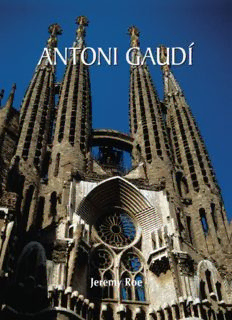
Table Of ContentAuthor: Jeremy Roe
Layout:
Baseline Co. Ltd.
61A-63A Vo Van Tan Street
4th Floor District 3, Ho Chi Minh City
Vietnam
© Confidential Concepts, worldwide, USA © Parkstone Press International,
New York, USA © Catédra Gaudí photographs pp.16-21-31-60-109-110-113-
140
© Eduard Solé photograph p.70
© Luis Gueilburt photograph p.111
Casa Milà, La Pedrera (Barcelona). Thanks to Fundació Caixa Catalunya.
François Devos for all photographs Special thanks to Gaudí Club
ISBN: 978-1-78310-742-1
All media rights reserved worldwide.
Unless otherwise mentioned, all reproductions are the copyright of the
photographers. Despite due diligence, we have been unable to identify copyright
holders in all cases. Anyone with a claim should contact the publisher.
Author: Jeremy Roe
ANTONI
GAUDÍ
CONTENTS
Essential Gaudí
Perspectives on the Life of Antoni Gaudí
Gaudí’s Childhood
Architectural Studies in Barcelona
Gaudí’s Character and Thought
Architecture and Catalan Identity
Religion and Spirituality
Gaudí’s Death and Barcelona’s Tributes to his Life
Gaudí’s Barcelona
Gaudí and the Architecture of his Day
Modernisme
Barcelona: The Growth of a Modern City
Theories of Architecture and the Search for a Modern Style
Architecture and Ideology
Gaudí and the Ideals of the Industrial Age
The Celebration of the Values of Catalonia and Modernity
Preserving Past Values and Practices in the Modern Era
Shops and Streetlamps: Gaudí’s Urban Projects
Transforming Domestic Space
Casa Vicens
El Capricho
Casa de los Botines
Casa Calvet
Bellesguard
Houses for Two Friends and a Painter
Casa Batlló
Casa Milà
Gaudí’s Ecclesiastical Architecture
Early Studies and Altarpieces
First Church Designs
A New Façade for Barcelona’s Cathedral
Two Altarpieces
Representing Ecclesiastical Authority: the Bishop’s Palace, Astorga
A Contemplative Style: College for the Company of St Teresa
The Catholic Missions, Tangier
Two Projects for His Hometown
A Sculptural Installation
Restoring Tradition in Mallorca
Unfinished Projects
The Creative Encounter of Gaudí and Güell
The First Project: a Dragon for a Country House
The Güell Palace
The Güell Colony Crypt
The Güell Park
The Sagrada Familia
Gaudí’s Vision
The Nativity Façade
Working on the Sagrada Familia
In the Shadow of the Cathedral: the Sagrada Familia Schools
Biography
List of Illustrations
1. Park Güell, trencadís mosaïc of the bench.
Essential Gaudí
In order to understand the real significance of Gaudí’s architecture it is necessary
to take into account various factors which influenced his thinking. His family
background, childhood, place of birth and schooling, the historical context of
Catalonia and Spain during his lifetime, his friends and relations, all form the
framework for the very special and very distinct architecture of Antoni Gaudí
Cornet.
However, his personality is hard to capture for various reasons. In the first
place, Gaudí’s shy and retiring nature meant that there are virtually no original
documents in existence that show what he was like. He closely guarded his
privacy, and it is a sancta sanctorum into which the historian should not try to
penetrate, both out of respect and because he lacks sufficient judgement to draw
any definite conclusions.
Hence the numerous fantasies that have been written about Gaudí –
fabrications that are of no historical value despite their appeal to the public, ever
eager for details of the intimate lives of great men regardless of whether or not
they are true. Gaudí’s family background must be taken very much into account,
for the nature of the trade which his father and both his paternal and maternal
grandfathers followed is very revealing. More than five generations of Gaudís
had been coppersmiths, producing the vats for distilling alcohol from the grapes
grown in the Camp de Tarragona.
The spatial aspects of the curved forms of these vats, made of beaten copper
plates, had a considerable influence on Gaudí, as he himself admitted, for they
taught him to visualise bodies in space rather than projected geometrically on to
a single plane. These visions from his childhood and his father’s workshop of
brightly coloured, shining, malleable shapes, sculptural living forms, persisted in
his architecture.
Brought up in a Christian family of artisans and craftsmen, he went to school
at the Piarist college in Reus, where he received a broad-minded and humanistic
education that undoubtedly played and important part in defining his character.
There he met Eduard Toda Güell, who sowed in him the seeds of a love of the
monastery of Poblet and of the history of Catalonia in general.
The town of Reus in the middle of the nineteenth century was a centre of
political, radical and republican agitation. Although Gaudí never left any desire
to play an active part in politics, nor in anything else other than his own
particular form of architecture, it is clear that he caught the strong feelings of
those around him and became deeply concerned about the serious problems from
which the country suffered.
He was a student during the last of the Carlist Wars, and although he never
actually had to take part in any fighting he was mobilised for the entire duration.
When later, while studying architecture in Barcelona, he showed his concern
for the problems of the working classes by collaborating in the design of La
Obrera Mataronense, the first co-operative factory in Spain, he was putting into
practice some of the ideas he had formed during his schooldays in Reus.
Reus and the nearby village of Riudoms, where he spent many summers in a
small cottage that his father owned, both had an influence on Gaudí, not only
through the character of their inhabitants but also through their climate and
landscape.
Dry stony lands, with a special luminosity, where vines, almonds, hazels,
cypresses, carobs, pines and olives grew: lands that could have been set in Lazio
or the Peloponnese; Mediterranean lands par excellence, which Gaudí
considered the ideal place in which to contemplate Nature, for the sun shines
with unusual splendour and falls on the ground at an angle of forty-five degrees,
producing the most perfect light effects. Reality in all its truth and beauty could
be found in the landscape of the Camp de Tarragona under the Mediterranean
sun.
Gaudí considered himself an observer of things in their natural state. His
immense imagination was based only on the capacity to assimilate the reality of
Nature, exquisitely lit and portrayed by the sun of that beautiful region. But we
all know that the sun - including the sun in the Camp de Tarragona-shines for
everyone, but it does not suggest to everyone what it suggested to Gaudí. And
this brings us to a second factor, for Gaudí’s capacity for observation was a
result of his being a sickly child who suffered from rheumatic fever, which
prevented him from joining in the games the other children played. Isolated and
alone, he spent the best part of his time observing Nature, and he realised, with
intelligent perception, that of the infinite number of forms that exist in the world,
some are highly suitable for structures whilst others are highly suitable for
decoration.
At the same time he noted that structure and decoration occur simultaneously
in Nature - in plants, rocks and animals - and that Nature creates structural forms
that are both statically perfect and extremely beautiful, and are based merely on
functionality.
The structural part of a tree and the skeleton of a mammal do no more than
strictly conform to the laws of gravity, and hence the laws of mechanics.
The scent and formal beauty of a flower are no more than the mechanisms for
attracting insects and thus ensuring the reproduction of the species. Nature
creates beautifully decorated structures without the slightest intention of creating
works of art.
At this stage we must consider another point in relation to Gaudí’s character.
It has been explained how the concept of structure was formed in his mind from
the beaten copper shapes that his father produced in his workshop. But among
Gaudí’s ancestors there were no architects or even bricklayers. This meant that
he was not burdened with three thousand years of architectural culture, as occurs
in families of architects.
Although the history of architecture has taken many turns, and seemingly very
different styles have followed each other in succession, in actual fact from the
early Egyptians to the present day the architecture of architects has been based
on simple geometry involving lines, two-dimensional figures and regular
polyhedrons combined with spheres, ellipses and circles. This architecture was
always produced from plans - plans which have always been produced with
simple instruments like the compass and set square and from which the masons
have always worked.
Gaudí, however, saw that Nature made to preliminary drawings and appeared
to use none of these instruments for constructing its beautifully decorated
structures. Moreover, Nature, whose field covers all forms of geometry, rarely
uses the most simplified one which is common to the architects of all ages.
Without any architectural preconceptions, but at the same time with great
humility, he considered that there is nothing more logical than that which is
created by Nature, with millions of years of trying out forms until they were
perfected.
He tried, with much thought and reflection, to discover the geometry that
could be used for architectural construction and that, in addition, had been
habitually employed by Nature in plants and animals. His research covered both
plane and solid geometry, but in order to follow more clearly his line of thinking
the two will be dealt with separately here.
It is a well-known fact that the arch, as a development on the lintel rearranged
in voussoirs, was used in the Ancient East and also by the Etruscans, who passed
it on to the Romans. Arches in ancient architecture were basically semicircular,
or else were segmental, elliptical or basket arches.
In Nature, when an arch forms spontaneous – on a mountain eroded by the
wind, or due to rocks falls - it is never semicircular nor any other shape drawn
by architects using a compass.
Natural arches are appreciably parabolic or catenary. Strangely enough, the
catenary arch, which follows the curve formed by a chain suspended freely from
two points, but inverted, and possesses excellent mechanical properties that were
already known by the end of the seventeenth century, was scarcely ever used by
architects, who considered it ugly, influenced as they were by long centuries of
architectural tradition that had accustomed them to shapes drawn with a
compass.
Gaudí on the other hand, thought that if this arch was the most mechanically
perfect and was the one produced spontaneously by Nature, then it must be the
most beautiful because it was the most simple and functional. Simple as regards
its natural formation, but not when drawn with architectonic instruments.
In the stables at the Finca Güell (1884), the waterfall in the garden of the Casa
Vicens (1883), in the blanching room at La Obrera Mataronense (1883), Gaudí
used this type of arch with confidence and with supreme elegance, and he
continued to employ it in his more modern buildings such as Bellesguard (1900),
the Casa Batlló (1904) and La Pedrera (1906). With regard to solid geometry,
he noticed the frequent occurrence in Nature of ruled warped surfaces - that is to
say, curved surfaces generated solely by straight lines.
All natural forms of a fibrous composition, such as a cane, a bone or the
tendons of muscles, will, when they are twisted or warped and the fibres remain
straight, produce so-called ruled warped surfaces. A bundle of sticks dropped on
the floor will form these warped surfaces, and the tents of the North American
Indians are built of poles covered with skins which form ruled warped surfaces.
It was not until the end of the eighteenth century that these warped surfaces
were studied geometrically (mainly by Gaspard Monge), and it was then that
they were given the complicated names of helicoids, hyperbolic paraboloids,
hyperboloids and conoids. The names are difficult, but the geometric forms are
very easy to understand and to produce.
A hyperbolic paraboloid is formed by two straight lines, in different planes,
with a third line sliding continuously along them, thus generating a curved figure
in space which is formed entirely of straight lines.
Hyperbolic paraboloids can be found in mountain passes, between the fingers
of one’s hand, etc. The Indian wigwam referred to earlier is a hyperboloid, as is
the human femur. The shoots on the stalk of a plant grow helicoidally, and the
bark of eucalyptus trees is helicoidal.
Geometry generated by straight lines can be found in all the kingdoms of
Nature (animal, vegetable and mineral) and it produces forms that are
structurally perfect.
Gaudí noticed something else. In Catalonia, a system of construction that has
long been and still is frequently used is one that consists in laying slim bricks so
that only the largest face is visible (the bricks in each course being laid end to
end). This process, using plaster, lime mortar or cement for the joints and
forming surfaces one or two layers thick, is employed for floors, partitions or
walls and also for vaults, which are warped surfaces in space and are known in
Catalan as voltes de maó de pla. To construct these, bricklayers generally use
flexible wooden battents, although sometimes they simply make do with two
rules and a string, and the results can be seen in lofty staircases and ceilings.
Gaudí thought that if one started with two rules on different planes and built
the various courses of the vault following the string running from rule to rule,
Description:Spanish architect and designer, Antoni Gaudí (1852-1926) was an important and influential figure in the history of contemporary Spanish art. His use of colour, application of a range of materials and the introduction of organic forms into his constructions were an innovation in the realm of archite