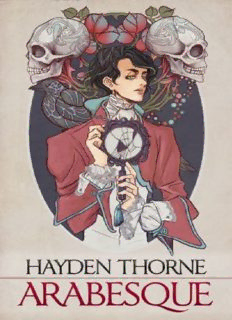
Table Of ContentArabesque
Title Page
Chapter One
Chapter Two
Chapter Three
Chapter Four
Chapter Five
Chapter Six
Chapter Seven
Chapter Eight
Chapter Nine
Chapter Ten
Chapter Eleven
Chapter Twelve
Chapter Thirteen
Chapter Fifteen
Chapter Twenty
Chapter Twenty-One
Epilogue
Arabesque
Hayden Thorne
Smashwords Edition
Copyright 2011 Hayden Thorne
Cover Art by Ms. Rosek
Smashwords Edition, License Notes
This ebook is licensed for your personal enjoyment only. This ebook may not
be re-sold or given away to other people. If you would like to share this book
with another person, please purchase an additional copy for each recipient. If
you're reading this book and did not purchase it, or it was not purchased for your
use only, then please return to Smashwords.com and purchase your own copy.
Thank you for respecting the hard work of this author.
Chapter One
As with most fireside tales, this one begins with magic. It goes back to a time
when a great modern nation was still a cluster of sovereign lands, when gods,
demi-gods, and mortals wandered the earth in a tempestuous relationship marked
by passion, madness, and arbitrary justice, and Nature and Fortune often proved
to be more formidable powers than immortals, who resented and yet feared
them.
In a kingdom somewhere in Western Europe, a magnificent palace was built
on soil rich enough to encourage ambitions of a man-made idyll. As the palace
grew, rising up and expanding sideways, a massive garden suddenly appeared
around it, spreading in all four directions till it nearly dwarfed the palace with
acres of trees and flowering shrubs of every possible variety. The oddest thing
about this was the fact that the palace as well as its protective gardens appeared
and grew day by day without any indication that mortal hands were involved.
Each day, the palace simply appeared larger than it was before, room by room,
floor by floor, its private woodland denser than it was previously. No signs of a
busy army of carpenters, architects, painters, or gardeners were ever noted.
Indeed, no one even heard a single sound throughout the construction process—
hammers, axes, or even voices of busy workmen. All that could be heard were
birds and the breeze whistling through branches.
Peasants all over the kingdom stared in wonder at the rapidly swelling “forest
of enchantment,” asking among themselves, “Why build a grand palace and hide
it behind all this?”
“Mark my words, there’s black magic going on there.”
“The sorcerer-king, you mean? Yes, I’ve heard about him.”
“They say it’s black magic that’s forming this woodland garden of his. Have
you seen people toiling away, hour after hour, planting and watering?”
The consensus was a “no,” which only fueled more speculation among the
hungry and the ignorant, whose fear of the unknown overrode curiosity, and for
better or for worse, they kept their distance from the palace.
They were, of course, quite near to the truth, as they discovered in time. Übel
was the king, though his ascension to the throne seemed rather quiet and
suspicious, for no one had ever heard his name spoken before. The royal family
who ruled this land lived in another region of the kingdom, and they’d remained
largely detached and phantom-like figureheads for generations, with no one
beyond the usual courtiers and ministers clapping eyes on them. When word
spread that they’d decided to move their home to this part of the land, eyebrows
rose, but no one questioned such a curious decision. The old palace was
destroyed—taken down one stone at a time—till nothing was left but the telltale
outline of a great structure in the grass and weeds.
No one outside the court had seen the household move. It seemed as though
one day they were there, and the next, the palace stood empty, to be torn down
by hired men who knew nothing about what was going on save for the coin-
filled purses that had been dropped into their eager, trembling hands.
Before long, Übel was declared king, the palace was built, and the woodland
garden rose around it. The process was quiet, quick, and trouble-free, though
people all over exchanged uneasy whispers, and ministers who served as the link
between the peasantry and the court refused to speak about anything remotely
disparaging of their new king lest they be tried and executed for treason. Pale
and drawn, their figures slouched and tense, their gazes darting here and there or
stealing anxious looks behind them—they were clearly frightened, as though
their steps were shadowed by something that stalked them, but were forced into
secrecy about what truly haunted them. Their silence devoured these pitiful old
men, however, and one by one, ministers died by their own hands, and those left
behind were no wiser than they were before. And those who came after fared no
better, everyone meeting the same end or simply being struck down by
unexpected illnesses.
As time came and went, no one knew what took place in the palace, for
servants were never seen carrying out orders for the royal household’s day-to-
day needs. In the open-air markets and the town squares, no one from the palace
was spotted running around from shop to shop, buying meat from butchers,
ordering new clothes from the best tailors.
“The royal family would have their own butchers, tailors, and bakers,
wouldn’t they?” some folks said, which didn’t settle the doubts that had always
plagued everyone.
“It’s too quiet,” others replied, stealing uneasy glances in the direction of the
palace.
Fifty years passed—fifty years of unchecked disease ravaging the
countryside, fifty years of hunger, fifty years of unrest among the filthy
populace, which often escalated into small riots here and there that could barely
be contained by overworked and underpaid forces led by unhappy sheriffs. All
those years, not a single word was heard from the palace, only indirect orders
handed down through feeble and frightened authority figures who barely kept
the kingdom intact.
When the stench of rotting flesh carried by the winds to the nearby towns
alerted people of something desperately wrong in the royal palace, long-held
suspicions spilled out again among frightened subjects, mobilizing the sheriff of
that county and his men, who braved the shadows of the woodland garden and
broke down the tall, silent doors of a beautiful, glittering palace.
There, they said, they found their dead king. He lay on the floor of what
appeared to be the library, stiff and contorted with eyes open, bulging, and
milky, his lips pulled back in a pained grimace, his fingers curled like wrinkled
claws as his hands scrabbled at the air. He must have been struck down by a
seizure of some kind and quite likely died even before he hit the floor. Oddly, a
looking-glass stood close enough as though Übel had been looking at himself in
the mirror in his final moment.
He—or perhaps something—had also scrawled one word on the mirror’s
dark surface, the brownish color of the letters suggesting dried blood: Virtue.
He apparently lived alone because he didn’t have any need for human help,
whatever his needs being satisfied by unnatural agents he’d most likely
summoned from beyond. Books, scrolls, and all manner of artifacts used in the
dark arts filled practically every space in the palace, while bones—human and
animal alike—were discovered in an underground vault. More recent kills were
found on the grounds, scattered among the trees as though awaiting the
appearance of scavenging beasts to clean out the bones.
“Perhaps he was too old and frail to dispose of the bodies properly,” the
sheriff observed, grimacing in disgust as he covered his nose with a
handkerchief.
Tattered and faded clothes from men and women, young and old, rich and
poor, littered several of the airy, empty apartments. Many bore marks of a
savage killing, with dried blood and bits of shriveled skin still clinging to the
fabric. Clumps of bloodied hair—in various states of dryness—were also found
tucked away in an ornate gold trunk.
“I believe that we’ve just found the royal family and their servants,” one of
the men said as he sifted through the clothes. “And perhaps a few travelers
unlucky enough to wander in this direction.” As to how random strangers were
lured to the palace, no one could say, given its excessive privacy, but no one
certainly doubted the role of black magic in that matter.
The uproar following the ghastly discovery was immense, and it took the
sheriff’s force all they had to keep the populace from storming the cursed palace
and burning it to the ground.
“Do what you will with the body,” the sheriff said before turning around and
spitting on the floor of the palace’s great hall. “If you want justice, damn the
bastard’s soul.”
The people knew how. They took Übel’s stiff, withered body and brought it
to the town square, where it was hacked to pieces before an angry mob, the parts
tossed into a sack. The sack and the remains of the sorcerer-king vanished in the
night, however, and no one knew where it was hidden or buried. Those who
likely knew of its whereabouts said nothing or claimed ignorance, but they
fooled no one. It was a prudent move not to divulge the truth, for the grave,
wherever it might be, could very well be vandalized within hours. Superstitious
folk exchanged theories about Übel being buried in a forest near the
southwestern borders of the kingdom.
“It’s a proper place for the old bastard.”
“No one goes to that old forest—too dangerous. If he’s buried there, it’ll be
worse.”
“Let him lie there, unconsecrated,” some cried, waving their fists in the air.
“Let him be damned!”
The royal bloodline was at first rumored to be broken, but historians and
genealogists were quickly set to work to find their next king, no matter how
remote, and at length, they found their successor. This new king, drunk with
ambition, adored the cursed palace enough to refuse to have it razed to the
ground in a holy cleansing ritual, instead turning to folk magic to rid if of all
unnatural elements. Practitioners of white magic were summoned, offerings to
the gods were made simultaneously, and before long, the palace was declared
safe and livable. It was cleaned out, modified, and made accessible to ministers
and visiting nobility, the surrounding woodland garden also purged of its evil
associations before being reshaped into a sprawling and enchanting retreat,
which enjoyed further modifications and enhancements with every generation of
the royal bloodline.
The kingdom settled down into a relatively peaceful state, the legend of the
sorcerer-king blurring as it was passed from storyteller to storyteller. In time, all
that was known about Übel was the fact that he’d murdered to keep his powers
alive, but even black magic couldn’t protect him from death. That he was a
condemned soul was a given, but the circumstances behind his death and his
burial varied. The forest where he was rumored to be buried turned evil, it was
said, where nothing but shadows and madness awaited foolish wanderers who
set foot within its leafy borders.
*
Hours turned into days, weeks, months, years, decades, a century and then
two…
Europe grew more and more restless, with immortals and men locked into
battles of wills with each other, at times engaged in outright challenges and
quarrels. Magic remained the weapon of choice for mortals who were
determined to raise themselves above the mediocre majority, and while they
remained helpless in wielding it against the gods, they’d no compunction at all in
using it against each other. While most practitioners of magic were prudent
enough to understand and be fearful of their powers’ capacity for destruction if
unchecked, thus limiting their services to healing, protecting, and purging
unwanted forces from individuals, groups, households, and even livestock, there
were those few who feared nothing and whose boldness was fed even more by
the enormity of the very fact that they held so much power. A few chanted
words, a finger pointed at a target, or a hand moving in a prescribed pattern—
one or a combination of those could easily destroy a portion of Nature’s fabric if
enough malice were poured into it.
Two young princesses from a tiny and inconsequential kingdom by the
restless seas understood that well enough.
Fourteen-year-old Amara scowled at her older sister as she shivered in the
dark, holding a candle aloft and waiting for Ulrike to finish throwing on a heavy
cloak and stepping into fur-lined slippers before fumbling around her wardrobe
for her small leather and gold chest, which housed a very precious book. With a
small exclamation of excitement, Ulrike carried the chest to her bed, unlocking it
with a murmured chant and pulled out her book—a large tome of old discolored
leather with strange characters carved into the cover in discolored gold. Amara
had caught a glimpse of the book but was completely forbidden from examining
it, for it was meant for Ulrike and Ulrike only, the older princess being its sole
user. The chest couldn’t be opened by any means other than through that
murmured chant, which Ulrike had long mastered and which Amara, for all her
curiosity, refused to learn.
“You’re playing a dangerous game, Sister,” Amara whispered, anxiety taking
hold of her when she saw her breath fog. A significant drop in the room’s
temperature, which was always marked by fogged breaths, alerted her to the
arrival—or the awakening—of Ulrike’s “tutors.”
“Hush, be quiet! Idiot! Do you want Mama or Papa to hear us?” Ulrike shot
back, her shadowy figure in the girls’ shared bedroom barely visible despite the
bit of light coming from Amara’s candle. Along with the iciness came the
thickening of the darkness around them—an unnatural deepness of the night that
made Amara’s skin crawl.
“You can’t control this even after you master everything! You know you
can’t!”
“It’s all a matter of taking the trouble to practice till you get it perfectly. It’s
just like any other lesson.”
“And how do you know that you’re doing it correctly?”
Ulrike had gathered her things by now and stood before Amara, who’d just
moved to block her way to the door. “Get out of my way,” she hissed.
“Any idiot knows that dark magic kills its wielder—drives him mad if he
doesn’t die first.”
“Do I look mad to you?”
“You don’t have to look the part to be it.”
Ulrike giggled, her voice soft and sounding like a faint chorus of several
whispering people. “You’re clever. I’ll give you that.”
“I don’t know you anymore. You—you’re cold and vicious—inhuman. Your
powers have changed you, Ulrike, but I know there’s hope. You can still stop
this, and I’ll help you. I can’t let you go on.” Amara set her mouth in a grim line
as she pressed her back against the door, moving her feet apart in an additional
show of defiance.
Ulrike’s look of irritation gave way to one of amused contempt. “By the
gods,” she whispered, drawing herself up as tall as she could, which wasn’t a
difficult thing to do since she was a good head taller than her younger sister.
That everyone in court marked her for a successful marriage to a great king was
certainly testament enough to the influence that her beauty and majestic bearing
on those who laid eyes on her. “You’re a determined little imp, aren’t you?”
“Ulrike, listen to me—what you’re doing is dangerous! Why can’t you learn
simple enchantment instead?”
“What you call dark magic, Sister, is more powerful than ‘simple
enchantment,’ and anyone who fears it is clearly not suited to learning its secrets
and mastering its power. Unlike you, you vile little coward, I’ve made plans for
my future, and I never compromise. Never.” Ulrike’s smile twisted into a sneer.
“And no one stands in my way. Not even you.”
Amara watched her sister raise a hand, palm facing out and aimed at her. She
swallowed but didn’t move an inch. “No,” she said, her low voice trembling. “I
won’t let you destroy yourself. You’re stronger than this. I know that you’re
capable of turning this around—maybe even using it for good.”
“And how did you suddenly become a mistress of the dark arts?”
“I’ve read up on it and—and asked Mistress Alda for—”
Ulrike let out a sound of annoyance and disgust. “Mistress Alda, the town
witch? Well, I suppose I can’t accuse you of speaking without knowledge.” Her
mouth curled in a sneer.
Amara shook her head. “She said that if your will’s strong enough, you can
still subvert your powers and use them for good.”
“And if I don’t, hmm? I go mad. Is that it? I’m well aware of being able to
turn my powers around, Fool, but why would I do that? What reason can you
give me for taking a gift and twisting its purpose? It sounds like the last resort of
the desperate and the feeble.”
“The time will come, maybe, when you find yourself making that choice
because you’ve got nothing else left.” Amara took a deep breath. “I won’t let
you get that far.”
Ulrike shrugged, her hand still raised. “Oh, fine. Don’t blame me, then.”
With a gasp, Amara felt her breath wrung out of her lungs, as though an
invisible, giant hand just took her in its grip and squeezed hard. She dropped her
candle as she clawed frantically at her neck, the air, and when she collapsed on
the floor, writhing and gasping, the cold wood beneath her.
“I warned you, didn’t I? Stupid bitch.”
Ulrike moved quickly, stepping over her choking sister and moving through
the door without a second’s hesitation. Once the door shut behind her, the spell
broke, and Amara wheezed and coughed as she struggled to fill her lungs with
air. Tears squeezed out of her eyes at the horrific pain in her chest, and she could
barely see the vague outlines of the bedroom furniture and the candle that lay on
the floor beyond her reach. It took her several moments to breathe normally
again, and when she did, it was all she could do to crawl to her bed, use it to
raise herself up on weak and trembling legs, and then burrow under the blankets.
It was past midnight. Ulrike’s lessons would take another two hours, and
then the chill would vanish, the night resuming its normal cloak of darkness.
In the meantime, Ulrike sat in the family vault, specifically in an old and
unoccupied chamber that had been marked for her parents’ future interment. She
needed no light to guide her steps there, for she could easily see in the dark with
a few whispered words of magic.
On the cold stone floor she sat, not at all feeling the bone-numbing iciness of
the subterranean crypts. She was protected by her tutors, after all. And like a
dedicated, immensely talented scholar, she sat with her back straight and her
head bowed, the hood of her cloak covering everything save her mouth and chin.
Like a dark ghost she sat still and read the black pages of the ancient book she’d
spread on her lap. Murmuring in the dark, she read that night’s lessons as they
appeared in fiery text across each page, glowing red and casting an eerie glow on
her marble-like features.
A low, hollow voice interrupted her reading every so often, and Ulrike
glanced up to stare at the wall before her—at the shadowy forms of predecessors
who’d also learned the same dark arts, flitting across the weathered, slimy stone,
encouraging her with voices from beyond the grave.
They were her tutors, anyway, all bound together as one entity, there to guide
anyone from a future generation who’d dare attempt those terrifying lessons.
From what Ulrike had discovered, there were half a dozen of her ancestors who
practiced black magic, and while none suffered death by execution, she also
knew that they all succumbed to the soul and mind-eating power of the dark arts.
She’d learned about them through dusty records kept in the royal family’s
library—old and abandoned tomes that were never destroyed, perhaps kept
around as a means of remembering the past, or as Amara would likely refer to it,
the sins of the past. Of course, there was also the possibility that they were kept
in case someone down the line decided to dabble in black magic—a ghastly
legacy that seemed to be made specifically for the royal family’s bloodline.
Inserted between the pages of one of those books were torn sheets of paper in
an ancient tongue, which Ulrike rightly guessed to be some kind of spell that
began her lessons by making her book appear on her lap after she spoke those
old, old words several times over. From there on, the spirits of her ancestors took
her on, instructing her where to go and at what time, and Ulrike gladly obeyed.
But Ulrike wasn’t like any of her ancestors, though. She’d decided to learn
these forbidden lessons with a very pragmatic turn of mind. She had her
ambitions, all of which coincided nicely with what the court had long been
saying about her: a successful marriage to a great king, a long and magnificent
reign marked by prosperity and peace, a beautiful and strong family.
I need a bit of help to get there, she’d written in her journal. Unlike other
princesses who prefer to sit around, look pretty, and wait for a champion to
come along, I’d rather take matters in my own hands and see to it that my
ambitions bear fruit. Luck is a joke. Free will isn’t.
She was sixteen then, having begun her midnight lessons on her birthday,
and she proved to be a quick learner. Just after she turned eighteen, she was
married to the king of a land far, far greater than hers, and he whisked her off to
his grand palace and its magnificent pleasure garden.
Ulrike laughed, her giddy, girlish voice reverberating through the trees as she
ran past them, following one pretty lane after another. “I’m here!” she cried,
throwing her head back as she lifted her skirts, somehow managing to run in