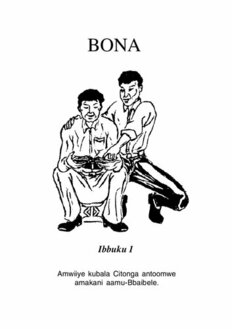
Table Of ContentBONA
Ibbuku 1
Amwiiye kubala Citonga antoomwe
amakani aamu-Bbaibele.
Mbokulembwa mabala masyoonto:
¼ i l m y u
k b o e s j
t w n d z c
¨ g p v f r h
Tonga language, Zambia
Aya mabbuku BONA alajanwa kuzwa ku:-
Baptist Publishing House
P.O. Box 31995
Lusaka, Zambia
Choma Bookroom
Box 198
CHOMA
Kwiindulula zibeela zyamajwi mubbuku 1 sicikolo ulaloolola
lyoonse.
a i u o e
la li lu lo le
ma mi mu mo me
ya yi yu yo ye
ba bi bu bo be
ka ki ku ko ke
sa si su so se
ja ji ju jo je
mba mbi mbu mbo mbe
ta ti tu to te
wa wi wu wo we
na ni nu no ne
mwa mwi mwe
nda ndi ndu ndo nde
za zi zu zo ze
ca ci cu co ce
.a .i .u .o .e
kwa kwi kwe
pa pi pu po pe
nga ngi ngu ngo nge
da di du do de
nka nki nku nko nke
nkwa nkwi nkwe
nta nti ntu nto nte
zya zyi zyu zyo zye
va vi vu vo ve
PRINTED BY BAPTIST PRINTING MINISTRY, LUSAKA, ZAMBIA
Lukumbo lwa-Mwami
A a
Taateesu ooli kujulu, B b
alilemekwe izina lyako,
C c
Abuze Bwami bwako,
D d
Alucitwe luyando lwako,
E e
Ansi ano mbubonya mbuli kujulu,
F f
Utupe sunu zilyo nzitubula,
G g
Utulekelele milandu yesu, mbubonya
H h
mbuli mbutubalekelede aswe bali
amilandu kulindiswe, I i
Utatweenzyi mukutepaulwa,
J j
Utuvune kumubi,
K k
Nkaambo Bwami mbubwako, anguzu
L l
abulemu, mane, kukabe
M m
kutamani. Ameni.
N n
Matayo 6:9-13 / .
O o
P p
R r
S s
T t
U u
V v
W w
Y y
Z z
BONA
Lyakalembwa a: T. Hamuka.andu
L. Hamaseele
M. Heisey
M.O. Lady
R. Rice
Sikucita zikozyano: Mwiindi Mwaanga
Ibbuku 1, Ziiyo 1-30
1. a, i, l, m, y 11. s 21. .
2. u 12. j, J, ee 22. kw
3. -- 13. mb 23. p
4. b, aa 14. t 24. ng
5. -- 15. w 25. d
6. k 16. n, uu 26. Mabala Mapati
7. -- 17. mw, ii 27. nk, nkw
8. o, oo 18. nd 28. nt
9. e 19. z 29. zy, v
10. -- 20. c 30. --
Published by
Brethren in Christ Church
Box 131, CHOMA
Copyright © 1984, Literacy International
All Rights Reserved.
1800 S. Jackson Ave., Tulsa OK 74107, USA
BUKANZE
Muntu mupati uukonzya kubala akulemba ndubono kucisi
cakwe akumbungano.
Muntu mupati uubala ulakonzya kubala akusumpula
milawo yacisi cakwe. Akumvwisya kupati ulakonzya kugwasya
cisi cakwe abasololi baco.
Muntu mupati uubala inga waba musyomi uuli anguzu
kwiinda mukubala ijwi lya-Leza. Ulakonzya kugwasya
mweembenzi abamwi basimbungano anoobala Bbaibele
mukamwini.
IBbaibele lyaamba kuti: “Kukusaanguna ndiyandisya kuti
kucitilwe bantu boonse zikombyo ankumbilizyo ankombelezyo
akulumba. Amukombele bami abaabo boonse bali mubwami, kuti
buumi bwesu bube bwaluumuno akutontola, tukale kabotu
akulemeka Leza. Eci ncibotu akutambulika kuli-Leza Mufutuli
wesu, uuyandisya kuti bantu boonse bafutulwe akuboola kuluzibo
lwakuziba lusinizyo.” (1 Timoteo 2:1-4)
Atugwasyanye umwi aumwi kubala akulemba. Mu-Kristo
oonse uukonzya kubala uelede kwiisya omwe wabantu
batakonzyi kubala. Omwe ayiisye omwe, alimwi akugwasya
boonse kubala. Mu-Kristo oonse uelede kubala Bbaibele lyoonse.
2
BULUNGULUZI
BONA mabbuku aayiisya mu-Kristo kubala Bbaibele
lyakwe. Mu-Kristo ulayumizigwa kwiisya boonse mu-Kristo auutali
mu-Kristo basimukobonyina mbuli mbokubalwa amabbuku aaya.
Kuli mabbuku obile aajisi ziiyo zili 69. Twaambo twamu-
Bbaibele tutalikila muciiyo 12 citalika kwaamba ijwi lya-Jesu.
Manamba, nsamusi akulemba lugwalo kulayiisigwa
muziiyo 49 a 50, makani aamu-Bbaibele mafwaafwi kuzwa mu-
Cizuminano Cipya ali muziiyo 51 kusikila ku-69. Mwiiyi uelede
kutobela Malailile Akwiisya kwiisya kabotu ziiyo eezi.
Milao Yakwiisya Kabotu
1. Ukanane mulubomba.
2. Ukanane kusyoonto mbuli nkokonzya.
3. Lyoonse komuyumya sicikolo wako.
4. Utaambi kuti “Peepe, eco taciluzi.”
5. Ulitesye, utondezye lulemeko kulisicikolo wako.
6. Utaseki kukulubizya kwakwe.
7. Muyande sicikolo wako akumwaambila kuti uli masimpe kuti
ulakonzya kwiiya cakufwambaana.
Langisya: Kutegwa ukonzye kwiisya cakuzwidilila, uleelede
kutobela nzila yakwiisya amalailile mbuli mbwapedwe kutobela.
Muntu uuisya ziiyo eezi takonzyi kwiisya kabotu katabali akucita
“Mwiiyi ncaamba” mbuli mbokwiisigwa mukabbuku kaitwa
Malailile Akwiisya. Mwiiyi uleelede kubala akulibambila kwiisya
ciiyo aciiyo katanaswaana asicikolo wakwe. Koyiisya
kweendelana antaamu zyosanwe.
Kobeleka - Kokomba - Akupa Bumboni
3
TEACHING GUIDE
HOW TO TEACH AND WITNESS
A. HOW TO WITNESS
I. Preparing to witness
II. What the Christian says
B. HOW TO TEACH
I. Preparing to teach
II. Pre-reading exercises
III. How to teach reading
IV. How to teach manuscript writing
V. Capital letters
VI. Homework
CONCLUSION
Every literacy lesson includes three main parts: reading, writing, and
witnessing. All of these parts are important for the new reader to be able to
learn well.
A. HOW TO WITNESS
I. Preparing to witness
The main purpose of the literacy ministry is to teach students to read the
Bible, and so strengthen their spiritual lives and witness potential in the church.
The teacher must prepare for his opportunity to witness with each lesson. As you
help your student read, you may eventually uncover deeper spiritual needs. The
teacher should be a friend to the student. Beginning or ending the class with
Scripture and prayer opens a door to witness. The dedicated teacher will prepare
himself through prayer before each meeting with his student(s).
The testimony of the teacher after each lesson is the most important part
of the lesson. There is a Bible reference on the second page of every lesson.
The teacher may read this Bible reference to his student(s) at the close of each
lesson; or he may choose his own reference from one of the Gospels or other
Scripture. Beginning with Lesson 12, the name Jesus is introduced, and in the
reading section of each following lesson there is Bible content. The teacher must
be ready at any time to hold Jesus up for the student to see Him and respond.
4
Jesus said, “I, if I be lifted up (on the cross) will draw all men unto Myself.” Your
service of teaching, without witness, is inadequate. Witness, without service, often
fails to convince. But prayer, loving service, and witness — these three together
— give us our best opportunity to win many to Jesus Christ.
From the beginning of the lesson, help the student feel at ease and relaxed.
He will then be rested at the end of the lesson and ready for the teacher’s witness.
For presenting the Gospel in literacy missions, the following method is useful.
II. What the Christian says
If you are teaching prayerfully and with Christ’s love, the student may be
asking himself a silent question: “Why is my teacher so good to me? What makes
him so kind?” The teacher asks this question at the end of the first lesson: “Do
you know why Christians teach people to read?” Then the teacher says: “We do
this because Jesus wants us to. Jesus is our leader and friend, the kindest person
who ever lived. He healed the sick, fed the hungry, and opened the eyes of the
blind . . . But more than this, He loved me enough to suffer and die for my sins,
and for yours, too. Jesus died as God’s only sacrifice for the sins of everyone.
Then God raised Jesus from the dead, and Jesus lives today with His Father in
Heaven. If you have darkness in your heart, Jesus can send God’s light to take
away the darkness. If you have fear or trouble in your heart, Jesus can send
God’s peace to take away your fears and troubles. He can forgive our sins and
bring God’s love into our hearts. Jesus sends God’s Holy Spirit to all who love
and obey Him . . . I want you to know Him and learn to read His story in the
Bible. Jesus is my Savior and He can be your Savior too.”
Through your friendly teaching you are earning the opportunity to speak
to your student about Christ. Being a friend to your student so that he trusts you
opens a way from your friendship to the friendship and saving grace of Jesus
Christ.
After teaching the second lesson, again with praise and encouragement,
you are ready for the second witness. If you would rather read than tell it, you
can say:
“I told you about the wonderful love of Jesus, Who died for us and now
lives for us. Let me read to you one of the wonderful stories of Jesus in the Bible.
People who cannot read are blind to what is in books. But as soon as you finish
these lessons you will be able to read the stories by yourself. This story is about a
man born blind . . .” (John 9:1-7, 35-41).
The witness of the teacher after each lesson should be short — only a
few minutes at most. As his witness, the teacher reads the Bible reference (on
the second page of each lesson) to his student(s) at the close of each lesson. Or,
5
he may choose to read a different reference from one of the Gospels or other
Scripture. Answer any questions your student may ask. Listen to the Holy Spirit,
Who can lead you to say what you should say, and Who can keep you from
saying what you should not say.
B. HOW TO TEACH
I. Preparing to teach
Before teaching your student, tell him that you expect him to teach at
least one other person to read, as soon as he has learned to read. Just as your
student has freely received help, he should be willing to help one other person
learn to read.
Teaching adults is very different from teaching children. The adult comes
to learn of his own free will. He is not forced to come. Many adults fear that they
cannot learn and that they will be embarrassed by their failure. But adults want to
learn, as fast and as easily as possible. With this in mind, we have the adult
student begin reading from the first lesson. You do not want to offend your student.
You want him to return for more teaching. Therefore, carefully practice the
following:
1. Speak quietly. Be courteous and respectful.
2. Always encourage your student. Do not forget to praise him often for his
good effort. Never become angry at his mistakes.
3. Keep humble, showing honor to your student. Treat him as an equal:
never appear superior.
4. Never laugh at mistakes or allow others to laugh. Do not make the student
work too hard, nor let him think he is learning too slowly.
5. Love your student and tell him you are sure he can learn quickly. Make
the study as happy and interesting as possible.
6. When you are unable to teach, either find a substitute teacher or plan
with your student well in advance to teach him at another time.
As you teach, remember these important points:
1. Say as little as possible.
2. Never say, “No, that is wrong,” or “Don’t you know that?” Try to help
him find the correct answer by himself. Only if necessary, tell it to him.
3. Ask only questions your student should be able to answer. Do not ask the
student what he has not yet been taught. With every right answer, he
builds his confidence.
6