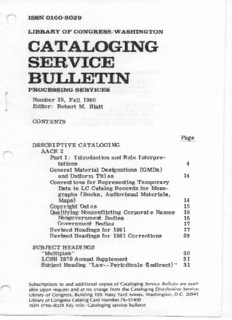
Table Of Content/"4 ISSN 0160-8029
LIBRARY OF CONGRESS/WASHINGTON
CATALOGING
SERVICE
BULLETIN
PROCESSING SERVICES
.+
Number 10, Fall 1980
Editor: Robert M. Hiatt
I*
CONTENTS
Page
DESCRI PTIVE CATALOG1N G
AACR 2
,-
Part I: Introduction and Rule Interpre-
tations
General Material Designations (GMDS)
and Uniform Tit1 es
Convent ions for Representing Temporary
Data in LC Catalog R.ecords for Mono-
,
graphs (~ooksA udiovisual Materials,
Maps)
Copyright Dat es
Qualifying Nonconflicting Corporat e Names
Nangovernment Rodies
Government Bodies
R,evised Headings for 198 1
Revised Headings for 198 1 Corrections
SUBJECT HEAD1 NGS
'' Multiples " 30
LCSH 1979 Annual Supplement 31
Subject Heading "Law- - Periodicals (Indirect ) " 3 1
-
Subscriptions to and additional copies, of Cataloging Service Bulletin are avail-
able upon request and at no charge from the Cataloging Distribution Service,
Library of Congress, Building 159, NaVy Yard Annex, Washington, D.C. 20541
Library of Congress Catalog Card Number 78-51400
ISSN 0160-8029 Key title: Cataloging service bulletin
CONTENTS (Cont 'd) Page
LCSH 9: Correction of Errors in the Freefloat
Removal Program 31
Library of Congress Subject Headings in Micro-
form 32
PUBLICATIONS
Early Printed Books
LCSH, Mfcrofiche Edition
Library of Congress Filing Rules
MARC Formats for Bibliographic Data
-
Cataloging Service Bulletin, No. 10 / Fall 1980
NOTICE
It is with regret that the Library of Congress must announce that
beginning with issue number 11, Winter 1981, Cataloging Service Bulletin
will become available only on a subscription basis at a single-copy cost
of $10.00 annually for the four quarterly issues. Although distributed
cost-free since its inception, rising production and distribution costs
coupled with postal rate increases necessitate this change. Multiple
subscriptions will also be available for copies mailed to the same address
at the following rates:
.......................
Package of five (5) ....................... $14.00/package
Package of ten (10) .................. $17.00/package
Twenty-five (25) or more $ 1.00 each
Current subscribers to the bulletin will be receiving an annual renewal
n notice from the Cataloging Distribution Service in the fall of 1980 that
will provide details about the payment and subscription procedure.
n
Cataloging Service Bulletin, No. 10 / Fall 1980
DESCRI PTIVE CATALOG1N G
Part I : Introduction and Rule Internretati ons
The ISBD(G) on which all of Part I is based insures unifor-
mity within AACR 2 for all types of library materials. There is provision
for new types of materials, however, in the assignment of chapter num-
bers, those for 14-19 being omitted. Moreover, the general rules in
chapter 1 express principles that may be used as the basis for catalog-
ing all kinds of library materials. The ISBD(G) as a framework is re-
flected in the organization of the rules.
Chapter 1 contains all the rules generally applicable to all
the types of materials covered in chapters 2-12. Normally these rules
are not restated in the individual chapter for the particular types of .
library materials. The individual chapters contain further specific
rulings and details applicable only to the type of material covered in .
the particular chapter. All catalogers will therefore use chapter 1, the
general chapter, in conjunction with the specific chapter for a particu-
lar type of material.
The choice of the particular chapter applicable to the item
is determined by a "cardinal principle" in 0.24: "the'description of a
physical item should be based in the first instance on the chapter deal-
ing with the class of materials to which that item belongs," that is,
the description is based on the physical form of the piece in hand, not
an earlier manifestation in a different medium. As an example, for a
reproduction of the text and illustrations of a printed publication in
a filmstrip, use chapter 8, "Graphic Materials," not chapter 2, "Books,
Pamphlets, and Printed Sheets. " Exceptional treatment for serials
(chapter 12) includes "serial publications of all kinds and in all media"
(cf. 12.OA). The rules in chapter 12, therefore, refer to the appro-
priate chapters for specific rules that vary according to the type of
material. For example, in the rules for the physical description area,
rule 12.5C refers to "rule 5C in the chapter dealing with the type of
material to which the serial belongs." Therefore, 11.5C is the rule
for a serial in microform; 7.5C for a serial motion picture or video-
recording, etc. Similarly, the rule for the chief source of information
for nonprinted serials refers to the appropriate chapter (cf. 12.0~2).
Items made up of several types of material, with no one pre-
dominant type, may require the use of more than one individual chapter
(cf. 1.10~). Kits, for example, require a combination of chapters.
CHAPTERS 1-2
The schematic illustrations show specific data elements for
the first and second levels, while for the third level there is only a
statement that all applicable elements would be included in the descrip-
tion. It is neither possible nor desirable for items to be cataloged
strictly according to the schemas. The only absolute requirement about
them is the fact that one may not fall below the first level and still
claim to be applying AACR 2. The greatest difficulty, if one reads the
schemas instead as absolute requirements, would lie in distinguishing
--
second from third level cataloging since the extensive list of ele-
ments in the second level schema frequently would constitute all the
elements applicable to the item. Lib2ary of Congress records will
usually be at the second level although the implementation of certain
options automatically means that the third level has been achieved. The
Library of Congress will produce,no records exactly at the first level.
4 Cataloging Service Bulletin, No. 10 / Fall 1980
For serials, however, it has been suggested that the records will gen-
erally be at the first level augmented principally as follows.
GMD (when required by the options decision)
Parallel title(s)
First statement of responsibility (always, no matter
what the choice of main entry heading)
First place of publ.ic ation, with first publisher,
distributor, etc
Other physical details; dimensions
Series
Subseries
Only the subrule "Single part items" applies to serials. Note
that it is the first issue published (not "first issues published") that
is the basis for the description (cf. 12.0~1)a~nd this first issue is
then a "single part item." h he subrule "Multipart items" is not appli-
cable to serials also because the glossary deeinition of "multipart item"
excludes serials.)
Note that the second paragraph of this rule includes a pro-
vision for transposing data to their proper positions. For example, if
a title proper appears following a subtitle in the source, transpose the
title proper to the first position in the title and statement of respon-
sibility area (cf. also the schemas in 1.0~). Thus, l.lE2 is simply a
further ruling to record other title information as it appears, but only
after one has transposed the title proper according to l.lA2. Rule l.lF3
is the specific rule for transposing a statement of responsibility to
its proper position if possible.
In AACR 1, the .comparable rule in punctuation (rule 131) in-
cluded the statement that three of the prescribed punctuation marks (the
colon, equal sign, and slash) were to be retained in the transcription
when written without a space on either side. This means that these marks
may be transcribed only when normal usage would permit the space to be
closed yp on either side (e.g., "1967/1968"). If this is typographically
impossible, then substitute another mark for the mark in question. The
statement is not included in AACR 2 but the Library of Congress will con-
tinue the same policy.
Treat an abbreviation consisting of more than a single letter
as if it were a distinct word, separating it with spaces from preceding
or succeeding words or initials.
Ph. D.
Ad bibliothecam PP. Franciscan. in Anger
Dr. Seuss
If two or more distinct initialisms (or sets of initials),
acronyms, or abbreviations appear in juxtaposition, separate each from
the other with a space.
M... .J .P. Rabaut ...
par R.F. s. d. C. Paris
Cataloging Service Bulletin, No. 10 / Fall 1980
Because of the difficulty in determining the "main" content
of an item, without having to resort at times to arbitrary and artificial
standards, the Library of Congress will restrict the application of the
first sentence in.l.1~8t o an item in which the written, spoken, or sung
--
content is in only one language or script when the determination of
"main" content is not perfectly obvious.
Transcribe parallel titles according to the instructions in
1.1B.
For items issued in the United States, record all parallel
titles appearing on the chief source.
The rule assumes that the cataloger will recognize a state-
ment of responsibility as such and then directs the cataloger to record
the statement so recognized in the title and statement of responsibility P
--
area provided it appears prominently in the item. ("Prominent"
sources are defined in 0.8 as those prescribed in the title and statement
of responsibility area and the edition area.) Statements so recognized
that do not appear prominently should be ignored unless they seem impor-
tant in relation to the remainder of the description. If a nonprominent
statement is judged to be this important, record it in the note area.
If no statement of responsibility is recognized in the item, do not for-
mulate one. It is permissible, and frequently happens, that there is no
statement of responsibility in the title and statement of responsibility
area. n
Most such titles should be recorded as they appear (cf. " ~ e
prince" example in l.lG2). Generally restrict the application of this
rule to cases in which the secon.d ary titles do not appear in the same
source as the predominant title
Always add the place and name of a distributor, releasing
agent, etc., if the first name refers to a publisher. When two entities
performing the same f'unction are named, record both; if three or more
are involved, record only the first.
Note that 1.4~6i s out of step with 1.4~2( cf. 1.OE) and
1. k3. In order to reconcile the inconsistency, use a well-established
English form (if there is one):
a) when supplying another form of a local place (1.4~2);
b) when adding the name of a larger jurisdiction that does
not appear together with the name of the local place
(1.4C3);
c) when supplying a place of publication, distribution, etc.
(1.4~6)
1, The phrase "recognizable form" should usually be taken
n
Cataloging Service Bulletin, No. 10 / Fall 1980
.h
to mean "full form." For example, if only "ALA" appears in the first
area, and the publisher statement in the item shows "~mericanL ibrary
Association," then this full form should be recorded as it appears and
1.LD4 ignored.
2. Occasionally a body named in the title and statement of
responsibility area is the publisher but there is no explicit publisher
statement in the item. Apply 1.4~4e qually to cases in which there is
such an explicit statement or not.
1. Usually make a separate entry for material that either is
not issued at the same time as the main item or shows an important dif-
ference in titles or statements of responsibility from those appearing
in the main item.
2. Do not apply multilevel description to any item.
3. Generally record in a note material of the following
types :
a) The item is clearly of little bibliographic impor-
tance.
b) Although the item might be eligible for method dl,
it is best described by a less .g eneral terminology
than that used under method d)
c) The item is best described by a note because the title
on the item is more a description than a true title.
-
4. Generallyrecord material at the end of the physical
description when the item in hand satisfies all the following conditions:
a) It is issued at the same time and by the same pub-
lisher as the main work, and essentially is of use
only in connection with the main item.
b) It is by the same author as the main item, or makes
no mention of an author, or, if it is by a dif-
ferent author, the nature of the item makes unneces-
sary any note or added entry for this different
author.
c) The title is a general term (e.g., "teacher's manual")
or is otherwise dependent on the title of the main
item or lacks a title altogether (e.g., "plates").
(When re-recording material at the end of the phy-
sical description always use a generic term in
English. )
As a special matter, note that all supplements, etc., to
serials are cataloged separately, except for indexes that may be noted
(according to 12.7~17)o r sup.p lements, etc., that may be noted infor-
mally according to method c)
There is no mention of an "at head of title1' note apart from
an example under 2.7B6. According to l.lA2, l.lF3, etc., other title
information and statements of responsibility appearing at head of title
are transposed to their proper position. Occasionally, however, a phrase
or name that is not clearly other title information or a statement of
responsibility appears at head of title. Use an "at head of title'' note
F.
Cataloging Service Bulletin, No. 10 / Fall 1980
for these and any other indeterminate cases.
Give the citation to other items and other manifestations of
the same item in the standard form "title / statement of responsibility."
For the title, use the title proper (or uniform title if one has been
assigned).
For each item listed, give the title proper (or uniform title
if one has been assigned), the statement of responsibility, and the
entire publication, distribution, etc., area. If there are more than two
items, cite all the other items in the record for the first item; in the
records for succeeding items, cite only the first item.
If the items are too numerous to be listed in the "with"
note, make an informal note such as the following:
No. 3 in vol. with binder's title:
Brownist tracts, 1599-1644.
The chief source of information for kits is the item itself
(including all components) together with the container and any accom-
panying material.
If the chief source (cf. above) includes more than one title,
select as the title proper the one that collectively describes the con-
tents as a whole. If there is more than one such unifying title,
choose the one from a unifying piece (e.g., container or manual) that
identifies the contents as a whole most adequately and succinctly.
The special provision for the physical description area
allows a choice of three methods. Do not select the second method for
any case.
[No particular rule interpretation statements have been developed yet
for chapter 2. Note that all the chapter 1 statements above apply to
books. 3
CHAPTERS 3-13
Organization and orientation of the rules
The chapter covering microforms is placed after the chapters
covering all other categories of material because a microform may be a
mere reproduction of several other categories of material. The chapter
for serials is the penultimate one because serials represent a biblio-
graphic condition, rather than a cetegory of material. The chapter at
the end of Part I is for the mode of description called analysis; analy-
sis has a potential for all the categories of material covered by the
preceding chapers, and for the condition of seriality it is a frequent
certainty. The cataloger may have an item in hand that is a category of
material covered by one of the first eleven chapters of Part I and this
item may be issued serially; the item may be a microform reproduction of
an anterior category of material; it may also be subject to analysis.
In short, chapters 11-13 may overlap any of the preceding chapters and
they may overlap one another.
General Material Designat ions
General material designations (GMDSa) re possible with each
n
Cataloging Service Bulletin, No. 10 / Fall 1980
-
category of material. The Library of Congress, however, will display
only some of the GMDs. Cataloging Service Bulletin, no. 6, provided
the following information:
Category A. The Library of Congress catalogs the material:
it will display the GMD.
filmstrip
kit
microform
mot ion picture
slide
sound recording
transparency
videorecording
Category B. The Library of Congress does not catalog the
material: it would display the GMD if it did catalog the material.
chart
diorama
flash card
game
microscope slide
model
realia
Category C. The Library of Congress does not catalog the
material: it will decide whether to display the GMD if and when it adds
the material to its cataloging program.
art original
picture
machine-readable data file
technical drawing
Categ0ry.D. The Library of Congress catalogs the material:
it will not display the GMD .
globe
map
manuscript
music
text
Note that because there is no universally accepted policy about the dis-
play of GMDs, the Library of Congress will not apply any of the options
that permit specific material designations to be shortened when they are
repetitious of GMDs (e.g., 6.5B1).
Choice of a Chief Source
The provisions for chief source in chapters 3-12 are not as
clear as the comparable provision in chapter 2 for books. There are
basic questions about choosing a chief source or a title proper that
need to be answered comprehensively as follows:
1. When a single title proper appears in a single source
within an item, use this as the chief source for the item.
2. When a single title proper appears in more than one
source within an item, consult the special rule for chief source in the
appropriate chapter. If more than one of the smces listed in the rule
contains the title proper, choose the chief source according to the
preferred order of sources listed in the rule.
-
Cataloging Service Bulletin, No. 10 / Fall 1980
rrq
3. When more than one title proper appears in the item,
choose as the title proper the title that appears in the chief source
specified in the particular rule for chief source in the appropriate
chapter. The source containing the title proper chosen becomes the chief
source for the item. If more than one of the sources listed in the rule
contains a title proper, choose the chief source according to the pre-
ferred order of sources listed in the rule.
Chapter 5 (Music)
Rule 5.1B2 says that a statement of key, etc., is part of
the title proper whenever the title otherwise consists only a generic
term. Rule 5.1D1 shows as an example such a title proper repeated com-
plete in parallel titles. Too often, however, the repetition is incom-
plete, as in the following example:
Sonat e
fiir Violine und Klavier in h
for Violin and Piano in B
Adopt the following solution: when the title proper begins with a generic FI
term that appears once, while the succeeding elements of key, etc.,
appear in multiple languages, end the title proper after the first state-
ment of key, etc., and punctuate each of the other statements of key,
etc., as elements of other title information (cf. 1.1~5):
Sonate fiir Violine und Klavier in h : for violin and
piano in B
Then consider a somewhat more complicated example of the
same problem such as the following:
Concerto
D-Dur/D Maj or/Rg Maj eur
f'ih Horn und Orchester
for Horn and Orchestra
pour Cor et Orchestre
Adopt the following sol.u tion: When the source shows that succeeding
statements of key, etc , are broken up rather than showing all the state-
ments in any one language together, transcribe the statements so that all
elements in one language are together. Treat the first group of elements
in one language as part of the title proper and punctuate each one after
the first as an element of other title information. (~oteth at this
means ignoring the implications of l.lB5 for such a case.) The above
case would then be transcribed as
Concerto, D-Dur, fiir Horn und Orchester:
D major, for horn and orchestra : r6 majeur,
pour cor et orchestre
Further problems arise when data that are other title infor-
mation or statements of responsibility are only partially repeated from
language to language. For such a problem with a statement of responsi-
bility, e.g.,
...
[Czech title proper1
Revidoval--Revidiert von Antonfn Myslfk
rule 1.1F11 provides a solution in the second paragraph ("1f it is not
practicable ..."I by saying to give the statement that matches the lang-
uage of the title proper and to omit the other statement(s):
n
Cataloging Service Bulletin, No. 10 / Fall 1980
Description:additional holdings;,thus printed cards will reflect the holdings con- tained in ..
Friedrich, Carl Joachim, 1901-. Furman . Kierkegaard, Sglren Aabye , 1813-.