Table Of ContentF R E E D O M
F L Y E R S
THE TUSKECEE AIRMEN OF WORLD WAR II
FREEDOM FLYERS
FREEDOM FLYERS
FREEDOM
The Tuskegee Airmen
J. Todd Moye
FLYERS
of World War II
OXFORD
UNIVERSITY PRESS
2010
OXFORD
UNIVERSITY PRESS
Oxford University Press, Inc., publishes works that further
Oxford University’s objective of excellence
in research, scholarship, and education.
Oxford New York
Auckland Cape Town Dar es Salaam Hong Kong Karachi
Kuala Lumpur Madrid Melbourne Mexico City Nairobi
New Delhi Shanghai Taipei Toronto
With offices in
Argentina Austria Brazil Chile Czech Republic France Greece
Guatemala Hungary Italy Japan Poland Portugal Singapore
South Korea Switzerland Thailand Turkey Ukraine Vietnam
Copyright © 2010 by Oxford University Press, Inc.
Published by Oxford University Press, Inc.
198 Madison Avenue, New York, NY 10016
www.oup.com
Oxford is a registered trademark of Oxford University Press
All rights reserved. No part of this publication may be reproduced,
stored in a retrieval system, or transmitted, in any form or by any means,
electronic, mechanical, photocopying, recording, or otherwise,
without the prior permission of Oxford University Press.
Library of Congress Cataloging-in-Publication Data
Moye, J. Todd.
Freedom flyers: the Tuskegee Airmen of World War II / J. Todd Moye.
p. cm.
Includes bibliographical references and index.
ISBN 978-0-19-538655-4
1. United States. Army Air Forces. Fighter Group, 332nd.
2. United States. Army Air Forces. Fighter Squadron, 99th.
3. United States. Army Air Forces. Composite Group, 477th.
4. World War, 1939-1945—Aerial operations, American.
5. United States. Army Air Forces—African American troops.
6. World War, 1939-1945—Regimental histories—United States
7. World War, 1939-1945—Campaigns—Europe.
8. World War, 1939-1945—Participation, African American.
9. African American air pilots—History. I. Title.
D790.252332nd.M69 2010
94°.54'4973—de22
2009034079
1 3 5 7 9 8 6 4 2
Printed in the United States of America
on add-free paper
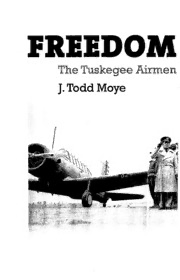
Title page illustration: Maj. James A. Ellison reviews the first class of Tuskegee cadets
TAAF, returning the salute of Mac Ross. U.S. Air Force Historical Research Agency.
For Luke and Henry
Contents
Prologue: “This Is Where You Ride” i
1 The Use of Negro Manpower in War 13
2 The Black Eagles Take Flight 41
3 The Experiment 70
4 Combat on Several Fronts 98
5 The Trials of the 477th 123
6 Integrating the Air Force 145
Epilogue: “Let’s Make It a Holy Crusade All the Way
Around” 171
Acknowledgments 187
Notes 191
A Note on Sources 217
Bibliography 221
Index 233
vii
Pxologue
“This Is Where You Ride”
John Roach grew up in the South End of Boston, the son
of West Indian immigrants. His father, a native of Montserrat, had fought
for the British Empire in World War I in a unit composed entirely of dark-
skinned men and worked in Boston as a laborer; his mother worked for
white families as a domestic. Roach's neighborhood was mixed—"Chinese,
Japanese, Italians, Greeks, Russians, all kinds of people.” Scraps with kids
from the Irish neighborhoods nearby were not uncommon, but Roach
cherished his experience growing up in the South End. “I think it was a
gratifying experience to live in that area because it was like an international
community,” he remembered. “You got to know each other and got to real
ize that no matter where you're bom, you're a person. Everybody has likes
and dislikes, everybody has quirks that you may or may not like. And you
realize that you just take people as they come, and the better you treat them,
the better they'll treat you in most cases.” He learned something else from
his parents: “You can't fight your way up to the top with your fists. You can
with your character.” Roach developed a keen mind and a strong character,
and he expected to rise as high in life as his talents could take him.1
As a child, Roach developed a fascination with airplanes. His mother
later told him that when she took him for walks in his baby carriage, he
would scan the skies for airplanes and point at them excitedly if any should
pass overhead. In elementary school he found kindred spirits, two class
mates who shared his interest in flying machines. “We found out that you
could get to East Boston Airport by going down to Rose Wharf on Atlan
tic Avenue in Boston, and there was a ferry that went across the bay to
the edges of the East Boston neighborhood. We'd walk along in front of
where the ferry came in and where you paid your money to go across on the
ferry, and we'd beg pennies from the neighbors going by until we had 4c,”
enough for ferry fare. From the ferry landing in East Boston they walked a
mile or more to the airport.
“You couldn't get out on the airport, but you could hang on the fence.
And we would hang on the fence and watch the airplanes take off and land.
Once in a while one would taxi by, and we'd just go out of our minds,”
Roach said. “We'd do that all day on a Saturday after we had done our
chores at home, and then we'd head on back, beg pennies again from the
1
people on the sidewalk, come across on the ferry, and then walk home. My
mother never knew I did that, or she would have killed me.
“That was my introduction to the aircraft,” Roach remembered. “I just
watched them take off. I couldn’t understand how a huge thing like that
could get up in the air and fly so graceful, but that did it. I said, ‘Somehow
I’m going to fly airplanes.’ I didn’t know how. I didn’t know where or why
or when, but I knew somehow I’d do it. My mother said she thought so too
when she found out I liked airplanes.” Roach could not have known it then,
but the nation’s armed forces systematically denied African Americans
even the opportunity to learn to fly, and civilian institutions were not much
more accommodating. At the beginning of 1939, the year Roach turned
fourteen, there were only twenty-five licensed African American pilots in
the entire country.2
Roach attended racially integrated Boston public schools. When he
graduated from Mechanic Arts High School, a venerable institution sev
eral miles from his home, in 1943, he knew little of the political machi
nations on the part of the National Association for the Advancement of
Colored People (NAACP) and other black institutions that had recently
forced the U.S Department of War to open a military flight training facil
ity in Tuskegee, Alabama, for African Americans. He just knew that he
wanted to fly. “That’s when I found out that there was this unit being
established at Tuskegee Army Air Field to train black pilots,” he said.
Before then it had “never crossed my mind that there were no black mili
tary pilots. I figured, you know, airplanes were airplanes” and could be
flown by anyone with the desire and ability to learn how to fly them.
Roach, who considered himself as patriotic and gung-ho about military
service as any other American teenager, began devouring reports from
the Tuskegee program that he found in the black newspapers in his
neighborhood barbershop. Six months after his seventeenth birthday, in
June 1943, Roach gathered up his birth certificate, his diploma, and a let
ter from his parents giving him permission to join the armed forces, and
set off for the recruiting station in downtown Boston to enlist in the Army
Air Forces (AAF) for flight training.
“What would you like, sonny?” a white sergeant at the station asked him.
Roach answered that he had come to join the AAF. The sergeant explained
to him, not unkindly, that the AAF was not accepting black recruits but
that he was welcome to sign up for service in the infantry. Roach started
to argue with the sergeant based on what he had learned from the newspa
pers, thought better of it, and left. He went to nine other recruiting stations
in greater Boston and was rebuffed at each one. Roach started to wonder
if he wasn’t being discriminated against. “I was kind of surprised because
after reading the African American newspapers and all the other papers,
2 FREEDOM FLYERS