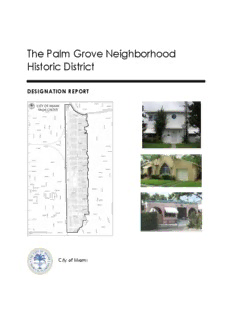
Table Of ContentThe Palm Grove Neighborhood
Historic District
DESIGNATION REPORT
City of Miami
REPORT OF THE CITY OF MIAMI PRESERVATION OFFICER
TO THE HISTORIC AND ENVIRONMENTAL PRESERVATION BOARD
ON THE POTENTIAL DESIGNATION OF THE
PALM GROVE NEIGHBORHOOD
AS A HISTORIC DISTRICT
Original Survey and
Report: Thomason & Associates
Nashville, Tennessee1
Reviewed and
Edited by: Ellen J. Uguccioni
Preservation Officer
Passed and
Adopted on February 3, 2009
Resolution Number HEPB-2009-12
1 The original reports and individual site file forms are on file with the City of Miami Planning Department Historic
Preservation Section.
TABLE OF CONTENTS
I. General Information 4
II. Significance / History 7
III. Predominant Architectural Styles 13
IV. Planning Context 18
V. List of Contributing and Non-Contributing Properties 19
VI. Bibliography 27
Palm Grove Neighborhood Historic District Designation Report
February 3, 2009
Page 3
I. GENERAL INFORMATION
Historic Name:
A part of this district is located in the 19th century settlement of Lemon
City, an important shipping port before Miami’s incorporation (1896).
While Lemon City had no “official” boundaries, author Thelma Peters’
places its point of beginning at and near the present NE 61st Street. While
there is evidence of sporadic settlement dating back to the mid-19th
century, the first mention of Lemon City in the public record occurs in
December, 1889.2 Today, there is virtually nothing left standing from the
community, with the exception of the Dupuis Medical Office and
Drugstore, located at 6041-45 NE 2nd Avenue, built in 1902.
Current Name:
Palm Grove Neighborhood
General Boundaries:
The area is generally bounded on the north by the Little River; on the
south by NE 58th Street; on the east by the rear property lines of the
buildings fronting Biscayne Boulevard; and on the west by the FEC
Railway.
Description
The boundaries of this district include approximately forty blocks
within Miami’s Upper East Side. The Biscayne Boulevard/ MiMo
Historic District is immediately east of the proposed historic district.
The following describes the breakdown of those properties which are
found to contribute to the character of the historic district, and those
that are found not to contribute either because:
a. Through alterations/ additions the original character of the
property is no longer discernible
b. The resource falls outside of the period of significance.
Number of Contributing Resources: 342
Number of Non-Contributing Resources: 224
(Total improved properties) 566
Vacant Lots 47
Parking Lots 6
2 Thelma Peters. Lemon City, Pioneering on Biscayne Bay 1850-1925 (Miami: Banyan Books) 1976. 20
Palm Grove Neighborhood Historic District Designation Report
February 3, 2009
Page 4
Period of Significance
1921-1959
Present Owners
Multiple, Individual Addresses and Folio Numbers
Available in the Planning Department, Historic Preservation Section
Present Use
Residential and Liberal Commercial
Zoning District (s)
R-3
C-2
Classification
Historic District
Tax Folios
Multiple Numbers, A complete list of tax folios is available in the Planning
Department
Palm Grove Neighborhood Historic District Designation Report
February 3, 2009
Page 5
Palm Grove Neighborhood Historic District Designation Report
February 3, 2009
Page 6
II. SIGNIFICANCE / HISTORY
Summary Statement of Significance
The Palm Grove Neighborhood is worthy of local historic district designation
primarily for its portrayal of the growth and development of Miami from the
1920s to the late 1950s, as it embodies dwellings that display popular styles of the
period. Characterized by single-family and multifamily dwellings as well as
warehouses, the original residents were generally from the middle classes, and
their homes were modest in terms of size and design. The neighborhood was
initially platted in the 1920s, but many of the lots remained undeveloped as the
Florida Land Boom came to an abrupt end in 1926. By the mid-1930’s another
wave of construction began lasting well into the 1940s as returning servicemen
and women took advantage of government–insured loans. By the mid-1950s
the majority of lots within the neighborhood had been developed, illustrating
the rapid growth and expansion occurring in the city into this period. As a result,
the Palm Grove Neighborhood contains a significant collection of residential
architecture from the early to mid-20th century. The district includes a collection
of one-story Mediterranean Revival homes; apartments that express Art Deco
detailing; and a wider variety of the form known as “Minimal Traditional” and
Ranch, which characteristically employed decorative detail gleaned from other
stylistic vocabularies which include: Craftsman, Art Deco, and Art Moderne.
A Brief History
Miami, incorporated in 1896, was at that time, a settlement encompassing
approximately two square miles. By 1913 the city had expanded to sixteen
square miles, and by the end of the unprecedented real estate boom of the
1920, the city had grown to some forty-three square miles.3 The timing,
individuals or companies involved, and platted landscapes of the subdivisions
included in the Palm Grove Historic District are typical of the development that
occurred during this last period of rapid expansion from 1921 to 1926.
Some portions of the area included within the Palm Grove Neighborhood are
located in one of the area’s earliest settlements --- Lemon City. Two
homesteading families likely began living in the area where modern NE 61st
Street reaches Biscayne Bay in the 1870s. By the time they obtained legal title to
the area in 1890, they had already begun to sell parcels of it. Newcomer to the
area E. H. Harrington purchased 11 acres for a subdivision dubbed Lemon City.
The name stuck, and began to be used for both the subdivision and the
backcountry surrounding it.4
3 Aristides J. Millas, “Miami,” in Miami’s Historic Neighborhoods: A History of Community, ed. Becky Roper Matkov
(San Antonio: Historical Publications Network, 2001), 20.
4 Thelma Peters, “History,” on file at City of Miami Planning Department, a1.
Palm Grove Neighborhood Historic District Designation Report
February 3, 2009
Page 7
Lemon City provided the only deep water access at the time and developed
quickly as a major shipping port along the Florida coast. As the local population
grew and people constructed other subdivisions, they began to build roads and
businesses. By 1895 Lemon City had grown to include a sawmill, blacksmith
shop, two hotels, a few saloons, a restaurant, stores, a real estate office, and
some eighty houses.
Around the turn of the century, Lemon City began expanding westward. The
railroad came through in 1896, and a 1902 rock road along modern NE 2nd
Avenue connected Lemon City to Miami and its newly developed railroad and
steamboat shipping operations. While a vibrant community at its beginnings,
ultimately with the option of the deep water port of Miami, Lemon City became
less an economic focal point. Lemon City along with the 19th century settlement
of Cocoanut Grove was incorporated by the City of Miami in 1926. Little
remains from the Lemon City settlement today.
Miami’s second period of development, from 1913 to 1920, was defined by
continued growth. The Dixie Highway, the first continuous paved route from the
Midwest to the Southeast, terminated in Miami in 1915.5 The accessibility of
Henry Ford’s Model “T”, the growth of the railway system, and the continuing
improvement of the roads set the stage for the waves of Americans who came
to Florida in the 1920s, seeking to buy their own small piece of paradise.
By 1920, had women received the right to vote, prohibition became law and
more than 23 million cars took to the newly built highways. The “Roaring
Twenties” had arrived, and Florida was at its epicenter.6 The volume of real
estate transactions was nothing short of phenomenal, as streets were crowded
with real estate entrepreneurs and ships and trains moved non-stop into the
ports and stations with building materials. At one point the FEC Railway closed
the train tracks to nothing but perishables, as the weight of the lumber had done
serious damage to the tracks. New cities were created almost overnight,
among them the Glenn Curtiss’ developments of Opa Locka, Hialeah and
Miami Springs and George Merrick’s Coral Gables. Commercial high-rise
development was in high gear north of the Miami River in the commercial
downtown, while estate homes on Brickell Avenue (then nicknamed Millionaire’s
Row) rose south of the river.
Significantly, the plats that are included within the Palm Grove Neighborhood
were filed during this period. They are: Bay Shore, 1922; North Gate, 1922;
Morningside, 1924; Baywood, 1921 and Federal Way, 1926.
5 Millas, “Miami,” 19 – 21.
6 Samuel D. LaRoue Jr. and Ellen J. Uguccioni. The Biltmore Hotel—An Enduring Legacy. (Miami: Centennial Press)
2002. 13
Palm Grove Neighborhood Historic District Designation Report
February 3, 2009
Page 8
The Development of the Palm Grove Subdivisions
With a freight embargo, the default of loans, a devastating hurricane, and
continuing criticisms from the press, Florida’s seemingly unstoppable boom,
came abruptly to an end. By 1926 the future was indeed gloomy, and some of
those early cities which had borrowed heavily by issuing bonds, encumbering
themselves with great debt, found themselves bankrupted when they could not
pay even the interest due of the bond issue. In 1929, as the nation entered the
depression, Florida had already endured a painful downturn, but experienced a
better economy sooner than the rest. Tourism proved a major industry, and
helped the region rebound economically and avoid many affects of the Great
Depression.7
The Palm Grove neighborhood owes its existence to five residential
developments platted during the early 1920s. Furthest south in the proposed
district is Bay Shore. The Bay Shore Investment Company received city and
county approval in 1922 to construct Bay Shore; its unit’s one and four were
platted in the six blocks between modern NE 54thStreet, Biscayne Boulevard, NE
60th Street and the railroad tracks. The Delaware-based company’s Mid-Atlantic
roots reflected in their choice of street names such as Piedmont, Albemarle, and
Potomac, but they also included names that reflected the area such as
Biscayne and Hibiscus.8
Above Bay Shore was the subdivision of North Gate. North Gate’s plats show
plans for 176 lots located along and between modern NE 60th Street (then
called Virginia Street), Biscayne Boulevard, (East Dixie Highway), NE 65th Street
(Kanawha Street), and NE 4th Court (Harriman Avenue). The city and county
approved the North Gate development plans offered by C. J. Pearson,
President of the West Virginia-based C. J. Pearson Company, in 1922.9
Morningside was north of North Gate. Its founders, a married couple named L.
E. and Carrie E. Edwards, received city and county approval for the
development in 1924. The notary public examined Carrie E. Edwards
independently to insure that she acted “without any constraint, compulsion,
apprehension or fear of or from her said husband.” Morningside’s plat included
200 lots along and between NE 66th Street, modern Biscayne Boulevard (East
Dixie Highway), the southern side of NE 69th Street, and NE 4th Court.10
7 Becky Roper Matkov, ed., Miami’s Historic Neighborhoods: A History of Community (San Antonio: Historical
Publications Network, 2001), 213.
8 Clerk, Plat 5, Clerk, Plat 15, and Clerk, Plat 16.
9 Clerk, Plat 8 and Clerk, Plat 9.
10 Clerk, Plat 12.
Palm Grove Neighborhood Historic District Designation Report
February 3, 2009
Page 9
Above Morningside was Baywood, the earliest of the five developments to
receive city and county approval. In 1921, Miami and Dade County authorized
The Krames and Carlett Company and L. E. and Carrie E. Edwards to begin their
plans for 94 lots north of NE 69th Street (then called Minerva Drive), Biscayne
Boulevard (East Dixie Highway), NE 71st Street (Baywood Drive), and NE 4th Court
(3rd Street). Along the southern edge of modern NE 71st Street, the Baywood
development continued to the edge of Biscayne Bay.11
Federal Way was the furthest north of the five subdivisions. Bounded by NE 71st
Street, Biscayne Boulevard (6th Avenue), NE 79th Street, and the railroad tracks, it
constituted the largest development within the proposed Palm Grove Historic
District. O. W. and W. C. Ewing, from Dade County and another husband and
wife team, received approval for their development in 1926. Federal Way was,
thus, also the last of the developments included in the proposed district.12
The development of Bay Shore, the southernmost of the historic developments
included in the proposed Palm Grove Historic District, is a case study for Miami
boom development patterns. James H. Nunnelly, who owned a candy
company, turned real estate developer early in the decade. He founded the
Bay Shore Investment Company in Delaware; it was one of several out-of-state
companies eager to take advantage of the frenzied development in south
Florida. The company’s subdivision in its entirety crossed modern Biscayne
Boulevard to plat the area between modern NE 54th Street, Biscayne Bay, NE
60th Street, and the railroad tracks. In 1922, Nunnelly launched the Bay Shore
subdivision.13
The investment company billed Bay Shore as south Florida’s “most superior
development.” Amenities included paved roads, sidewalks, swales, medians,
underground telephone and electric wiring, storm sewers, gas lines, streetlights,
fresh water supplied by a well and pumping station, and underground conduits.
The company planted 4000 trees and landscaped the parkways with
bougainvillea, palms, coleus, and St. Augustine grass. A master architect
stipulated setbacks and lot frontages.14
Prominent architects with important local credits designed some of the early Bay
Shore houses. Robert Law Weed, who designed part of the 1929 Sears building
north of downtown Miami; L. Murray Dixon, heavily involved in Miami Beach
design work; H. George Fink, who worked with George Merrick in the design for
11 Clerk, Plat 5.
12 Clerk, Plat 14 and Clerk, Plat 25.
13 Gail Meadows and William E. Hopper Jr., “Morningside and Bay Point,” in Miami’s Historic Neighborhoods: A
History of Community, ed. Becky Roper Matkov (San Antonio: Historical Publications Network, 2001), 38.
14 Ibid.
Palm Grove Neighborhood Historic District Designation Report
February 3, 2009
Page 10
Description:1 The original reports and individual site file forms are on file with the City of Miami Planning Department Historic While Lemon City had no “official” boundaries, author Thelma Peters' .. Anglo names such as Dean Clark, at 445 NE 55th Street, Robert E. and Nan Cook .. 6401 – 6403 NE 5 AV.