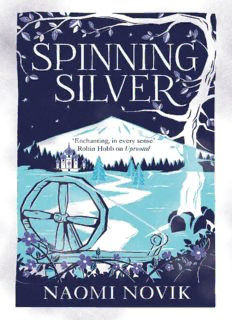
Table Of ContentSPINNING
SILVER
NAOMI NOVIK
MACMILLAN
CONTENTS
CHAPTER 1
CHAPTER 2
CHAPTER 3
CHAPTER 4
CHAPTER 5
CHAPTER 6
CHAPTER 7
CHAPTER 8
CHAPTER 9
CHAPTER 10
CHAPTER 11
CHAPTER 12
CHAPTER 13
CHAPTER 14
CHAPTER 15
CHAPTER 16
CHAPTER 17
CHAPTER 18
CHAPTER 19
CHAPTER 20
CHAPTER 21
CHAPTER 22
CHAPTER 23
CHAPTER 24
CHAPTER 25
Read on for an extract from Uprooted
CHAPTER 1
T
he real story isn’t half as pretty as the one you’ve heard.
The real story is, the miller’s daughter with her long golden hair wants to
catch a lord, a prince, a rich man’s son, so she goes to the moneylender and
borrows for a ring and a necklace and decks herself out for the festival. And
she’s beautiful enough, so the lord, the prince, the rich man’s son notices her,
and dances with her, and tumbles her in a quiet hayloft when the dancing is over,
and afterwards he goes home and marries the rich woman his family has picked
out for him. Then the miller’s despoiled daughter tells everyone that the
moneylender’s in league with the devil, and the village runs him out or maybe
even stones him, so at least she gets to keep the jewels for a dowry, and the
blacksmith marries her before that firstborn child comes along a little early.
Because that’s what the story’s really about: getting out of paying your debts.
That’s not how they tell it, but I knew. My father was a moneylender, you see.
He wasn’t very good at it. If someone didn’t pay him back on time, he never
so much as mentioned it to them. Only if our cupboards were really bare, or our
shoes were falling off our feet, and my mother spoke quietly with him after I was
in bed, then he’d go, unhappy, and knock on a few doors, and make it sound like
an apology when he asked for some of what they owed. And if there was money
in the house and someone asked to borrow, he hated to say no, even if we didn’t
really have enough ourselves. So all his money, most of which had been my
mother’s money, her dowry, stayed in other people’s houses. And everyone else
liked it that way, even though they knew they ought to be ashamed of
themselves, so they told the story often, even or especially when I could hear it.
My mother’s father was a moneylender, too, but he was a very good one. He
lived in Vysnia, forty miles away by the pitted old trading road that dragged
from village to village like a string full of small dirty knots. Mama often took me
on visits, when she could afford a few pennies to pay someone to let us ride
along at the back of a peddler’s cart or a sledge, five or six changes along the
way. Sometimes we caught glimpses of the other road through the trees, the one
that belonged to the Staryk, gleaming like the top of the river in winter when the
snow had blown clear. “Don’t look, Miryem,” my mother would tell me, but I
always kept watching it out of the corner of my eye, hoping to keep it near,
because it meant a quicker journey: whoever was driving the cart would slap the
horses and hurry them up until it vanished again.
One time, we heard the hooves behind us as they came off their road, a sound
like ice cracking, and the driver beat the horses quick to get the cart behind a
tree, and we all huddled there in the well of the wagon among the sacks, my
mother’s arm wrapped around my head, holding it down so I couldn’t be
tempted to take a look. They rode past us and did not stop. It was a poor
peddler’s cart, covered in dull tin pots, and Staryk knights only ever came riding
for gold. The hooves went jangling past, and a knife-wind blew over us, so when
I sat up the end of my thin braid was frosted white, and all of my mother’s sleeve
where it wrapped around me, and our backs. But the frost faded, and as soon as
it was gone, the peddler said to my mother, “Well, that’s enough of a rest, isn’t
it,” as if he didn’t remember why we had stopped.
“Yes,” my mother said, nodding, as if she didn’t remember either, and he got
back up onto the driver’s seat and clucked to the horses and set us going again. I
was young enough to remember it afterwards a little, and not old enough to care
about the Staryk as much as about the ordinary cold biting through my clothes,
and my pinched stomach. I didn’t want to say anything that might make the cart
stop again, impatient to get to the city and my grandfather’s house.
My grandmother would always have a new dress for me, plain and dull brown
but warm and well-made, and each winter a pair of new leather shoes that didn’t
pinch my feet and weren’t patched and cracked around the edges. She would
feed me to bursting three times every day, and the last night before we left she
would always make cheesecake, her cheesecake, which was baked golden on the
outside and thick and white and crumbly inside and tasted just a little bit of
apples, and she would make decorations with sweet golden raisins on the top.
After I had slowly and lingeringly eaten every last bite of a slice wider than the
palm of my hand, they would put me to bed upstairs, in the big cozy bedroom
where my mother and her sisters had slept as girls, in the same narrow wooden
bed carved with doves. My mother would sit next to her mother by the fireplace,
and put her head on her shoulder. They wouldn’t speak, but when I was a little
older and didn’t fall asleep right away, I would see in the firelight glow that both
of them had a little wet track of tears down their faces.
We could have stayed. There was room in my grandfather’s house, and
welcome for us. But we always went home, because we loved my father. He was
terrible with money, but he was endlessly warm and gentle, and he tried to make
up for his failings: he spent nearly all of every day out in the cold woods hunting
for food and firewood, and when he was indoors there was nothing he wouldn’t
do to help my mother. No talk of woman’s work in my house, and when we did
go hungry, he went hungriest, and snuck food from his plate to ours. When he
sat by the fire in the evenings, his hands were always working, whittling some
new little toy for me or something for my mother, a decoration on a chair or a
wooden spoon.
But winter was always long and bitter, and every year I was old enough to
remember was worse than the one before. Our town was unwalled and half
nameless; some people said it was called Pakel, for being near the road, and
those who didn’t like that, because it reminded them of being near the Staryk
road, would shout them down and say it was called Pavys, for being near the
river, but no one bothered to put it on a map, so no decision was ever made.
When we spoke, we all only called it town. It was welcome to travelers, a third
of the way between Vysnia and Minask, and a small river crossed the road
running from east to west. Many farmers brought their goods by boat, so our
market day was busy. But that was the limit of our importance. No lord
concerned himself very much with us, and the tsar in Koron not at all. I could
not have told you whom the tax collector worked for until on one visit to my
grandfather’s house I learned accidentally that the Duke of Vysnia was angry
because the receipts from our town had been creeping steadily down year to
year. The cold kept stealing out of the woods earlier and earlier, eating at our
crops.
And the year I turned sixteen, the Staryk came, too, during what should have
been the last week of autumn, before the late barley was all the way in. They had
always come raiding for gold, once in a while; people told stories of half-
remembered glimpses, and the dead they left behind. But over the last seven
years, as the winters worsened, they had grown more rapacious. There were still
a few leaves clinging to the trees when they rode off their road and onto ours,
and they went only ten miles past our village to the rich monastery down the
road, and there they killed a dozen of the monks and stole the golden
candlesticks, and the golden cup, and all the icons painted in gilt, and carried
away that golden treasure to whatever kingdom lay at the end of their own road.
The ground froze solid that night with their passing, and every day after that a
sharp steady wind blew out of the forest carrying whirls of stinging snow. Our
own little house stood apart and at the very end of town, without other walls
nearby to share in breaking the wind, and we grew ever more thin and hungry
and shivering. My father kept making his excuses, avoiding the work he couldn’t
bear to do. But even when my mother finally pressed him and he tried, he only
came back with a scant handful of coins, and said in apology for them, “It’s a
bad winter. A hard winter for everyone,” when I didn’t believe they’d even
bothered to make him that much of an excuse. I walked through town the next
day to take our loaf to the baker, and I heard women who owed us money talking
of the feasts they planned to cook, the treats they would buy in the market. It was
coming on midwinter. They all wanted to have something good on the table;
something special for the festival, their festival.
So they had sent my father away empty-handed, and their lights shone out on
the snow and the smell of roasting meat slipped out of the cracks while I walked
slowly back to the baker, to give him a worn penny in return for a coarse half-
burned loaf that hadn’t been the loaf I’d made at all. He’d given a good loaf to
one of his other customers, and kept a ruined one for us. At home my mother
was making thin cabbage soup and scrounging together used cooking oil to light
the lamp for the third night of our own celebration, coughing as she worked:
another deep chill had rolled in from the woods, and it crept through every crack
and eave of our run-down little house. We only had the flames lit for a few
minutes before a gust of it came in and blew them out, and my father said,
“Well, perhaps that means it’s time for bed,” instead of relighting them, because
we were almost out of oil.
By the eighth day, my mother was too tired from coughing to get out of bed at
all. “She’ll be all right soon,” my father said, avoiding my eyes. “This cold will
break soon. It’s been so long already.” He was whittling candles out of wood,
little narrow sticks to burn, because we’d used the last drops of oil the night
before. There wasn’t going to be any miracle of light in our house.
He went out to scrounge under the snow for some more firewood. Our box
was getting low, too. “Miryem,” my mother said, hoarsely, after he left. I took
her a cup of weak tea with a scraping of honey, all I had to comfort her. She
sipped a little and lay back on the pillows and said, “When the winter breaks, I
want you to go to my father’s house. He’ll take you to my father’s house.”
The last time we had visited my grandfather, one night my mother’s sisters
had come to dinner with their husbands and their children. They all wore dresses
made of thick wool, and they left fur cloaks in the entryway, and had gold rings
on their hands, and gold bracelets. They laughed and sang and the whole room
was warm, though it had been deep in winter, and we ate fresh bread and roast
chicken and hot golden soup full of flavor and salt, steam rising into my face.
When my mother spoke, I inhaled all the warmth of that memory with her
words, and longed for it with my cold hands curled into painful knots. I thought
of going there to stay, a beggar girl, leaving my father alone and my mother’s
gold forever in our neighbors’ houses.
I pressed my lips together hard, and then I kissed her forehead and told her to
rest, and after she fell fitfully asleep, I went to the box next to the fireplace
where my father kept his big ledger-book. I took it out and I took his worn pen
out of its holder, and I mixed ink out of the ashes in the fireplace and I made a
list. A moneylender’s daughter, even a bad moneylender’s daughter, learns her
numbers. I wrote and figured and wrote and figured, interest and time broken up
by all the little haphazard scattered payments. My father had every one carefully
written down, as scrupulous with all of them as no one else ever was with him.
And when I had my list finished, I took all the knitting out of my bag, put my
shawl on, and went out into the cold morning.
I went to every house that owed us, and I banged on their doors. It was early,
very early, still dark, because my mother’s coughing had woken us in the night.
Everyone was still at home. So the men opened the doors and stared at me in
surprise, and I looked them in their faces and said, cold and hard, “I’ve come to
settle your account.”
They tried to put me off, of course; some of them laughed at me. Oleg, the
carter with his big hands, closed them into fists and put them on his hips and
stared at me while his small squirrelish wife kept her head down over the fire,
darting eyes towards me. Kajus, who had borrowed two gold pieces the year
before I was born, and did a good custom in the krupnik he brewed in the big
copper kettles he’d bought with the money, smiled at me and asked me to come
inside and warm myself up, have a hot drink. I refused. I didn’t want to be
warmed. I stood on their doorsteps, and I brought out my list, and I told them
how much they had borrowed, and what little they had paid, and how much
interest they owed besides.
They spluttered and argued and some of them shouted. No one had ever
shouted at me in my life: my mother with her quiet voice, my gentle father. But I
found something bitter inside myself, something of that winter blown into my
heart: the sound of my mother coughing, and the memory of the story the way
they’d told it in the village square so many times, about a girl who made herself
a queen with someone else’s gold, and never paid her debts. I stayed in their
doorways, and I didn’t move. My numbers were true, and they and I knew it, and
when they’d shouted themselves out, I said, “Do you have the money?”
They thought it was an opening. They said no, of course not; they didn’t have
such a sum.
“Then you’ll pay me a little now, and again every week, until your debt is
cleared,” I said, “and pay interest on what you haven’t paid, if you don’t want
me to send to my grandfather to bring the law into it.”
None of them traveled very much. They knew my mother’s father was rich,
and lived in a great house in Vysnia, and had loaned money to knights and even,
rumor had it, to a lord. So they gave me a little, grudgingly; only a few pennies
in some houses, but every one of them gave me something. I let them give me
goods, too: twelve yards of warm woolen cloth in deep red, a jar of oil, two
dozen good tall candles of white beeswax, a new kitchen knife from the
blacksmith. I gave them all a fair value—the price they would have charged
someone else, not me, buying in the market—and I wrote down the numbers in
front of them, and told them I would see them next week.
On my way home, I stopped in at Lyudmila’s house. She didn’t borrow
money; she could have lent it herself, but she couldn’t have charged interest, and
anyway no one in our town would have been foolish enough to borrow from
anyone but my father, who would let them pay as they liked or didn’t. She
opened the door with her practiced smile on: she took in travelers overnight. It
came off when she saw me. “Well?” she said sharply. She thought I had come to
beg.
“My mother is sick, Panova,” I said, politely, so she’d keep thinking it just a
little longer, and then be relieved when I went on to say, “I’ve come to buy some
food. How much for soup?”
I asked her the price of eggs after, and bread, as though I were trying to fit
them to a narrow purse, and because she didn’t know otherwise, she just
brusquely told me the prices instead of inflating them twice over. Then she was
annoyed when I finally counted out six pennies for a pot of hot soup with half a
chicken in it, and three fresh eggs, and a soft loaf, and a bowl of honeycomb
covered with a napkin. But she gave them to me grudgingly, and I carried them
down the long lane to our house.
My father had come back home before me; he was feeding the fire, and he
looked up worried when I shouldered my way in. He stared at my arms full of
food and red wool. I put my load all down and I put the rest of the pennies and
the one silver kopek into the jar next to our hearth, where there were only a
couple of pennies left otherwise, and I gave him the list with the payments
written on it, and then I turned to making my mother comfortable.
*
After that, I was the moneylender in our town. And I was a good moneylender,
and a lot of people owed us money, so very soon the straw of our floor was
smooth boards of golden wood, and the cracks in our fireplace were chinked
with good clay and our roof was thatched fresh, and my mother had a fur cloak
to sleep under or to wear, to keep her chest warm. She didn’t like it at all, and
neither did my father, who went outside and wept quietly to himself the day I
Description:Will dark magic claim their home?Miryem is the daughter and granddaughter of moneylenders, but her father’s too kind-hearted to collect his debts. They face poverty, until Miryem hardens her own heart and takes up his work in their village. Her success creates rumours she can turn silver into gold