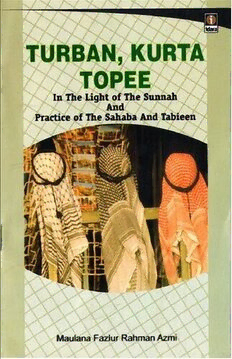
Table Of ContentIN THE LIGHT OF THE SUNNAH
AND
PRACTICE OF THE SAHABA AND TABIEEN
~hei/@huCHudith
Hazrat Moulana Fazlur Rahman Saheb
1
CONTENTS TRANSLATORS NOTE
We are presently passing through a phase of Islamic History where the
overall spiritual urge and religious zeal of the general masses is perhaps at
Translator's Note
it's lowest ebb. Those endowed with spiritual insight are looking, appalled at
Turban,Topee,Kurta- Introduction
the overwhelming degradation of Islamic values and are vehemently
Sunnal Huda
1 searching for a solution. Alas a thorough appreciation of the situation fills
Sunan-uz-Zawaaid
Turban II one with a hopeless sense of despair.
Ahaadith Pertaining to the Turban I
I
The Loose End of the Turban It must be understood that a basic solution lies in returning to the Shariah
The Length of the Turban and reviving the Sunnah. However such a revival does not lie in mere lip
The Shari Ruling Concerning the Wearing of the Turban in Namaaz
service and empty slogans but in a genuine attempt to practically incorporate
The Wearing of a Topee Under the Turban
Islam within ourselves. The driving impetus behind this attempt would be
The Practice of the Sahaaba With Regard to the Turban
an absolute irrefutable certainty that our excrtion would gain us tremendous
The Colour of the Turban
'fhe Virtue of the Turban remuneration both in this world as well as in the hereafter.
The Topee
The Topee of the Sahaaba and Taabieen Furthermore it is of implicit importance that we realize that Islam is a
The Kurta practical religion. The model upon which such practice is based is the
Information Concerningthe Kurta and the length of it's Sleeves I
1 lifestyle of our guide and master, Nabi-e-kareem (Sallallahu Alaihi
The Style of Kurta Worn by the ~ahiabaan d Taabieen
Wasallam). The vehemence placed upon this principle is clearly highlighted
by the following hadith wherein Nabi-e-kareem (Sallallahu Alaihi
Wasallam) is reported to have said; "None of you has Imaan until I do not
BIBLIOGI<APIIY
I
, become more beloved to him than his parcnts, children and the entire
Raddul Muhklar (Shaami) Darrc Sa'adah mankind". The exprcssion of this love, so essential for the perfection of
Khasail Nabawi
(comrncntary oC Shamnail-e-Tirmizi) I..dia 1960 faith, would be in the degree of emulation of our Prophet's (Sallallahu Alaihi
Sharah Shamaail - Allama Ahdul Raoof Munawi iootnotc of
Jamul wasa'il - Mulla Ali Qari Bcirut Wasallam) lifestyle. So blind and thirsty should this love be that our zeal for
Sahih Bukhari Pakistan emulation should know no bounds. Every action, trait or habit etc. of our
Sahih Muslim Pakistan
Jami Tirmizi Pakistan Prophet (Sallallahu Alaihi Wasallam) should become ours. This spirit
Ibn h.lajah Pakistan burned at it's strongest and sparkled in the lives of the Sahaba (Radiallahu
Mosannai Ihn Ahi Sllaiha Pakistan
Shamaailc - Tirmizi Pakistan Anhum). They understood success only in his Sunnah. His eating, walking
Almustaclr:~k I.il H;~akinl Pakistan
sleeping became theirs. Their thirst knew no bounds and their love no limit.
Abu Dawood Pakistan
nnzlrrl bf~~jllood Pakistan For them dignity and status were only rcprcsented in the Sunnah.
hl:~jma'uzZ awa:~i(l- Noorutl Dccn llaytliami ncirut
hlisl~kaatulM asnabill Intlia
Alrnaqasidul Hasan ah - All;~niaS akhawi Bcirut It is towards the appreciation of this spirit of emulation that this treatise is
UIII(I(IIQII(~t( ~ri Pakistan
Tulifatul Ahwarcc lntlia dedicated. After exhaustive rescarch, the wealth of Ahaadith with regard to
FaizuI Bnrcc Pakistan the Turbaan, Kurta and Topcc has bccn prcsentcd to you. The practice of
Al:~rf-uz-Sl1a7cch 1:l';la Tirn~izi Pakistan
Nnful Mufti was Sacl'il -hloulana Rasulullah (Sallallahu Alaihi Wasallam) and the Sahaaba (Radiallahu
Abdul Hay Lakhnawi P:~kist:ln
Fatwa Rashccdia Pakistan Anhum) in this regard becomes crystal clcar from these Ahaadith. However
hizul Qadccr-- S Iiar11 Jamills Snghccr Bcirut the reader must realize that the actual bcncfit of knowledge can only be
Al-Isaaba Hafiz Ibn Hajar Beirut
Fathul Bari Ibn Flajar realised through practice. Consider, beloved Muslims, when just one Hadith
(with foatnotcs of Shcikli Bin Bi~az) Bcirut was enough for the Sahaaba (Radiallahu Anhum) to make something their
K;lhccri. SIi:rrh Muniyattul Musalli llidia
Fataawa Rahcc~nia India
Durrlll Mukl~taarm a Ratltlul Mul1ta;lr D;~rusS a'adah
Muk;~dd;~lnE;~~t hulB arcc - Ihn 1i:ljar
Al.sira J~IIM unccr - Commentary of
Jamins S:~ghrcr
lifetime practice, how poor a reflection would it not be of our Imaan, if we,
after reading so many Ahaadith still fail to practice.
Another important point to remember is that a thorough knowledge of the THE TURBAN, TOPEE AND KURTA
Sunnah is also necessary. Many people sincerely endeavour to follow the
Sunnah, but due to lack of knowledge, are steeped in innovations. This is IN THE LIGHT OF THE AI-IAADEETI-I OF RASULULLAH
indeed destructive since this threatens the very essence and foundation of (Sallallahu Alaihi Wasallam) AS WELL AS THE SAYINGS AND
Islam. Hence it is necessary to reject all such practices which have no basis PRACTISES OF THE SAIIABA, TAABIEEN AND THE PIOUS
in Deen and follow only that which is proved to be authentic and reliably PREDECESSORS
established to be the practice of Rasulullah (Sallallahu Alaihi Wasallam).
This can be achieved by searching for the relevant Ahaadith while knowjng One must affirm that there can be absolutely no doubt in the fact that each
that every Hadith we read with the correct intention is a source of immense and every act (Sunnah) of our beloved Nabi (Sallallahu Alaihi Wasallam) is
reward. It is towards the creation of a spirit incorporating both these ideals considered supreme and well worthy of emulation by a true believer and
(i.e. practice based upon sound knowledge of the authenticity of said follower of his esteemed lifestyle. In fact a true lover of Nabi (Sallallahu
practice) that this booklet is also dedicated. It is for this very reason that Alaihi Wasallam) would be prepared to give his life for the practical
such a wealth of Ahaadith together with a profound commentary of their presevation of even one Sunnah. Such is the overwhelming thirst for
acceptability has been included. Even seemingly minor aspects such as the emulation present in a true Ummati that it does not matter to him whether
manner of tying the turban, the colour ctc. have been established in the light the Sunnah is connected to Ibadat (the manner in which Nabi (Sallallahu
of Shari proof. Alaihi Wasallam) carried out the various acts of worship) or whether the
Sunnah pertains to his habit or lifestyle (the manner of his speech, manner sf
Indeed, this wealth of research can only truly be appreciated by those who walking, eating, dressing etc.) As long as it can be ascerlained that our Nabk
have some affinity with the science of Hadith. (Sallallahu Alaihi Wasallam) did it, thcn a true Aashiq-e-Rasool (lover of
Nabi Sallallahu Alaihi Wasallam) will go to any lengths to bring ii into his
May Allah Ta'ala grant Hazrath Moulana Fazlur Rahman Saheb [mz] a long life.
life, good health and prosperity in this world and Jannatul Firdaus in the
hereafter. May He accept this booklet and make it a means of unending At this point one must realise that in order to cultivate such adherence it
benefits for the Ummat at large. Aamccn. would be of fundamental necessity that we exhaust ourselves in searching
for his Sunnats and then to the extent of our ability attempt to practicalily
Ahmed Suleman adopt them into our lives. Furthermore we should note that it would be the
Madrasak Arabia Islamia Azaahille dictates of devotion that those Sunnats which we perceive difficult and are
7 January 1992 unable to inculcate should be a source of immense grief and distress to us.
The divine remuneration for such adherence is absolutely tremendous and
beyond our wildest dreams.
It should be noted at this point that the Sunnah of Nabi (Sallallahu Alaihi
Wasallam) is generally classified into two categories:
1. Sunanul Huda
2. Sunan-uz-Zawaaid
Allama- Shaami has defined these categories as follows:
"Sunnah") is the Subheadings in books of fiqah such as; "The chapter of
1. SUNANUL IIUDA
Witr and Nafl".
Those Sunnats which were connccted to the perfection of religious rites
Consequently, the author even mentions the Sunan-e-Muakkadah in this
and to which Nabi (SallallahuAlaihi Wasallam) and after him the Khulafa-e-
chapter.
Rashideen (Rightly Guided Caliphs) adhered to meticulously without
(Raddul Mukhtaar Vol. Pg 70)
abstention. They are thus very close to Waajib (compulsory) and one who is
neglectful of these is generally considered to be a deviate. To leave them
The point of this discussion is to impress the fact that emulation of even the
out' is classified as Makrooh (reprehensible) and a sin. Examples of this
dressing of Nabi (Sallallahu Alaihi Wasallam) is Sunnat and a source of
category are: Azaan, Iqaamat and Salaah with Jamaat (congregation).
much virtue and blessing, even though neglcct in this regard will not always
be regarded as Makrooh or a source of deviation.
2. SUNAN-UZZAWAAID
Those Sunnats which Nabi (Sallallahu Alaihi Wasallam) so meticulously
A WORD OF CAUTION:
and unfailingly adhered to that they became considered to be his habit and
Let us be warned however, that the above mcntioned conclusion pertains to
daily ritual. He would very rarely leave them out. The basic difference
such forms of dressing wherein no direct injunction of adherence or
between this category and the above mcntioned one is that these Sunnats did
abstinence has been mentioned. However in those matters wherein one finds
not deal with the perfection of religious rites and were not Shi'aar of Deen
clear prohibition in the Shariah, it would be necssary to abstain therefrom. In
(distinguishing characteristics of Islam). It is merely due to this slight
these matters the logic of an individual plays no importance. Example of
difference that abstention from any of these acts is not referred to as
these are us follows:
Makrooh.1
It is Makrooh to allow one's pants or kurta or lungi to hang below the ankles
due to the fact that Nabi (Sallallahu Alaihi Wasallam) clcarly prohibited this.
Examples of this category are as follows:
It is not permissible for men to wear clothes of silk. Likewise the clothes of
The manner of dress of Nabi (Sallallahu Alaihi Wasallam). The practice of
the proud, arrogant and boastf~o~nlc s arc not permissible.
Rasulullah (Sallallahu Alaihi Wasallam) that he would lcngthen his Qiyaam
At all times the covering of the Satar (part of the body, the exposing of
(standing in salaat) and Qu'ood (sitting in salaat). Likewise the long qiraat
which is not permissible in the Shariah) is of fundamental importance.
he would recite in salaat and thc lengthy rukoos and sajdas that formed a
Hence the wearing of such clothes which do not conceal the private parts or
distinguishing characteristic of his namaaz.
such garments which are so tight-fitting (referred to as body hugging
garments nowadays) that they clearly outline the private parts, will definitely
At this point it would be appropriate to mention what is meant by Nafl or
be MAKROOH and not permissible.
Mustahab. Firstly let us understand that this is a completely seperate
category from both the forms of sunnah mcntioncd above. The categories of TURBAN
"Mustahab" and "Mandoob" (prcfcrable acts) too are included in this
category of Nafl. Some specific or gcncral "dalccl" (proof) exists regarding
Concerning the Turban Hadhrat Shcikhul Hadith Moulana Mohammed
it being a preferred action. Howcvcr, thcsc acts wcre not warranted the same
Zakarriya Khandalwi (R.A) has writtcn the following in his commentary of
unswerving adherence granted to the other acts of Sunnah. It is for this
"Shamaail Tirmizi", "Khasaail-e-Nabawi";
reason that a Nafl act is lcsser in status than a "Sunanuz Zawaaid" practise.
However, occasionally the word "nafl" is uscd in a more broader and general
"The tying of the turban is a "Sunnatc Mustamirrah" (pcrpctually adhered to
sense. In such cases it even includcs thc "Sunan Muakkadah" (highly
practice of Nabi Sallallahu Alailli Wasallam).
stressed Sunnats which should not be omitted). An example of this (where
Nabi (Sallallahu Alaihi Wasallam) has cnjoincd the tying of the turban upon
"nafl" includes
us. It has been reported; "Tic thc turban. It will increase you in
H o w ro ne sl~ouldr enlise tlra mtr11 rlnrsifirflion arrk took plore 101rg offer tlre time of //re Sdmbn (Rdidlnlru forbearance".
Anlwm). To tlris illustrious group , tl~em erefrrrt tl~oNt di (Sollnllidrlr Aloilri Ii'nsnllnt~rd) id it r~ws uficicnr i~~pctufosr
tltem to go to my lengtlts to prnrtire it. Likeuie i~ rlre ot~itrr<l'e,1 rut! trrre belie) cr.
1. Hazrat Arnr bin Umayya Damri (Radiallahu Anhu) reports: I saw Nabi
(Salllallahu Alaihi Wasallam) making masah of his Moza (leather socks) and
(Fatlzul Baarie) turban1
(Bukhari Slzareef Vol. I Pg 33)
It is also reported that somebody enquired of Hazrat ibn Umar (R.A.)
whether the tying of the turban was Sunnat or not. He replied in the 2. Hazrat Mughira ibn Sho'ba (Radiallahu Anhu) reports that Nabi
affirmative. (Sallallahu Alaihi Wasallam) performed wudu and made masah of the front
portion of his head as well as of his turban and leather socks.
It is reported in one hadith that Nabi (Sallallahu Alaihi Wasallam) said: (Muslim Skareef Vol. I Pg134)
I
"Wear the turban as it is a sign of Islam and distinguishes between a Muslim
and kaafir" (Ainee). 3. Hazrat Huraith (Radiallahu Anhu) reports that Nabi (Sallallahu Alaihi
(Tlze above extract is form Kl~asaaileN abawi Pg. 6;8) Wasallam) addressed the people while wearing a black turban.
(Muslim Slzarief Vol. I Pg439; Ibtie Abi Sllaiba Vol. 8 Pg 233)
'Marfoo l~haadithP ertaining to the l'nrban
Concerning the turban many Ahaadith have been reported .Some are In another narration it is reported: "I saw Nabi (Sallallahu Alaihi Wasallam)
Saheeh2 while others are Daeef 3and yet some are ~ a u d o o ~ wearing a black turban."
In his commentary of Shamaail-e-Tirmizi, Allama Abdur Raoof Munawi (Sl~amaaiTl irmizi Pg 8; Ibn Majah P2.56)
Misrie (passed away 1003 A.H.) writes: "A Turban is a Sunnat especially for
namaaz or when worn with the intention of beautification. Many ahaadith 4. Hazrat Jaabir (Radiallahu Anhu) reports that on the occasion of Fateh
have been reported concerning the turban, however a lot of them are also Makkah (The Conquest of Makkah), Nabi (Sallallahu Alaihi Wasallam)
Da'eef". entered Makkah Mukarramah while wearing a black turban.
(Muslim Vol. I Pg 439; Tirmizi Vol. I Pg 304; Ibtz Majak Pg 256)
Nevertheless their reliability and strength increascs due to the fact that the 5. It is also narrated from Hazrat Ibne Umar (Radiallahu Anhu) that on the
same hadith has been reported through various chains of narration (i.e. the occasion of Fateh Makkah, Nabi (Sallallahu Alaihi Wasallam) entered
weakness found in one chain is suplemenlcd by another chain). To consider wearing a black turban.
most of the ahaadith dealing with the Turban as Maudoo (fabricated) would (Ibne Majah Pg. 256; Ibtz Abi SIraiba Vol. 8 Pg 237)
be an error". N.B. Conclusive evidence concerning Nabi (Sallallahu Alaihi Wasallam)
(Foottzotes of Jam'ul IVsaail-cominet~taryo f Slumaail Tirmizi Vol. I Pg. wearing a black turban is attaincd from the abovementioned Ahaadith.
165) Furthermore one should note that all those narrations are of the Sahih
(absolutely authentic) category.
The Ahaadith are as follows:
is the opinion ofnlost offlre Fr8qdla Ilrlmr hfa.~nsnol,f 011l.vr lre 7irrbr11i1s notprn~issiblem dnor sr8ficient for absolr~ing
one ofthe conpulsory nmsd of tltc iread Lr n'rrd~r.I lobtc~~csrl~ ouhol ne cover o quarter ofrhe /tend in nus& and lien
'Madoo had111- rlris I% a tcrnr us& in tlre science of [Ire rln~ri/cr~!ioonfc dtcmii~lt.I t w'ill be used for a hadit11 in which pass l e1 1Md over l et urban tl~eno ne ~mrldbe obsosoh~cd. Fronr Il~~iirflit~ oit beconres established tl~dth is is wlta
if /tar been clemly establislredrltd us cltnin of nnrrrrrors goes riglrr rq, to Nabi (SaIIrdlrJluA lailli W~sallanr). Nabi (Sallallalw Alailu Warallm~a) rf~rdldy d.
-
2 S d ~ ea~ tcr nr used to denote strengrlr and relinbiliry.
3Daw- a term inplies w&ess
-
4Maudw a fabrieatednarration
6. Hazrat Ibne Abbas (Radiallahu Anhu) reports that during the illness just
THE LOOSE END OF THE TURBAN
prior to his passing away, Nabi (Sallallahu Alaihi Wasallam) addressed the
Sahaba while wearing a black turbanl.
(Bukhari Sharief Vol. I Pg 536; Slzamaail Tirmizi Pg. 8) It is preferable that the turban be tied in such a manner as to allow either one
7. Hazrat Abu Saeed Khudri (Radiallahu Anhu) narrates: "It was the or both ends of it to hang down in the form of a tail or loose end. The loose
practice of Nabi (Sallallahu Alaihi Wasallam) that whenever he wore a new end may be allowed to hang in the back or the front. However most
item of clothing, he would (first) take the name of it i.e. turban or kurta or narrations mention the tail as being at the back. Some Ulama have attested
chaadar (cloak)., Thereafter he would make the following dua - 0 Allah, I to the permissibility of tying the turban in such a manner that no loose end is
am indeed grateful to You for this clothing which You have granted me. I left hanging at the back or front.
(Jant'ul Wasaail Vol. 1 Pg 168)
beg of You the virtue of it and the benefit for which it was made. I seek
protection in You from its harm and from the evil which it was created for."2
(Tirmizi Vol. 1P g 306, Mustadrak Vol. 4 Pg 192) We will now make mention of a few ahadith wherein some indication
8. Hazrat Anas (Radiallahu Anhu) reports "I saw Rasulullah (Sallallahu concerning the tail of the turban can be found
Alaihi Wasallam) performing wudhu. He had on a "Qitri" turban. When
performing the masah of the hcad, without untying the turban, he entered his , 11.Hazrat Huraith (Radiallahu Anhu) narrates that he saw Nabi (Sallallahu
hand beneath it and made masah of the front portion of his head." Alaihi Wasallam) standing on the pulpit while he had on a black turban.
(Abu Dawud Pg. 19) Both the loose ends of the turban wcrc hanging between his shoulder blades.
"Qitri" - This is a type of thick coarse cloth which has an element of redness (i.e. at the back)
in it. Perhaps this is attributed to the place of "Qatar". From this narration (Muslim Vol. 1 Pg 490; Iblt Abi Sliaibali Vo1.8, Pg239,Ibrt Majdz Pg 256,
Abu Dawood Pg 653)
the permissibility of wearing red turbans can be ascertained.
(Bazlul Majliood Vol.1 Pg 89)
9. Abdur Rahman Soolami says, "I oncc saw Hazrat Abdul Rahman bin Auf 12.Ataa bin Rabaah (Radiallahu Anhu) narrates that once while I was with
(Radiallahu Anhu) enquiring from Hazrat Bilal (Radiallahu Anhu) about the Hadhrat Abdullah bin Umar (Rdiallahu Anhu), a youngster came to him and
wudhu of Rasulullah (Sallallahu Alaihi Wasallam). Hadrat Bilal (Radiallahu questioned him concerning the tail of !he turban (what the practise of Nabi
Anhu) explained: Sallallahu Alaihi Wasallam was in this regard). Hazrat Ibn Umar
"Whenever Rasulullah (Sallallahu Alaihi Wasallam) wished to perform (Radiallahu Anhu) informed the youngcster that he knew well the answer to
wudhu, I would bring the water for him. (During his wudhu) he would pass his query and would gladly explain thc matter to him.
his hand over his turban and also the corners of his eyes." He then said: "I was once in the Masjid of Nabi (Sallallahu Alaihi
(Abu Dawood Vol. 1 Pg 21) Wasallam). Together with the Prophet (Sallallahu Alaihi Wasallam), the
From all the narrations above it is lcarnt that Rasulullah (Sallallahu Alaihi following Sahaba (Radiallahu Anhum) were also present ;Abu Bakr, Umar,
Wasallam) used to wear a turban. Uthmaan, Ali, Ibn Mas'ud, Huzaifa, Abdur Rahmaan Ibn Auf, Abu Saeed
Khudri (Radiallahu Anhum). Altogether we wcre 10 Sahaba.1
In tlre actual narration t11e nord "isa~nrrrn~ lmrro"is rrserl. Ilonn~rsi rrcc lrrmo~rTt irrrrii nt~.ntionedr ltis trruiirion in
his elrapter on "An~annrah("t urban), illis wolrl~tle rrd to rflirrrr rlre Jocr tlzrrt he has regcu~cle~ltnl~oerd s "Isadant o nrean a
turban. Tlw reason for ~ltisd iscrrssiort is tlte Jcrcr 111crr [Ire ilrrrbic u,o,d "fsnr~l>a"ltaas wider nreanirrg tlrrut I Very @en llte Sal~abaw ould narrnte an inci(ierrt rrrenrior~irtg~ rririrues, rrppose(1ly rmi~rrportantd, etails. The remon for
*Anmnltn(turban). It nteans curyrl~inga ~lrichi s riecl nrtd sirtre the rrrrbru~i s dso lie<<r itere slrould be no objectio~r such mention is to convince tlw questioner of tlte clnriy n.irk u~l~icrlrl~ eyr crrtentbcr rltose rt~m~ennt'si h Nabi (SalIal/nIw
regarding tlte assunytion t/~nttl te w~ordn 'os octuol!,. rrse(1 to rle,tote n rrrrbnrt. Ariotlrer rranslation n#riclt could be am& AlaiIu Wasallan3 Md tlrm put tlre questiorter at enre n.itlt regard to tlre nrrrlteitriciry of tlreir report. TIus is indieaIive
is "oily bradage", ie. clue to sn'ere ~I~NIINIr~rbIi I(SCcr llnllrdr~l.rI,l rrilri Il'nrdi'urr) could well have opted for a bandage of tlte fondness wirlr nhich tlrey renroitberedrl~ec loys uitlr Nrhi (Snllnllnl~rAc lnil~iI +'asalIrun)
(Trmlator)
tlrat qpeared oily due to tire oil n+~iclNr nbi (SrrllolldrrrA lrrilri Il'ru rrllrr~rrc) r/~plietdo Iris Mrrboornk head. 9
Tirmi. 11as classified [Iris hmiitl~o s "Irmi" (sorrrrrl). Iloerkirrr Irm srrrrcrl flrcrt it corrr~dest o tire conditions ofInmaanr
Muslim, hence if is of rite "Sd~iltc"o regory. AllnrrrnZrdrhi Irr,.r crls u ngrecd nsirh tlris ~iewr( hiust&ak Vol. 4 Pg192)
14.Hazrat Ayesha (Radiallahu Anha) narrates that once a person riding a
Turkish horse (a particular breed of horse) came to Nabi (Sallallahu Alaihi
An Ansaari (native of Madina) youngster entered the Masjid, greeted Wasallam). The rider had on a turban, the tail of which hung between his
Rasulullah (Sallallahu Alaihi Wasallarn) with salaam and sat down ... Nabi shoulders. She questioned Nabi (Sallallahu Alaihi Wasallam) concerning
(Sallallahu Alaihi Wasal1am)turned his attention towards him (and gave him him. Nabi (Sallallahu Alaihi Wasallarn) expressed surprise over the fact that
a few valuable words of advice). Thereafter Nabi (Sallallahu Alaihi she had seen the rider and informcd her that it was Jibraeel (Alayhis
Wasallam) informed Hazrat Abdur Rahrnan Ibn Auf (Radiallahu Anhu) that Salaam).
a squadron of Mujahideen would be departing in the morning and that he (Ibid)
should prepare himself to join them. In the morning Hazrat Abdur Rahman 1S.Hazrat Ibn Umar (Radiallahu Anhu) rcports that when Nabi (Sallallahu
Ibn Auf, wearing a black cotton turban, presented himself ready for the Alaihi Wasallam) would tie a turban he would allow its tail to hang between
impending mission. Nabi (Sallallahu Alaihi Wasallam) motioned him closer his shoulders. Nafi (a renouncd studcnt of Ibn Urnar Radiallahu Anhu)
to himself and removed his turban and ticd a white turban on his head. This reports that Ibn Urnar (Radiallahu Anhu) also did likewise.
turban was tied in such a rnanncr that a loose end of approximately four The author of the commentary of Tirrnizi statcs; "This Hadith is nevertheless
fingers length was allowed to hang down from the back. So doing Nabi "Hasan" (reliable). The Hadith of Arnr bin Huraith in Muslim as well as
(Sallallahu Alaihi Wasallam) said: "Ibn Auf ,tic your turban in a like fashion other Ahadith support this Hadith and strcngthcn it."
as it is more appropriate and apparent." (This could also mean that this is the (Tulzfa Vo1.3 Pg 50).
method of the Arabs and the better way). Nabi (Sallallahu Alaihi Wasallam) Ubaidullah (one of the narrators of this hadith) says that he saw Qaasim and
then instructed Bilal (Radiallahu Anhu) to hand Hazrat Abdur Rahman Ibn Salim also doing likewise . (Tirmizi Vol. 1 Pg 304)'
Auf (Radiallahu Anhu) the flag (this indicated that he was being given the 16.Hazrat Ayesha (Radiallahu Anha) narrates Nabi (Sallallahu Alaihi
responsibility of leading the squadron)J Wasallam) tied on the turban of Hazrat Abdur Rahrnaan Ibn Auf (Radiallahu
(M~4sta(lrakH aakim vol. 4 Pg 540) Anhu) and allowed for a tail the lcngth of four fingers. He said "When I
ascended to the sky (rcfcrence to the Mcraj) I saw that most of the angels
13.Hazrat Ayesha (Radiallahu Anha) reports that on the occasion of the had on turbansV.2
Battle of the Trench she witnesscd sorncbody who greatly resembled Hazrat 17.Hazrat Musa Ashari (Radiallahu Anhu) narratcs that Jibraeel (Alayhis
Dahya Kalbi (Radiallahu Anhu). This person was seated on an animal and Salaam) wearing a turban carnc to Nabi (Sallallahu Alaihi Wasallam). The
was conversing in a low tone with Nabi (Sallallahu Alaihi Wasallam). He tail of the turban hung from thc back.3
had on a turban from which one end hung loose. She further reports that she 18.Hazrat Saubaan (Radiallahu Anhu) rcports that Nabi (Sallallahu Alaihi
asked Nabi (Sallallahu Alaihi Wasallarn) concerning the person and was Wasallam) would tie his turban in such a fashion that one end hung from the
informed that it was Hazrat Jibraccl (Alayhis Salaam) and that he had back and one from the front.4
commanded Nabi (Sallallahu Alaihi Wasallam) to proceed towards Banu
I Tirnrizi (RA) has clarsified tltis Iro'iitIr m "Glrttrieb"( n rent1 irtdiclicnrirrg rltor a 11rviitl1Il ar ken reported by only one
Quraiza (a Jewish tribe who were the enemies of Islam and resident in
climn of narrators). Tlw au111oro f tlrc co~rrrrrenrm.yo f li'ulrizi ~rrrres." rlris Irrulirlr is neverrlreless "Harm" (reliable)"
Madina at the time-Translator).
(TulrfaV ol. 3 PSO). llris hadit11i s also reported it1 t~ri.slrk~rttfrotTirir ttrizi mtd is classified as "Ilarm-g lrarieb" @. 374).
771;s wwuld tend to indcare tlrat tlre mttlter of Ali~hLnrtr Irrd cotrte ocl.oss strck a row of Tirnri5 wkic11 Itad tlre
It is quite clear that Jibracel (Alayhis Salaam) had come to convey the
clarsification Hasm next to ghariebX. Tlre Bcirrtr rqy of 1i'ruri:i ol.\o ltru tlris clmsificntion of "Ilarm."
command of Allah.2
Tabrani has reported tlris narration, Aouel'er, his Ustortdfialtr rtlrottt he has recorded tltis narration is "Daeef" (weak)
(Majnra-uz-mwm2 vol. 5 p 123)
Hmkim writes that despite the fact thqt Bukhnri nod Muslim did not mention this riwmyat, the nawation was albiet Tabrani narrared rltis Aarii111. fIolowa~zerin its rltrtiit ofttm.rrttors is AlrhtllrJI 1b11T mit-,,mnm 410is weak (Ibid)
SAHlH (without blemish and canpletely reli.?ble). Zhbi (!<.A) nlu, attested to tlw riwaayat being SAHIH. Qbid) Tabrani Iias reported tlris hadith in "hdnj~~tnArntla m". Ilon~c?'eor ne of irs narrrors, Hajjaj, is unreliable (Ibid)
Haythami has stated that T.lbnni has onmated it in "Awsnt." 11's "snrmd is hwnn (sound).
(MO~IIZImUn~d & Vd.5 Pg 123)
Musttxirak Ifdint Vol4 Pg 193 (Ifnnkin~Ir as ttecIr~rc~tlIr is Ir& to be Sdrilt). Zdtbi (RAj also agreed wiril flis
19.Abu Umamah (Radiallahu Anhu) rcports that whenever Nabi (Sallallahu and to wear their armour. They complied with Nabi (Sallallahu Alaihi
Alaihi Wasallam) would dispatch somebody as a governer to any place, he Wasal1am's)request and presented themselves before him. He took the cloth
would tie a turban on the head of the appointed pcrson. The turban would be and tied a turban for them in such a manner that the loose end hung from
tied in such a fashion that the loose end hung on the right side close to the either side (back and front).
ear. 1 (Umdatul Qaarie vol. 21 pg. 307 -from Kitaabul Jitzaad of ZbrzAbiAasim).
2O.Abu Abdus Salaam reports that he questioned Ibn Umar (Radiallahu 26.Hazrat Ayesha (Radiallahu Anha) reports that Nabi (Sallallahu Alaihi
Anhu) as to the method in which Nabi (Sallallahu Alaihi Wasallam) tied his Wasallam) tied a turban of cotton cloth for Abdur Rahmaan Ibn Auf
turban. He replied, "Rasulullah (Sallallahu Alaihi Wasallam) would tie the (Radiallahu Anhu) and caused "this much"1 to hang from the front.
fold of the turban on his head. He would pass the loose end from the back to (Umdatul Qaari vol. 2 I pg. 307 from Zbrz Abi Shaibah)
let it hang between the shoulders."2
27.Ibn Umar (Radiallahu Anhu) reports that Nabi (Sallallahu Alaihi
21.Hazrat Abdur Rahman Ibn Auf (Radiallahu Anhu) reports that Nabi Wasallam) tied a black turban of cotton cloth around the head of Ibu Auf
(Sallallahu Alaihi Wasallam) ticd a turban for him in such a manner that (Radiallahu Anhu) in such a manner that a tail of approximately the length of
there was a tail at the front and back. four fingers hung from the back. Nabi (Sallallahu Alaihi Wasallam) also
(Abu Dawoodpg 564 - one of tlze ~iarratorsis "Majlw01[~u~iz know~z]) said: "Tie your turbans in a like manner."2
(Umdatul Qaari: vol. 21 pg. 307)
22.Hazrat Ubadah (Radiallahu Anhu) reports that Nabi (Sallallahu Alaihi 28.Abdullah bin Bishr reports that when Nabi (Sallallahu Alaihi Wasallam)
Wasallam) said: "Make a practice of tying turbans since it is a hallmark of dispatched Hazrat Ali (Radiallahu Anhu) on the occasion of the "Campaign
the Angels.Futhermore, tie them in such a manner that the tail hangs at the of Khaybar", he tied a black turban for him causing the tail to hang from the
back". back and towards the left shoulder. Abdul Aa'laa bin Adi says that on the
(Bailzaqi reported it ill Sliiiab~iIlm aan; Mislzkaat pg 377) occasion of "Gadeer Khum" whcn Nabi (Sallallahu Alaihi Wasallam) called
Ali (Radiallahu Anhu) and tied on a turban for him, he caused the tail to
23.The Hadith above has also becn narratcd by Hazrat Ibn Umar (Radiallahu hang from the back and 'said; "tic your turbans in a like manner, because
Anhu). turbans are a hallmark of Islam and a distinguishing factor between Muslims
(Tabrani has reported this narration. Howcvcr, according to Dare-Qutni, one and Mushriks (Polytheist)".
narrator is "Majhool" [unknown]) - (Umdatul Qaari vol. 2I, pg 308ji-om Mu1rijbrusS alfaaba ofAbu Nuaem)
(Majnzauz Zawaaid vol. 5 pg. 123)
24.This hadith (hadith 22) has also been narrated by Hazrat Ibn Abbas
The term 'this much" was @ably defined by some sign she made with her fingas. However then is no mentioo of it
(Radiallahu Anhu); however the chain of narrators is weak -
in the namation. Nevertheless, the next narration clarifies this matter.
(Maqaaside Hasaizalz p 466) ?he apparent conttadiction that seems to occur from the nbove mentioned two narrations as to whether the tail was in
the front a back, mldb e &wily molved by rcprding each nnrntion as referring to a sepmte incident. An alert reader
25.0nce a person come to Ibn Umar (Radiallahu Anhu) and addressing him
may also observe a similar contradiction concerning the colour of the tuhan, whcn a comparison is made with hadith
by his nickname, Abu Abdurrahmaan, inquircd from him as to whether the
na12 However this contradiction would also be resolved with a siniilar answer.
practice of tying a turban was sunnat. Ibn Umar (Radiallahu Anhu) replied
in the affirmative and by way of clarification said that once Nabi (Sallallahu
Alaihi Wasallam) instructed thcm to go and place thcir cloths on their heads
Tabrmi has narrated tltis rrodilion; one of ils nrtrroiors I+. Jfitrree is unrelial,led (hlnjtanur Zawaaid vol. 5pg. 123)
Tabrani har reported 11"s rradirion. All its nnrmrors rrre of n rri~m.lnriirc ritegory besides one. Howmer even he is
'Siqdt' (rrushwrtlty) (Majnwuz Zawnriid vol. 5pg. In. Fahrl Qruleer 101. 5 pg. 213)
12
Allamah Abdur Ra'uf Munaawi has quoted Ibne Hajar Haisami as saying;
"Let it be known that some Huffaz have mentioned that there exists no clear
subtantiation concerning the length or breadth of the turban of Nabi
THE LENGTH OF THE TURBAN
(Sallallahu Alaihi Wasallam). In this regard, that which Tabraani has written
concerning seven arms
Mulla Ali Qari writes in Jam'ul Wasaa'il (commentary of Shamaail Tirmizi);
length or that which has been narrated from Hazrat Aisha (Radiallahu Anha)
"Shaikh Jazari has written in "Tasheeh-e-Masabih", "I earnestly searched the
that it was seven arms length long and one arms length wide is baseless.
books of hadith, history, etc. trying to get an idea as to the length of Nabi
Similar is the case of that which is reported that on journey he wore a white
(Sallallahu Alaihi was all am)'^ turban. However this search bore no fruits
turban and that while at home he wore a black cotton turban (in some reports
until I met a rel'iable and trustworthy person who informed me that Imaam
the opposite is stated) and that while on journey the tail was of a different
Nawawi (R.A) had written that Nabi (Sallallahu Alaihi Wasallam) had two
material as that of the actual turban and while at home the tail was of the
turbans, one being small while the other large. The length of the small one
same turban, are also baseless. They have no concrete evidence supporting
was seven arms length, while the large was twelve arms length".
it whatsoever".
Mulla Ali Qari further writes: "It became clear from the Kitaab (Al-
(Slzarak Mulzawi Lis Sllamaail Mu'a Jam'ul Wasaail, vol. 1, pg 170)
Madkhal) that Nabi (Sallallahu Alaihi was all am)'^ turban was seven arms
length long. There is no mention concerning there being a big or small
From the above discussion it can be quite clearly ascertained that despite
one". 1
exhaustive efforts by the authorities in this field, no reliable mention could
(Jam'ul Wasaa'il vol. 1 pg. 168)
be obtaiped with regards to the precise length of Nabi (Sallallahu Alaihi
Wasallam's) turban. Hence it would be appropriate to conclude that no
Allamah Suyuti has written in 'Alhalwa fil fataawa' that there is no narration
particular thing can be stipulated in this reeard. To wear whatever is
from which the length of Nabi (Sallallahu Alaihi was all am)'^ turban can be
considered a turban (generaily) would be assuGed that the Sunnat has been
proven.
fulfilled
(Tubf arul Al~waziv ol. 3, pg. 49) 1
Allamah Anwar Shah Kashmiri (R.A) has tendered the following
Moulana Abdul Rahman Mubaarakpuri writes that those who claim that
advices with regard to the turban:-
Nabi (Sallallahu Alaihi was all am)'^ turban was of such and such length
While commenting on the verse "adopt clothcs of beauty and dignity for
should provide proof substantiating this claim.
each Salaat" he writes:
A mere claim does not carry any wcight in establishing something.
"In the above verse the word "Zecnat" (dignified beauty) demands an
(Ibid)
individual be in a superlative condition, when attending the Masjid. Thus
the ahaadith and fiqah (Islamic Jurisprudence) have defined this. In the
ahadith we find that the turban of Nabi (Sallallahu Alaihi Wasallam) for
Hazrat Shaikh Zakariya (1I.A) writes:
namaaz was seven arms length long.
"No mention can be found among the reliable traditions concerning the
From the point of view of fiqah we find that it is mustahab (preferable) that
length of the turban of Nabi (Sallallahu Alaihi Wasallam). In one riwaayat
namaaz be performed while wearing thrce items of clothing; one of them
of Tabraani, seven arms length is mentioned. However, Baijouri has on the
being the turban".
authority of Ibn Hajar declared it baseless".
(Faizal Baari vol. 2 pg.8 kabeeri pg 214)
(Kliasaa'il Nabawi - commentary ofSIlamaail Tiumizi; pg. 67)
I MuJti Azcezur Ral~n~aSna lleb Deobruuii n3ritest lrot it is rtot nrtrkroolr to Muor n scwf on rlre tope. In far rl"s too will
Mulle Ali Qari has also written the hove discussion in 'Mircln:~~'. The above question of Jazari has also been
be included in tlre definition of rlre rurbrw and tlte person nuorirrg it nil1 06tnin tlre rmnrd of wearing a turban. llrere
by Allamah Abdur Riuf Munnnwi in his comment:lry of Sham:ln'il Tirmizi.
is no strict S~areesp ecific~~oinn this nrnrrer
(Fat- Darul Uloom Reobmd sd. I pg. 159)