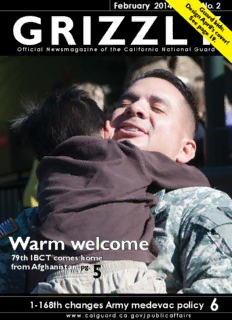
Table Of ContentFebruary 2014 Vol. 9 No. 2
D
e
s G
i
u
g
a
G R I Z Z LSYn rd
e A
e prki
p il d
ag ’s s:
e c
o
1 v
9. e
r
!
O f f i c i a l N e w s m a g a z i n e o f t h e C a l i f o r n i a N a t i o n a l G u a r d
Warm welcome
79th IBCT comes home
from Afghanistan pg. 5
6
1-168th changes Army medevac policy
w w w . c a l g u a r d . c a . g o v / p u b l i c a f f a i r s
L e a d e r s h i p C o r n e r
Make the most of annual training
Major General David S. Baldwin
This summer marks a significant milestone in the recent quickly standing up six additional joint reception centers vital role in the Cal Guard’s response to domestic emer-
history of the California National Guard, as our units will around the state to coordinate the movement of CNG and gencies and foreign contingencies.
conduct their first consolidated annual training (AT) since other military troops, delivering ready responders to in-
the beginning of the global war on terrorism more than a cident sites anywhere in California. Your readiness starts with you, and it is essential to the
decade ago. During those recent years, duty continuously security of this state and nation, as well as to the safety
called our Soldiers and Airmen overseas, necessitating a In June the forces will be delivered to four installations of yourself and your fellow Guard members. That means
shift in our training plans and objectives. With the end of around the state to respond to a three-day, multi-echelon preparing today to make sure your requisite training,
the war in Iraq and the drawdown of forces in Afghani- scenario requiring Guard support of domestic civil au- qualifications and paperwork are completed well in ad-
stan, we can now return to our pre-war cycle of events thorities. That will be followed by a three-day warfight- vance of your unit’s AT. If you are unable to participate
that incorporate all of our lessons learned during the last ing scenario and a further week of training at the brigade, in AT because of a failure to complete your schooling, li-
decade, culminating in a massive joint exercise in June. battalion or company level. censing or physical training, your unit will suffer.
Since 2001, the California National Guard has deployed Our Air wings will conduct separate AT events at loca- When you show up at AT, leave your civilian mindset at
Soldiers and Airmen more than 40,000 times, but we have tions throughout the state and nation. home and come prepared with a warrior attitude that will
never mobilized a force as large as the one that will de- enable you to exceed your leaders’ expectations and read-
scend on Camp Roberts, Camp San Luis Obispo, Fort The 129th Rescue Wing will participate in two large per- ily absorb information. Immerse yourself in the training,
Hunter-Liggett and Fort Irwin in June. Our recent mobi- sonnel-recovery exercises — Sentry Aloha in Hawaii and but keep a critical eye, taking note of bumps in the road
lizations have sent hundreds of troops at a time to places Soaring Angel at Fort Hunter-Liggett, Calif. The 162nd and identifying processes for improvement. That infor-
like Iraq and Afghanistan, where they typically fell in on CCG also will travel to Hawaii for hurricane-response ex- mation will be compiled in after-action reports and ana-
previously established bases that were well-equipped to ercise Makani Pahili. lyzed extensively to capitalize on your unit’s experiences.
sustain them.
The 144th Fighter Wing in Fresno, which recently con- Each training weekend or AT period is a chance to improve
More than 14,000 Soldiers will participate in the up- verted to the F-15 Eagle jet, will involve its entire wing our skills and prepare for the next state emergency or fed-
coming consolidated AT, requiring a different level of in an exercise of its ability to perform wartime missions eral conflict. As a reserve force, we must take full advan-
planning and a massive support effort involving Army, from a deployed location. The 146th Airlift Wing and tage of every opportunity and ensure we are cost-effective,
Air Force and California State Military Reserve person- 163rd Reconnaissance Wing will send civil engineering time-effective and rigorous in our pursuit of excellence.
nel. Designed specifically to handle such a task, the Cal contingents to Wisconsin and Massachusetts, respective-
Guard’s new Joint Task Force JRSOI — Joint Reception, ly, while the remainder of the 146th will focus on prepar- The civil-response and warfighting drills scheduled for
Staging, Onward movement and Integration — will es- ing for an upcoming deployment to Kuwait and the 163rd AT will demonstrate how each CNG unit works as a vital
tablish three locations throughout the state to process will work to finalize its upgrade to the MQ-9 Reaper re- piece of a larger whole in executing our responsibilities;
participating Soldiers. motely piloted aircraft. as a member of one of those units, your contributions are
a necessary part of that larger operation. Don’t underesti-
The task force’s headquarters is composed of 115th Re- It is incumbent upon every Soldier and Airman, regard- mate the importance of your upcoming training event or
gional Support Group Soldiers, 162nd Combat Commu- less of rank, to do their part to maximize their training your role in making it a success. Only by preparing today
nications Group (CCG) Airmen and California State Mili- time for themselves, their unit and the Guard as a whole. can we live up to our own expectations and those of Cali-
tary Reserve members from both branches. It is capable of Every troop is crucial to their unit, and every unit plays a fornia’s citizens.
Spc. Robert DeCosta of
the CNG’s 1st Battalion,
184th Infantry Regiment,
provides security for the
landing zone of a UH-60
Black Hawk helicop-
ter from the CNG’s 1st
Battalion (Air Assault),
140th Aviation Regiment,
during the units’ an-
nual training (AT) at Fort
Hunter Liggett, Calif., on
Cover Shot
July 22. More than 14,000
Soldiers from every CNG
brigade will gather at
Fort Hunter-Liggett and
three other sites across
California in June for the
Cal Guard’s first consoli-
dated AT in more than a
decade. Photo by Sgt.
Ian M. Kummer
2
Grizzly
TABLE OF CONTENTS
The Official Newsmagazine of 4 Infinite possibilities 9 TASMG makes most of deployment
the California National Guard The MQ-1 remotely piloted aircraft fills many roles for the The 1106th TASMG dodged hail and indirect fire during a
California Air National Guard productive nine-month tour in Afghanistan
February
A two-person job 12 There oughta be a law
146th Airlift Wing Security Forces personnel qualified on the New state laws will affect Guard members in 2014
two-person M-240B machine gun
2014 13 Keeping it together
Vol. 9 No. 2
5 Ready to do the job
Army-sponsored seminars strengthen troops’ marriages
Afghan police took sole responsibility for security in Uruz-
Victim advocate coordinator
gan after receiving final mentorship from the 79th IBCT
1st Lt. Anna Yribe is the newest member of the CNG’s Office
Publisher Home for the holidays
of the Sexual Assault Response Coordinator
Maj. Gen. David S. Baldwin
Christmas came early for 79th IBCT families, as the troops
The Adjutant General 14 Cyber partnership program
made it home from Afghanistan in December
Director of Public Affairs CNG Airmen traveled to Ukraine to foster cybersecurity and
6 At the top of their game
Lt. Col. Thomas Keegan further the Guard’s State Partnership Program
CNG combat medics bring an uncommon level of experience
Editor Thank you for your support
to medevac operations
Brandon Honig
Google is the latest company to express its desire to further
Effecting change for the better
Layout and design Guard and reserve members’ civilian career goals
Capt. Jason Sweeney CNG medics proved their value in Afghanistan, prompting
Getting excited for tax time
Staff Sgt. Felipe Arellano the Army to rethink its medic-training program
Learn how to sound smart at your next techno 1040 tax party
7 Time is of the essence
15 Back to basics
Every second counts when transporting injured Soldiers to
receive the medical care they need 1-144th Field Artillery Battalion troops qualified on the rifle
Submissions range and completed other essential training in January
Mountain rescue
Continuing education
A CNG medevac crew put its training into action with a life-
Articles:
saving rescue atop an Afghanistan mountain A former marksmanship instructor for the recently disbanded
Articles range from 350 to 2,000 words. Task Force Warrior takes every chance to share his knowledge
8 Bursting with potential
All articles should be accompanied by
Been there, done that
Sunburst Youth ChalleNGe Academy congratulated nearly
multiple high-resolution images.
200 new graduates Cheryl Harvey Hill served in a CNG infantry unit decades
Include first names, last names and mili- before restrictions on women’s combat service were lifted
tary ranks. Always verify spelling. Community/Base organization
16 Best of both worlds
Spell out acronyms, abbreviations and Joint Forces Training Base, Los Alamitos, welcomed 15,000
community members for the Wings, Wheels and Rotors Expo 1st Lt. Wilson Ugah’s Nigerian upbringing and American
full unit designations on first reference.
birth helped produce a top-notch U.S. Army officer
Only submit articles that have been Essential
approved by your unit’s public affairs 17 Keck named top enlisted leader
officer. maintenance Chief Master Sgt. Kristina Keck is the first Airman to serve as
the CNG’s senior noncommissioned officer
Photographs: 9 Roll out the red carpet
Highest resolution possible: MB files, Guard members enjoyed a free advanced screening of “Lone
not KB. Survivor,” based on the true story of a Navy SEAL mission
No retouched photos, no special effects. 18 SOS helps in hard times
Include the photographer’s name and The Army’s Survivor Outreach Services supports families of
rank, and a caption: what is happening in the fallen
the photo, who is pictured and the date
Autopilot is for flying, not for eating
and location.
Fitness guru Maj. Jonathan Shiroma talks turkey
E-mail submissions and feedback to:
[email protected]
In Every 2 Leadership 10 At a 19 News & 19 Did You
Issue Corner Glance Benefits Know?
Cover Shot
January
California National Guard mobilizations as of 2014
Asia
Continental U.S. Europe
Air
209
Army
216
Photo by Afghanistan
Antarctica
Master Sgt. Julie Avey
Afghanistan Kuwait Bahrain
Germany
536 2
Horn of Africa
Lyonel Mancilla, 4, leaps into the arms of
Kuwait
his father, Staff Sgt. Adan Mancilla of the Africa Kosovo Other
Kyrgyzstan
79th Infantry Brigade Combat Team, after 24 85 Oman
the Soldier surprised his children Dec. 11 at Qatar
the San Diego Zoo following a nine-month 22
deployment to Afghanistan.
Air Army
3
Grizzly | 2014 | February
163rd brings RPA to variety of joint missions
The MQ-1 remotely piloted aircraft boasts a wide range of capabilities for foreign and domestic ops
By SENIOR AIRMAN MICHAEL QUIBOLOY P
h
o
163rd Reconnaissance Wing to
b
y M
One asset. Infinite possibilities. aste
r Sg
From civil support to joint forces warfighting, much of t. Ju
the future of the Air National Guard’s dual mission lies lie A
squarely on the wings of the increasingly useful remotely vey
piloted aircraft (RPA).
The 163rd Reconnaissance Wing’s MQ-1 Predator RPA has
been utilized in a growing range of operations, most re-
cently in training with the crew of the Navy’s USS Ronald
Reagan off the California coast Nov. 6-13.
The sister services united in an effort to test the ship’s
radar-tracking systems and provide the crews a chance
to acquaint themselves with joint operations, said Lt. Col.
Andre Boyd, chief of wing plans for the 163rd. In addition
to standard intelligence, surveillance and reconnaissance
support, the wing showed the USS Ronald Reagan the vid-
eo capabilities the Predator can offer and tested the ship’s
ability to receive the RPA’s video feed.
The exercise with the Navy came just weeks after col-
laborative training efforts between the 163rd and several
Army units, which also made use of the MQ-1’s unique Senior Airman Thomas Thornburg of the 163rd Reconnaissance Wing directs an MQ-1 remotely piloted aircraft after a training
capabilities. flight in 2012 at the Southern California Logistics Airport in Victorville.
Coordinating through the Army’s National Training Cen- and they “[learned] to speak each other’s language,” Shaw hours a day, relaying real-time infrared and electro-optic
ter at Fort Irwin, Calif., the 163rd Reconnaissance Wing said, as each branch uses different terms on the radio. video to incident commanders on the ground. This en-
Formal Training Unit cooperated with Army troops in a abled them to more effectively combat the fire and ensure
live-fire “buddy-lase” exercise in October. The buddy-lase The 163rd worked in a different type of joint environment the safety of hand crews on the ground.
tactic uses the Predator’s laser targeting system to enable in August, when it teamed with the U.S. Forest Service and
an Army missile fired from an AH-64 Apache helicopter to the California Department of Forestry and Fire Protection “In the first 30 to 45 minutes [of viewing the Predator video
strike a target with extreme precision. Employed at war, (Cal Fire) to battle the Rim Fire, which scorched more than feed], I saw more of the fire than I had in four days of hik-
this tactic would be safer than a manned aircraft provid- 220,000 acres in and around Yosemite National Park. His- ing it,” said Cal Fire Capt. Jeremy Salizzoni. “We were able
ing the buddy-lase, said Maj. Jeffrey Shaw, a pilot with tory was made during that mission, as it was the first time to isolate, identify and act upon spot fires that would have
the 163rd. a National Guard RPA was used to aid a domestic firefight- become extensions of the fire in minutes, not hours.
ing effort.
MQ-1 pilot and sensor operator trainees saw their train- “I don’t think we’ve even scratched the surface of its capa-
ing come to fruition with real artillery during the exercise, The MQ-1 flew over the massive blaze for upwards of 20 bilities for public safety,” he added.
146th SecFor qualify on M-240B P
h
o
to
s b
y Se
n
Security Forces Airmen test out machine gun equipment upgrade io
r A
irm
an
By SENIOR AIRMAN NICHOLAS CARZIS “Being afforded the training opportunity at Camp San Luis Nich
1M4e6mth bAeirrlsi fot Wf thineg 146th Airlift Wing Security Forces Squad- OOanbbdiiss dppeooc rliisen agalrltyeioa dnt i ffftoherer uesnhs topioarttoeinxsi gimt rsiaetnylfg- bwee iocsaffeu,e sbrseu, ”ot fCM tahames tipen rcS Slaignnta .L tMiuoiins- olas Carzis
ron spent a week training and qualifying to operate heavy chael Stevens said.
weapon machinery at Camp San Luis Obispo, Calif., in
December. The Airmen paired up in groups of two and took turns
firing the M-240B, a belt-fed, two-man-operated machine
The base’s remote firing range is hidden in the hills of gun. Working together, the Airmen relied upon each
Central California, with targets up to 500 yards away scat- other to effectively operate the weapon. The Airman who
tered across the shooter’s line of sight. The weather was was not firing the weapon would suggest adjustments
cold and unpleasant in December, but the 146th Airmen when the shooter was off target, and the pair would work
didn’t appear to mind: This is the type of training they together to change the gun’s red hot barrels and replace
look forward to. ammunition.
“This was a new training scenario for the Airmen here, as
they were able to utilize the new M-192 tripods,” Stevens
said. “The tripods are a great upgrade compared to the
earlier, phased-out M-220 version. Qualifying on the new
equipment is important, and we are happy that the 146th
Airlift Wing was one of the first Air National Guard units
authorized to get them.”
With the training opportunity provided by Camp San Luis
Obispo, the members of the 146th Security Forces Squad-
ron will be ready and confident to jump into the fight when
needed. ABOVE: Staff Sgt. Steven Goss of the 146th Airlift Wing ob-
serves as Airmen operate an M-240B machine gun Dec. 10
“The support staff at Camp San Luis Obispo is of the high- during a heavy weapons certification course at Camp San Luis
est quality and caliber,” Stevens said. “The professionalism Obispo, Calif. LEFT: Tech. Sgt. Aaron Burgess fires an M-240B at
that was extended to us was excellent.” Camp San Luis Obispo.
4
Grizzly | 2014 | February
Afghan forces take P
h
o
to
b
y Sg
t. Je
the lead in Uruzgan ssi A
n
n
M
cC
o
rm
79th IBCT mentorship aids transfer of security ick.
responsibility to local police in Afghan province
By MAJ. HAYDN BARLOW those are not a major concern.
Australian Army
“At the end of the day, they don’t matter,”
Law enforcement in Afghanistan’s Uruz- he said, “because they are not where the re- would be difficult to teach if we did not P
h
gan province has reached a state of inde- sources are, not on lines of communication have those skills already in the team,” he oto
b
pendence, according to a senior coalition and not where the people live.” said. “But more than that, the Afghan po- y C
police adviser and CNG officer. lice feel more comfortable when they know pl. H
Partnering in recent years with a mix of they have fellow officers from agencies like aro
ld
Lritt.y C Foolr. cJeo nA Rss. iSstiaenpcmea Tnena mof sthaye s1 t8h4eth S oSeuctuh-- Uva.Sk.i,a nA utrsotroaplisa, nA, fDghuatcnh ,s eFcruernictyh faonrdce sS loin- tinhge tLhoesm A onng eploelsi cPeo wlicoer kD.”epartment advis- Flynn
ern Afghan province is now controlled by Uruzgan have steadily increased their
local Afghan security forces. reach and taken on more responsibility. One of the SFAT’s unlikely contributions
They have graduated from the days of liv- to the police force was helping them over-
“They are the clear center of gravity for ing and fighting side-by-side with a coali- come Uruzgan’s physical isolation.
providing security,” he said. “The police tion unit and now execute independent
are on the front lines of this fight, manning operations. “We brought them the internet,” Siepmann
the checkpoints and interacting with the said. “This has taken them from a system
population on a daily basis.” Combined Team Uruzgan will soon leave that relied on hand delivery over hundreds
the province altogether. of kilometers to one that can send and re-
Siepmann is one of about 70 members of ceive information from Kabul and Kanda-
the CNG’s 79th Infantry Brigade Combat Siepmann attributed Uruzgan’s success, in har instantly. … Opening lines of commu-
Team who deployed in April to support part, to local leader Matiullah Khan, who nication can have an incredible impact.”
Operation Enduring Freedom. A portion of has grown to be one of the country’s most
those Soldiers made up the 184th SFAT, effective provincial chiefs of police. With some advisers focused on improving
with the remainder serving as part of Com- the functionality of the police headquarters
bined Team Uruzgan, an Australian-led “In a place like this, you need strong leader- in the provincial capital Tarin Kot, other
force that mentors Afghan National Secu- ship,” Siepmann said. “Without it you lose members of the SFAT contributed to train-
rity Forces. direction and consistency, and consistent ing Afghan police officers.
behavior from the police is vitally impor- TOP: Soldiers with the CNG’s 79th Infan-
The 79th IBCT Troops returned to Califor- tant in a counterinsurgency fight. The most “Our principle achievement was to facili- try Brigade Combat Team prepare to raise
nia in December, having successfully over- important thing they have done is gain the tate formal instruction for nearly 300 po- the U.S. flag at Multinational Base Tarin Kot
seen the transition to full police indepen- support and trust of the population. lice in areas like logistics, bomb detection, in Uruzgan province, Afghanistan, on Aug. 5.
dence in Uruzgan. medical treatment and evidence collec- ABOVE: Sgt. Jeffery Nelan of the 79th pro-
“Brigadier General Khan is from this prov- tion,” Siepmann said. “These more refined vides security during a leadership engagement
“It is certainly a big achievement, and the ince; this is his home,” he added. “He is skills are still lacking throughout their at the Afghan Uniformed Police headquarters
progress in this province in recent years has responsible not just to the Ministry of In- force, but they have made significant gains in Uruzgan on Sept. 25.
been particularly impressive,” Siepmann terior, but also to the community, and that in a number of critical areas.
said. “The security forces are denying the makes a difference.”
enemy access to the district centers and the “For the first time ever, they took evidence “Tarin Kot is a clean city. I rarely see gar-
ability to move freely in the province. Siepmann said the 184th SFAT includes from a bomb blast, processed it effectively bage, but I do see constant productivity.
three Cal Guardsmen who work in law en- and transported it to the crime lab in Ka- There are paved roads where only a few
“This is police ground now.” forcement in their civilian lives, which lent bul,” he said. “This had never happened.” years ago there were none.
his team credibility.
Siepmann said there are still valleys and As his tour came to a close, Siepmann said “The markets are vibrant,” he said. “And so
remote areas with Taliban influence, but “Things like evidence-based operations he sees hope for the people of Uruzgan. are the people.”
Ph Santa brought gifts to run in the house and give cause of him and people
o
to b my children hugs.” like him. It feels good he is
y M creating these opportunities
aste 79th IBCT makes it home for the holidays Mancilla restrained him- for others.”
r Sgt. Julie By MASTER SGT. days as we weren’t sure if hseisl fk, itdhso uthgeh ,n aenxtd dsauyr parti stehde In Afghanistan the 79th
Ave JULIE AVEY he would be home or not.” San Diego Zoo. During the troops mentored Afghan se-
y
San Diego Regional Public Affairs Bird Show exhibit, the kids curity forces and police.
Britton was one of about 70 were called on stage as vol-
Watching. Waiting. “Hurry Soldiers with the California unteers and were shocked “The experience working
up, Dad!” Serenity Britton, Army National Guard’s and overjoyed to see their with another country and
4, says to herself, anxiously 79th Infantry Brigade Com- dad take the stage as well. culture was rewarding,”
scanning the arriving pas- bat Team who returned to They quickly ran to hug Mancilla said.
sengers at San Diego Inter- California in December, him as the crowd erupted in
national Airport on Dec. 10. brightening the holidays cheers and tears. The Soldiers made calls
Finally, Serenity spots her for the troops and their home when they first ar-
dad, runs, jumps into his families. “This was fantastic. They rived in the United States,
arms and refuses to let go of were so surprised,” said but there’s no substitute for
his neck. Staff Sgt. Adan Mancilla Adam’s wife, Neisy. “We meeting in person.
and his wife made Dec. 10 are so relieved to have him
“We’re not only happy to a special day just for them home safe with the family “It made all the difference
have Dad home for Christ- and postponed his reunion for the holidays. when I received his phone
mas but happy he’s home with their children. call,” said Jennifer Mu-
in time for Serenity’s fifth “Sometimes people do not noz, fiancée of Spc. Marco
birthday,” said Sherri Brit- “It was difficult as we drove realize the sacrifice families Nunez. “Of course now
Maj. Bobby Britton of the 79th Infantry Brigade Combat ton, wife of Maj. Bobby Brit- by the house,” he said later. go through,” she continued. that he is here with us for
Team returns home to San Diego on Dec. 10 following a ton. “We didn’t make any “I wanted to just say, ‘Nev- “Some of the amenities we Christmas it is even more
nine-month deployment to Afghanistan. drastic plans for the holi- er mind our plan.’ I wanted have in this world are be- outstanding.”
5
1-168th Medevac
The ‘Nightmare’ P
h
o
to
b
y C
ap
t. A
n
begins for 1-168th dre
w
C
o
ch
ran
By CAPT. ANDREW COCHRAN The 1-168th is also old hand at the “back
Combat Aviation Brigade, 1st Infantry Division wall” medic program, which places
a second medic inside the medevac
A California National Guard-based medical helicopter to care for patients. Two medics
evacuation (medevac) unit that includes are better at evaluating a patient’s condition
Soldiers from Nevada and Washington is and providing the proper treatment on
bringing a whole new level of experience the way to the surgeons, said company
to Task Force Nightmare in Afghanistan. standardization medic Staff Sgt. Andrew
Neal.
Most of the medics in Company C, 1-168th
General Support Aviation Battalion, work “Back home, if you call 911 for a homeless
full-time in emergency medical services or drunk, you get four paramedics and a
the medical field in their civilian jobs. fire truck,” Neal said. “If you don’t treat Afghan and U.S. military personnel rush a wounded Afghan Soldier to a UH-60 Black Hawk
a patient the right way on the battlefield, flown by Company C, 1-168th General Support Aviation Battalion, at Forward Operating Base
“Out of the 25 medics in my company, 19 death might come later instead of sooner, Delaram II, Afghanistan, on Nov. 14.
are either paramedics or registered nurses or a patient’s quality of life after recovery
who work in the medical field full-time might be worse.” treating injuries quickly and by trained their civilian experience to the fight, and he
back home,” said 1st Sgt. Joseph W. Loader medical professionals. respects and trusts them implicitly.
of Company C, who is a combat medic Aerial medical evacuation assets are highly
and a certified paramedic. “I even have sought after by the International Security Task Force Nightmare Commander Lt. Col. “I truly believe the medevac company is
a trained physician assistant filling in as Assistance Force and Afghan forces alike Fred Dufault said he believes in the the most experienced out there and is at the
medic.” because of the proven critical nature of company’s “quiet professionals” bringing top their game,” Dufault said.
“I truly believe the medevac company is the most
experienced out there and is at the top their game”
— Lt. Col. Fred Dufault, Commander, Task Force Nightmare
‘A-Team’ changes Army medevac policy
CNG medics outperform active duty teams in Afghanistan, prompting Army to improve its training
By SGT. IAN M. KUMMER wants; it acts based on data, statistics, trends and
69th Public Affairs Detachment studies,” Anderson said. “So I was very strict with my
See the CNG
[data collection]. In every mission, every patient had to
Throughout most of human history, death on the medevac study in the be entered in the system.”
battlefield was unavoidable. Even injured Soldiers who
Journal of Trauma and Acute
lived to see an operating table were likely to die from lack Army medics in Afghanistan face a unique challenge:
of sanitation or awareness of basic medical concepts like Care Surgery: The distance between the medical unit and the patient’s
circulation. For the U.S. Army, the likelihood of fatality unit can be far greater than in more-urban combat zones,
has been reduced incrementally with each successive http://tinyurl.com/klq6pvb and the flight is therefore much longer.
conflict, not just through improving technology but by
improving the training given to Soldiers. Even after rescue, the journey for a critically injured
patient is far from over. After being stabilized in a
In December 2008, California, Nevada and Wyoming helicopters for a medevac mission. Every flight medic hospital, the troop must be transported for long-term
Army National Guard Soldiers from Company C, in the company had received the 21-week Army course treatment, again under the watch of a flight medic.
1-168th General Support Aviation Battalion (GSAB), qualifying them as basic emergency medical technicians
deployed to Afghanistan with fifteen UH-60 Black Hawk (EMT-Basic), but they all also had another qualification: “So now you could have an EMT-Basic medic again
These Soldiers were civilian paramedics. Not only were handling an [intensive care unit] patient,” said Staff Sgt.
Ph they more extensively trained than EMT-Basic medics, Emmett Spraktes, who deployed with the 1-168th.
o
to most of them cared for patients on a daily basis.
b
y M Even the most qualified medic may face factors beyond
aj. Tim This increased training paid off. A study based on data their control, which means preparation is essential.
M gathered by Company C and published in the Journal of
e
ie Trauma and Acute Care Surgery in August 2012 showed “Even if you don’t make any mistakes, what if one patient
r
the unit’s patients had a 66 percent higher rate of survival was dehydrated when he left on the mission, so he bleeds
than those evacuated by other units. out faster?” said Sgt. John Gonsalves, noncommissioned
officer in charge of the CNG’s Task Force Warrior pre-
“I supported the recruitment of paramedics and deployment training assistance element.
provided aggressive medical training, including live-
tissue training and hospital rotations,” said Maj. Dan This medical mission is a key example of citizen-Soldiers
Anderson, who commanded the GSAB in Afghanistan. bringing their civilian job skills to their duty in a combat
“I had the ‘A-Team’ of medic noncommissioned officers.” zone.
The Army took notice of the 1-168th’s success and “A medic in the active duty Army may not take care of
changed its standards accordingly. The Army now patients every day,” Spraktes said. “But this is what we
plans to certify about 950 active duty flight medics as do for a living; we have hands-on patients all the time.”
paramedics in a newly created 55-week training course.
Medics with Company C, 1-168th General Support Aviation To view the study that convinced the Army to change its
Battalion, train at Camp Roberts, Calif., in February 2013. “I knew the Army does not change over feelings and training standards, visit http://tinyurl.com/klq6pvb.
6
1-168th Medevac
The Critical ‘golden hour’ P
h
o
to
b
y C
p
l. P
When transporting wounded troops, every minute is crucial to survival au
l P
e
te
By CPL. PAUL PETERSON get there a minute too late if the patient is important for the patient. He knows the rson
2nd Marine Expeditionary Force going to die.” same for me.”
Helicopter 865 touched down outside the Waller and fellow medic Sgt. Jeffrey Jacobs The two have handled roughly 30
medical tent at Forward Operating Base wrapped the ANA Soldier in a green wool trauma cases during their six months in
Delaram II, Afghanistan, just shy of 8:50 blanket Nov. 14 and strapped an oxygen Afghanistan. Since medical evacuation
a.m. on Nov. 14. Afghan National Army mask around his face. flights are for urgent patients only, they’ve
(ANA) medics had rushed an injured ANA honed their skills on the razor’s edge of life
Soldier into the base nearly 20 minutes “The fact that we are taking them up to and death for the patients in their care.
earlier and staunched the blood flow from altitude means … the oxygen levels in the
a gunshot wound in the lower abdomen. blood are not going to be as high as on the “Just the two medics in the back are
The wound posed a significant threat to the ground,” Waller said. performing the jobs of almost eight people
Soldier’s life, so the medics requested an in the hospital,” Jacobs said. “It’s humbling.
airlift to a surgical facility at Camp Bastion, Waller and Jacobs moved feverishly about At that point, you know it’s just you.”
Afghanistan. the helicopter with an unspoken sense
of purpose. Waller prepped a syringe, The nature of the helicopter itself is a
“We have an hour to get that patient — from holding the needle out for his partner to constant challenge, Waller added. The
the time they incurred their injury — to a see, as Jacobs tied off the patient’s right arm medics crawl around on their knees,
major hospital,” said Sgt. Jeffrey Jacobs, a and coaxed a vein to the surface. hooked to the helicopter by a safety
medic with the CNG’s Company C, 1-168th strap. The weight of their gear and the
General Support Aviation Battalion. “We’ve gotten used to each other’s body cramped conditions make it difficult to Spc. Ryan Waller of Company C, 1-168th
language and the flow of events,” Jacobs conduct traditional patient assessments. General Support Aviation Battalion, treats
Often referred to as the “golden hour,” said. “I can look at him, see what he’s The shearing sound of the engines drowns a wounded Afghan Soldier aboard a UH-60
medics know an injured troop’s chance of doing, and prep for what’s next.” out their ability to shout back and forth. Black Hawk helicopter while flying the patient
survival decreases greatly if more than 60 Unable to feel for a pulse or listen to the to Camp Bastion, Afghanistan, on Nov. 14.
minutes pass before reaching that hospital. Jacobs slid his needle into the Soldier’s arm patient’s lungs, they rely on an array
near the bend in the right elbow; Waller was of medical equipment and instincts to
“That ‘golden hour’ takes into account the already doing the same on the other side. monitor vital signs. By 9:11 a.m., Helicopter 865 touched down
time of injury to surgery,” said Spc. Ryan at Camp Bastion, where Waller and Jacobs
Waller, the lead medic for the Nov. 14 flight “The trust factor is huge,” Waller said. “The back [of the helicopter] really is where turned the patient over to critical care
to Camp Bastion. “We don’t know if we “I know if he is off doing something, it’s we shine,” Waller said. personnel waiting by the flight line.
Lifesaving training kicks into reality
By CPL. CLAY BEYERSDORFER Army training center at Shindand, was aircraft requiring immediate assistance. from all the training and experience I have
ISAF Regional Command South conducting pre-flight checks that day with had, it just becomes mechanical.”
a student. This was a routine Miller had “I got the call, and it was just go-time,”
Eight Cal Guard Soldiers make their been performing at Shindand for nearly a Lovett says. “We scrambled together, got Easter and his crew hoisted the two
way into a dimly lit tent on a brisk year, as he was just weeks from going home. in contact with a quick reaction force team individuals to the aircraft in litters, in what
December morning at Shindand Air Base, and we moved out immediately.” Lovett says took only an hour.
Afghanistan. This isn’t the first time these Miller and his Afghan co-pilot set off to
Soldiers from Company C, 1-168th General practice landing helicopters on top of small Miller removed himself and his co-pilot “We weren’t thinking about anything else
Support Aviation Battalion, have gathered points of mountain ranges, or “pinnacles.” from the burning aircraft, even though he or enemy threat,” Lovett says. “Thanks to
together, nor will it be the last time they tell had a severely fractured leg, and applied the quick reaction force team we had both
the story of the day they met Andy Miller. “What happened next was something out a tourniquet to himself and three to his up in the air and on the ground, we were
of a movie, something you just couldn’t co-pilot. Lovett adds that Miller doesn’t able to extract Andy and the Afghan pilot
Each has their own perspective on that day, believe,” Company C Commander Maj. remember doing any of this, “Probably quickly.”
Sept. 7, 2013, each with a different role, a David Lovett says. because of the sheer pain he was in. He was
different task, all of which played a part in running on pure adrenaline.” He smiles and says that only 24 hours
what became a lifesaving mission on top of As the helicopter touched down, it set off earlier, his Soldiers had been practicing the
a mountain in Western Afghanistan. a pressure-plate improvised explosive It was an “all hands on deck” situation, as exact same skills.
device, which destroyed the helicopter, crews from the 1st Attack/Reconnaissance
Chief Warrant Officer 4 Miller, a helicopter leaving a blazing, smoking frame. Back on Battalion, 135th Aviation Regiment, “It was just some weird form of irony that
instructor pilot at the Afghan National base, Lovett received a call of a downed Missouri National Guard, who were in the literally the day after we trained, here we
area conducting their own maintenance are doing this,” Lovett says. “It’s just crazy
Ph mission, flew in to provide aerial security, how things happen.”
o
to and Soldiers from 1st Battalion, 214th Field
b
y C Artillery Regiment, Georgia National Easter, along with the other seven soldiers
p
l. C Guard, provided ground security. in the room, echo that statement.
lay B
e
ye When the medevac crew arrived, 1st Lt. “It was just perfect timing,” he says. “It was
rsdo Thomas Easter, a physician assistant (PA) fresh in everyone’s minds; everyone knew
rfer with Company C, was one of the first on the what they had to do.”
ground. Easter’s helicopter hovered over
the crash site, and he was lowered down Less than a week later, Miller was being
to Miller and his co-pilot, who were both treated at Fort Gordon, Ga. A couple of
unable to move because of their injuries. months after that, he wrote an email to
Task Force Nightmare leadership to thank
“When I first got down there, I saw the the people who had saved his life.
burning aircraft and I knew it wasn’t going
to be good,” Easter says. “Thankfully … “A ‘thank you’ surely does not sum up
they were responsive and talking to me.” how thankful I truly am. Your Soldiers,
[noncommissioned officers] and officers
At that point, instinct took over, he says. truly saved my life that day,” Miller
wrote. “And even though I don’t know
“I work as a PA in the emergency room any of the names of those involved, I am
Cal Guard Soldiers with Company C, 1-168th General Support Aviation Battalion, disembark back on the civilian side,” Easter says. “As no less thankful to the professionals who
a UH-60 Black Hawk helicopter at Forward Operating Base Delaram II, Afghanistan, in 2013. a medic, you just have so many tasks, and rescued me.”
7
Grizzly | 2014 | February
Sunburst creates future stars P
h
o
to
s b
y S
g
Los Alamitos Youth ChalleNGe Academy celebrates 198 new graduates t. M
atth
e
w
By SGT. MATTHEW WRIGHT in your future,” U.S. Rep. Grace “The program has two phases them during phase two. A. W
40th Infantry Division Napolitano said, addressing the that the teens go through, which rig
h
cadets. “Reach for the stars; even if lasts a total of nearly 18 months,” “The post-residential phase is t
Nearly 200 students from the you fail, you’ll land on the moon.” said Chief Warrant Officer 2 (CA) when the students go back to
CNG’s Sunburst Youth ChalleNGe Robert Karleskint, a counselor at their high schools and continue
Academy attended a Dec. 13 The 198 cadets from Sunburst Sunburst. “The first 22 weeks, the to get their education, and they
graduation ceremony in Los Class 12 arrived at the ceremony teens are in a residency phase at will meet with their [Sunburst]
Alamitos. The graduates had lived with their heads held high. They Los Alamitos, going to school and mentors at different times to see
at Joint Forces Training Base, Los composed the third straight class receiving care and attention from where they are at,” Karleskint
Alamitos, for five months while to boast a 90 percent retention the teachers and staff to help lead said.
completing the residential phase rate, meaning nearly all the them in the right direction.”
of Sunburst’s school program for cadets successfully completed Not every Sunburst student
troubled teens. the residential phase. The mean During that phase, each student follows the same path, however.
grade point average for Class 12 developed a relationship with a Out of 198 students graduating
“The state of California invests was about 3.5 of a possible 4.0. mentor who will follow up with the residency phase in December, ABOVE: Sunburst Youth ChalleNGe
34 also graduated from their Academy cadet Jimmie Breland
respective high schools and sings the national anthem during a
celebrated that achievement in graduation ceremony celebrating
Los Alamitos on Dec. 13. Sunburst Class 12’s completion of
the program’s residential phase at
Three-quarters of the funding CNG Joint Forces Training Base, Los
for Sunburst comes from the Alamitos. LEFT: Class 12 cadets lis-
federal government, with the ten to a guest speaker at the gradu-
state of California providing the ation ceremony.
remaining 25 percent.
Dr. Jeff Hittenberger, chief Sunburst experiences with the
academic officer for the Orange crowd, describing how they
County Department of Education, changed from troubled youths
said the Sunburst cadets had with no direction or ambition to
shown attributes that will serve solid students with goals and a
them well for the rest of their strong drive to improve.
lives.
Graduate Kimberly Gutierrez
“I grew up in Haiti,” he said to said her and her fellow students’
the graduating class. “The two time at Sunburst was valuable,
words that people live by there and they would not let it go to
are ‘resilience’ and ‘grit,’ and that waste.
is something you have and will
show as you go through life.” “We are grateful for this, and
we won’t let you down as we go
Several graduates shared their forward in our lives,” she said.
JFTB welcomes community for WWR Expo
By LT. COL. (CA) RICK LALOR fornia State Assemblyman Allan “and we were grateful to receive Jones said the National Guard serve at JFTB, Los Alamitos, are
CNG Recruiting & Retention Battalion Mansoor. formal recognition from a number is working hard to support the proud to be a part of our local
of officials, including a certificate people in its communities. communities and look forward
The citizen-Soldiers of the Cali- “Whoever penned the words of congressional recognition to continuing those essential
fornia Army National Guard ‘it takes a community’ could from U.S. Rep. Loretta Sanchez “All of us who are privileged to partnerships,” he said.
stationed at Joint Forces Training very well have conceived that that commended the organizers
Base (JFTB), Los Alamitos, swung phrase for Wings, Wheels and for their dedication and skill
P
open the gates to their base on Rotors,” said Maj. Gen. Keith D. in overcoming a number of h
o
Oct. 27 and welcomed the citizens Jones, commander of the 40th challenges, including the federal tos b
they serve to the 12th annual Infantry Division and JFTB Los government shutdown of 2013.” y P
Wings, Wheels and Rotors Expo. Alamitos. “Multiple agencies fc. (C
A
and organizations collaborated JFTB Deputy Commander Lt. Col. ) D
An estimated 15,000 people together in partnership with the Nathan Range said it is important avid
attended the event, which was base to create an event that not for the JFTB to provide a safe and Zaslo
sponsored by the Los Alamitos only entertained our community secure environment for the public v
Area Chamber of Commerce. The members, but also helped to attending Wings, Wheels and
Chamber donates a portion of educate them regarding the Rotors.
the proceeds to the JFTB Morale, availability of many community
Recreation and Welfare Fund. services and showcased the “Due to the government
important missions of the JFTB shutdown and the resulting
There was plenty for the crowd to and the National Guard.” manpower challenges we faced,
enjoy, including military displays, there was serious concern during
vintage warbirds, helicopters Los Alamitos Army Airfield at the the three weeks leading up to
from the Guard and other public JFTB is the only military airfield event weekend whether we would
safety organizations, a car show in the greater Los Angeles/Orange have to cancel,” he said. “But
featuring more than 300 vehicles, County area, and JFTB is home to when the California State Military ABOVE: Wings, Wheels and Rotors
live music, a variety of vendors the Southern California Regional Reserve’s Installation Support Expo attendees check out aircraft at
and even a pumpkin patch. Emergency Operations Center. Command committed more than Joint Forces Training Base, Los Alami-
50 Soldiers to handle security and tos, on Oct. 27. LEFT: Retired CNG
A number of national, state and “This is truly a community other mission-essential tasks, it aviator Chief Warrant Officer 4 Ron-
local elected officials attended event,” said Johnnie Strohmyer, gave us the confidence to move ald Warner shows the flight controls
this year’s event, including U.S. chief executive officer of the Los forward, and we were very of a UH-60 Black Hawk helicopter to
Rep. Alan Lowenthal and Cali- Alamitos Chamber of Commerce, pleased with the outcome.” his nephew Nicholas Warner, 11.
8
Grizzly | 2014 | February
Mission accomplished: TASMG returns home
By CAPT. JASON SWEENEY
California Military Department Public Affairs
Soldiers from the 1106th Theater Aviation
Sustainment Maintenance Group (TASMG)
Task Force 14 returned home in December
just in time for the holidays after success-
fully completing a nine-month mission to
Afghanistan and Kuwait.
“Being home in time for Christmas was
definitely a treat,” said Capt. Chris Renner,
who deployed with the task force. “I’m
glad we got everyone home safe. That’s the
biggest thing.”
The 1106th TASMG, based at an aviation
facility in Fresno, is tasked to perform
aircraft maintenance for Army National
Guard aviation units in 13 western states.
In February 2013, about 100 Soldiers from
the TASMG were mobilized into Task
Force 14 and deployed to Afghanistan and
Kuwait. The task force was assigned to pro-
vide depot-level maintenance for two com- CLOCKWISE FROM TOP: Soldiers of the 1106th Theater Aviation Sustainment Maintenance Group Task Force 14 gather at Camp Arifjan, Ku-
bat aviation brigades (CABs) in theater that wait, on Dec. 13 at the end of a nine-month deployment that took some members to Kuwait and others to Afghanistan. Photo by the U.S. Army
were in command of about 400 aircraft. The Staff Sgt. Robert Schaubschlager, left, and Sgt. David Amezola prepare a helicopter engine for diagnostic evaluation at Camp Arifjan. Photo
task force was responsible for repairing by Spc. Martha Lozano Staff Sgt. Demetrius McCowan works to fabricate an AH-64 Apache helicopter part at Bagram Airfield, Afghanistan.
aircraft that had sustained damage beyond Photo by Staff Sgt. Patricia Galloway Task Force 14 Detachment I leaves its mark on a blast wall at Camp Arifjan. Photo by Spc. Martha Lozano
the level that the brigades could repair on
their own. veloped a battle rhythm of work, exercise, “Our Soldiers did great,” Williams said. summer temperatures that exceeded 120
self-improvement and rest,” Cabrera said, “They were extremely knowledgeable and degrees.
“Since their first deployment in 2004-2005 adding that the task force’s mechanics and knew what they needed to do.”
as the 1106th Aviation Classification and maintenance test pilots were able to hone “I had a good crew,” Detachment I non-
Repair Activity Depot, followed by anoth- their skills during the deployment. Capt. Joseph Burke, officer in charge of De- commissioned officer in charge Master Sgt.
er tour in 2009-2010, the TASMG has set a tachment II, said his detachment’s bread Rebecca Calleja said. “They kept busy.”
precedent of specialized aircraft mainte- Lt. Col. Bruce Malarky was the officer in and butter was repairing crash- and battle-
nance praised by Army combat aviation charge of Detachment III. damaged aircraft. With just six weeks left in the deployment,
brigades in combat zones,” TASMG Com- the International Security Assistance Force
mand Sgt. Maj. Ronald Cabrera said. “If an aircraft was shot, we repaired it,” “Certain locations had a lot of damage Joint Command in Kabul instructed the
Malarky said. “Three had been shot up from indirect fire, and there were a couple task force to shut down its operations at
During its most recent deployment, the through and through while we were at direct fire engagements on aircraft that we Mazar-i-Sharif and consolidate them at
Soldiers of Task Force 14 repaired aircraft Kandahar.” had to repair,” he said. Bagram.
that were damaged by direct fire, indirect
fire, hard landings, normal wear and tear, Malarky said Kandahar Airfield was hit Burke said the detachment’s machinist, “I honestly did not think it could be done
and at one point, a severe hailstorm that se- by 41 rockets during the nine months his Staff Sgt. Adrian Lizarraga, was able to as fast as we did it,” said Renner, the of-
riously damaged about 80 aircraft. detachment was there. Fortunately no one manufacture many needed parts and spe- ficer in charge of Detachment IV. “I was
was injured. cial tools that were unavailable or would extremely pleased with how fast my guys
“If there was complex-type damage to an have taken too long to arrive in country. took care of that work.”
aircraft, our guys repaired it,” task force On April 23, when the task force had been
Commander Col. Myles Williams said. in country for about a month, a hailstorm At one point an AH-64 Apache attack heli- Renner said the detachment shut down
hit Kandahar, damaging more than 80 heli- copter was unable to fly because of a miss- within 30 days of receiving the order, with
The task force was organized into four de- copters assigned to the 3rd CAB. ing bracket. The bracket would have cost all equipment accounted for.
tachments. Detachment I was assigned to about $60,000 and taken a long time to ar-
Camp Arifjan in Kuwait. Detachment II, “It was pretty intense,” Malarky said of rive. Two Soldiers in the detachment, Staff “It was a major muscle movement getting
III and IV were stationed in Afghanistan the hailstorm. “I’ve never seen anything Sgt. Demetrius McCowan and Staff Sgt. the site cleared of all the equipment, and
at Bagram Airfield, Kandahar Airfield and quite like it. Every single aircraft on the Jon Ward, got together with Lizarraga and it happened in a short period of time, but
Mazar-i-Sharif Airfield, respectively. In ramp was damaged. It was an incredible devised a way to manufacture the bracket they got it done,” Williams said. “Hats off
addition, a liaison officer was stationed in amount of damage for basically a half hour on site. to my guys.”
Kabul. of hail.”
“They manufactured the part and got the Cabrera said he was proud of the way
Williams said being in command of four Repairing the aircraft became a group effort aircraft back into the fight within a few his Soldiers performed and how they im-
detachments that were dispersed not only involving several units in theater and back weeks,” Burke said. “That was a big deal.” proved their skills during the deployment.
by distance but by time zones was a chal- in the United States; however, much of the
lenge, but they were able to make it work work fell on the shoulders of Task Force 14. At Arifjan, Detachment I was responsible “Task Force 14 returned home just in time
and get the job done effectively. The task force provided extra manning to for building aircraft engines and electronic for Christmas having fulfilled another suc-
get the work done and ensure the aircraft components that were in high demand in cessful deployment, with Soldiers better
“Task Force 14 situated themselves and de- would soon be back in the fight. theater. The detachment worked through than they were when they left,” he said.
9
RIGHT: Sgt. Martin Tajra, far
left, Pfc. Brandon Myers, Spc.
Anthony Iwami and Sgt. Lance
Fuller of the California Army
National Guard’s 49th Military
Police Brigade compete in a
four-way tug-of-war against
teams from the Air Force,
ENavy and Marines during an in-
termission of the Nov. 10 game
between the Vancouver Ca-
nucks and Anaheim Ducks on
Military Appreciation Night in
Anaheim. The Cal Guardsmen
brought glory to the Army with
C
a victory. Photo courtesy of the
Anaheim Ducks
RIGHT: Maj. Bernadette Javier of the 149th
Combat Communications Squadron salutes
during a January change-of-command ceremo-
ny installing her as leader of the 149th, succeed-
N
ing Lt. Col. Jeffery Richard. Photo by Chief War-
rant Officer 3 (CA) Jon-Nolan Paresa
A
BELOW: Tech Sgt. Christopher Dominguez of
L
the 129th Rescue Wing Maintenance Squadron
conducts a tail-rotor inspection on an HH-60G
Pave Hawk at Moffett Federal Air Field, Calif.,
on Nov. 26. Photo by Senior Airman John D.
Pharr III
G
A
T
A
ABOVE: California State Military Reserve Soldiers meet Jay Leno prior to the taping of a re-
cent episode of “The Tonight Show” in Los Angeles. Photo by the CA State Military Reserve
LEFT: Maj. Gen. Keith D. Jones, commander of the 40th Infantry Division and Joint Forces
Training Base, Los Alamitos, kisses his mother, Myrtle, following his promotion to major gen-
eral Dec. 7 in Los Alamitos. Photo by Sgt. 1st Class Benjamin Cossel
Description:Air Force and California State Military Reserve person- . Security Forces Airmen test out machine gun equipment upgrade .. honed their skills on the razor's edge of life .. Staff Sgt. Robert Schaubschlager, left, and Sgt. David Amezola prepare a helicopter engine for diagnostic evaluation at Camp